GATE AE Airfoils & Wings: Previous Year Questions
GATE AE (Aerospace Engineering) Airfoils & Wings previous year questions from the Aerodynamics section, with figures and the official answer key where available.
All GATE AE papers
GATE AE 2026, Question 20 (1 mark, MCQ)
Aerodynamics - Airfoils & Wings
The fundamental purpose of the Kutta condition in the thin airfoil theory is ________.
- to determine the total strength of the source distribution
- to determine the speed of the uniform flow
- to incorporate the essential effect of viscosity in the potential flow theory
- to incorporate the concept of induced drag in the inviscid theory
Official answer: C
GATE AE 2026, Question 25 (1 mark, MSQ)
Aerodynamics - Airfoils & Wings
Shown below are qualitative illustrations of the lift curve for an airfoil when two different control surfaces are in their respective retracted and deployed configurations. Which of the following is/are TRUE?
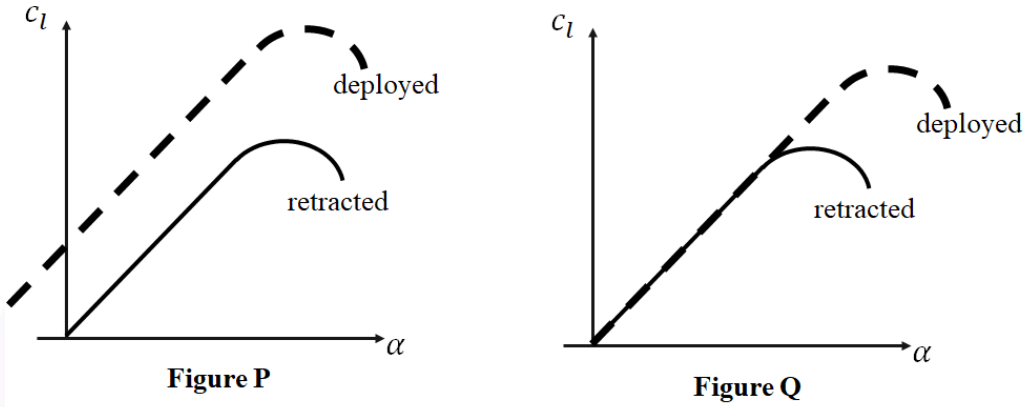
- Figure P is for a flap
- Figure P is for a slat
- Figure Q is for a slat
- Figure Q is for a flap
Official answer: A, C
GATE AE 2026, Question 35 (1 mark, NAT)
Aerodynamics - Airfoils & Wings
An elliptic wing has a span of 6 m and a planform area of 6 m$^2$. When generating a lift coefficient of 0.6, the induced drag it incurs is ________ $\times 10^{-3}$ (rounded off to 1 decimal place).
GATE AE 2026, Question 48 (2 marks, MSQ)
Aerodynamics - Airfoils & Wings
What is/are the use(s) of the single horseshoe vortex model of finite wing aerodynamic theory?
- It can approximate the wing pitching moment coefficient
- It can approximate the wing induced drag coefficient
- It can approximate the effect of the wing on the induced drag coefficient of a typical horizontal tail
- It can approximate the aerodynamic benefit/penalty of formation flight compared to isolated flight
Official answer: C, D
GATE AE 2026, Question 54 (2 marks, NAT)
Aerodynamics - Airfoils & Wings
For an airfoil section the pitching moment coefficient is determined about a reference point that is 0.3 times the chord behind the leading edge. It varies with the lift coefficient as shown in the table below. The distance of the aerodynamic center from the leading edge of the airfoil as a fraction of the chord is ________ (rounded off to one decimal place). $$\begin{array}{|c|c|c|c|c|}\hline c_l & 0.2 & 0.4 & 0.6 & 0.8 \\ \hline c_m & -0.02 & 0 & 0.02 & 0.04 \\ \hline\end{array}$$
Official answer: 0.2
GATE AE 2026, Question 56 (2 marks, NAT)
Aerodynamics - Airfoils & Wings
Consider a finite wing of aspect ratio 10 with span effectiveness factor 0.95. Its airfoil section has a lift slope of 0.106 per degree and a zero-lift angle of attack of –1.5°. The lift coefficient of the wing at an angle of attack of 3.5° is ________ (rounded off to 2 decimal places).
Official answer: 0.43 to 0.45
GATE AE 2026, Question 63 (2 marks, NAT)
Aerodynamics - Airfoils & Wings
Thin airfoil theory predicts the zero-lift angle of attack $\alpha_{L=0}$ of NACA 2412 airfoil as $-2.1^\circ$. The corresponding prediction of $\alpha_{L=0}$ for NACA 5410 airfoil is ________ degrees (rounded off to 1 decimal place).
Official answer: -5.5 to -5.0
GATE AE 2025, Question 18 (1 mark, MCQ)
Aerodynamics - Airfoils & Wings
For a NACA 4415 airfoil, the location of maximum camber, as a fraction of the chord length from the leading edge, is ______.
- 0.44
- 0.40
- 0.15
- 0.04
Official answer: B
GATE AE 2025, Question 19 (1 mark, MCQ)
Aerodynamics - Airfoils & Wings
A positively cambered airfoil is placed in a uniform flow (velocity, $U_\infty$) at its zero-lift angle of attack. M is the corresponding pitching moment. Which one of the following representations accurately describes this scenario?
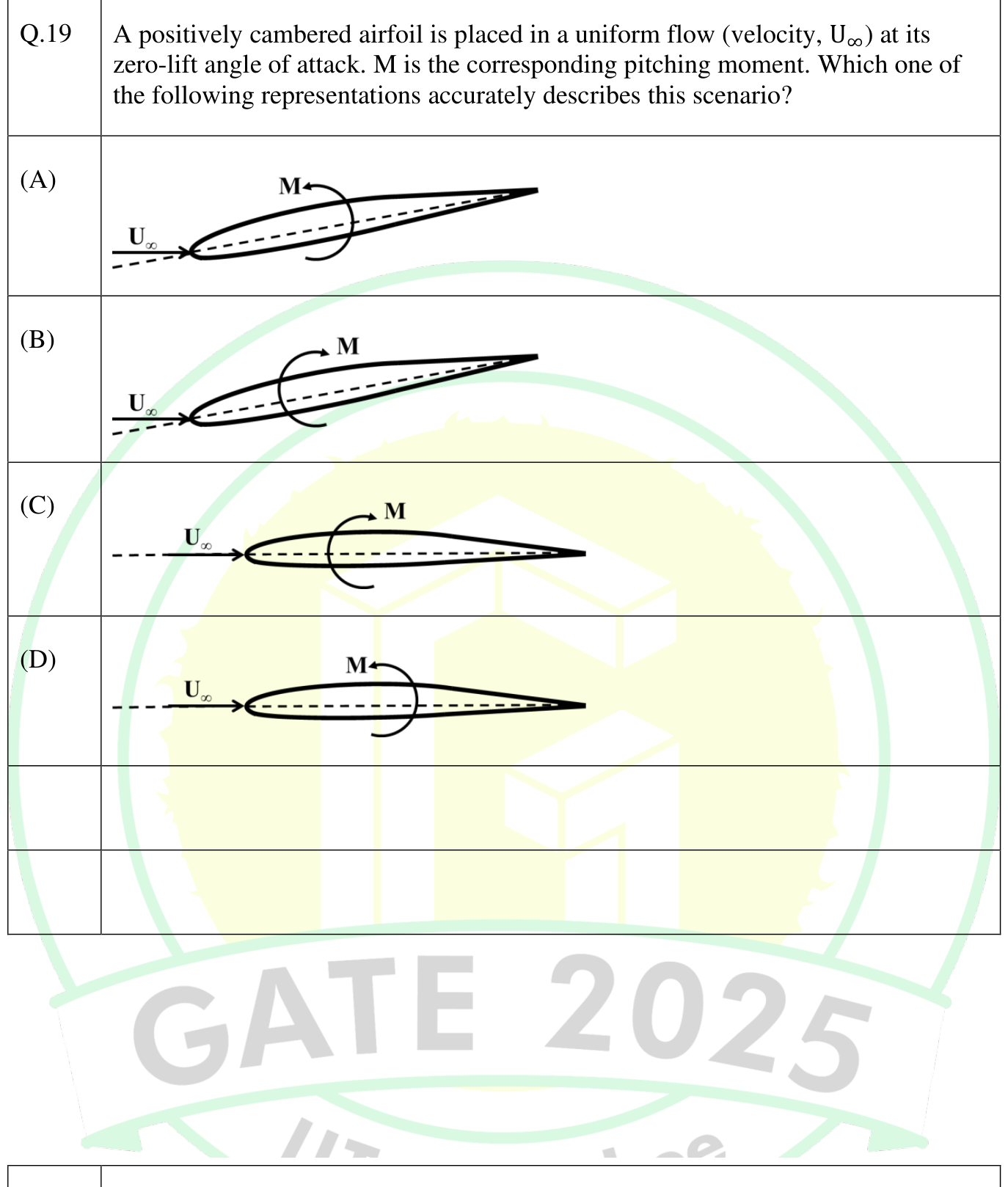
Official answer: A
GATE AE 2025, Question 36 (2 marks, MCQ)
Aerodynamics - Airfoils & Wings
A lifting surface has a spanwise circulation distribution of $\Gamma(\theta) = A\sin 3\theta$ (where $A \neq 0$) over its span $-\frac{b}{2} \leq y \leq \frac{b}{2}$, and $y = -\frac{b}{2}\cos\theta$ is the spanwise coordinate. Furthermore, the downwash varies along the span as $w(\theta) = V_\infty\left(\frac{3A\sin 3\theta}{\sin\theta}\right)$, where $V_\infty$ is the freestream velocity. Which one of the following options represents the total lift ($L$) and induced drag ($D_i$)?
- $L = 0$ and $D_i = 0$
- $L = 0$ and $D_i \neq 0$
- $L \neq 0$ and $D_i = 0$
- $L \neq 0$ and $D_i \neq 0$
Official answer: B
GATE AE 2024, Question 24 (1 mark, MCQ)
Aerodynamics - Airfoils & Wings
Consider steady, incompressible, inviscid flow past two airfoils shown in the figure. The coefficient of pressure at the trailing edge of the airfoil with finite angle, shown in figure (I), is $C_{P_I}$ while that at the trailing edge of the airfoil with cusp, shown in figure (II), is $C_{P_{II}}$. Which one of the following options is TRUE?

- $C_{P_I} < 1,\ C_{P_{II}} < 1$
- $C_{P_I} = 1,\ C_{P_{II}} = 1$
- $C_{P_I} = 1,\ C_{P_{II}} < 1$
- $C_{P_I} < 1,\ C_{P_{II}} = 1$
Official answer: C
GATE AE 2024, Question 35 (1 mark, NAT)
Aerodynamics - Airfoils & Wings
Using thin airfoil theory, the lift coefficient of a NACA 0012 airfoil placed at $5^\circ$ angle of attack in a uniform flow is _____________ (rounded off to 2 decimal places).
Official answer: 0.54 to 0.56
GATE AE 2024, Question 64 (2 marks, NAT)
Aerodynamics - Airfoils & Wings
An airplane of mass 1000 kg is in a steady level flight with a speed of 50 m/s. The wing has an elliptic planform with a span of 20 m and planform area 31.4 m$^2$. Assuming the density of air at that altitude to be 1 kg/m$^3$ and acceleration due to gravity to be 10 m/s$^2$, the induced drag on the wing is _________ N (rounded off to 1 decimal place).
Official answer: 62.0 to 66.0
GATE AE 2023, Question 14 (1 mark, MCQ)
Aerodynamics - Airfoils & Wings
A two-dimensional potential flow solution for flow past an airfoil has a streamline pattern as shown in the figure. Which of the following conditions is additionally required to satisfy the Kutta condition?
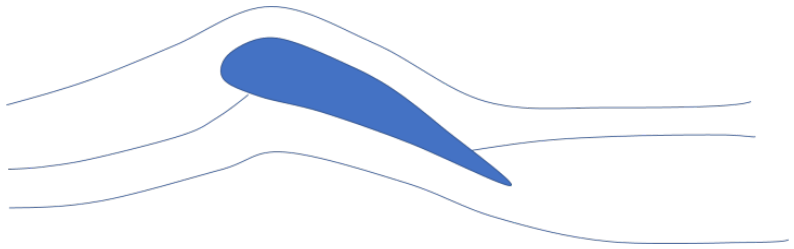
- Addition of a source of strength $Q > 0$
- Addition of a source of strength $Q < 0$
- Addition of a circulation of strength $\Gamma > 0$ (counter-clockwise)
- Addition of a circulation of strength $\Gamma < 0$ (clockwise)
Official answer: D
GATE AE 2023, Question 18 (1 mark, MCQ)
Aerodynamics - Airfoils & Wings
The figures shown in the options are schematics of airfoil shapes (not to scale). For a civilian transport aircraft designed for a cruise Mach number of 0.8, which among them is aerodynamically best suited as a wing section?
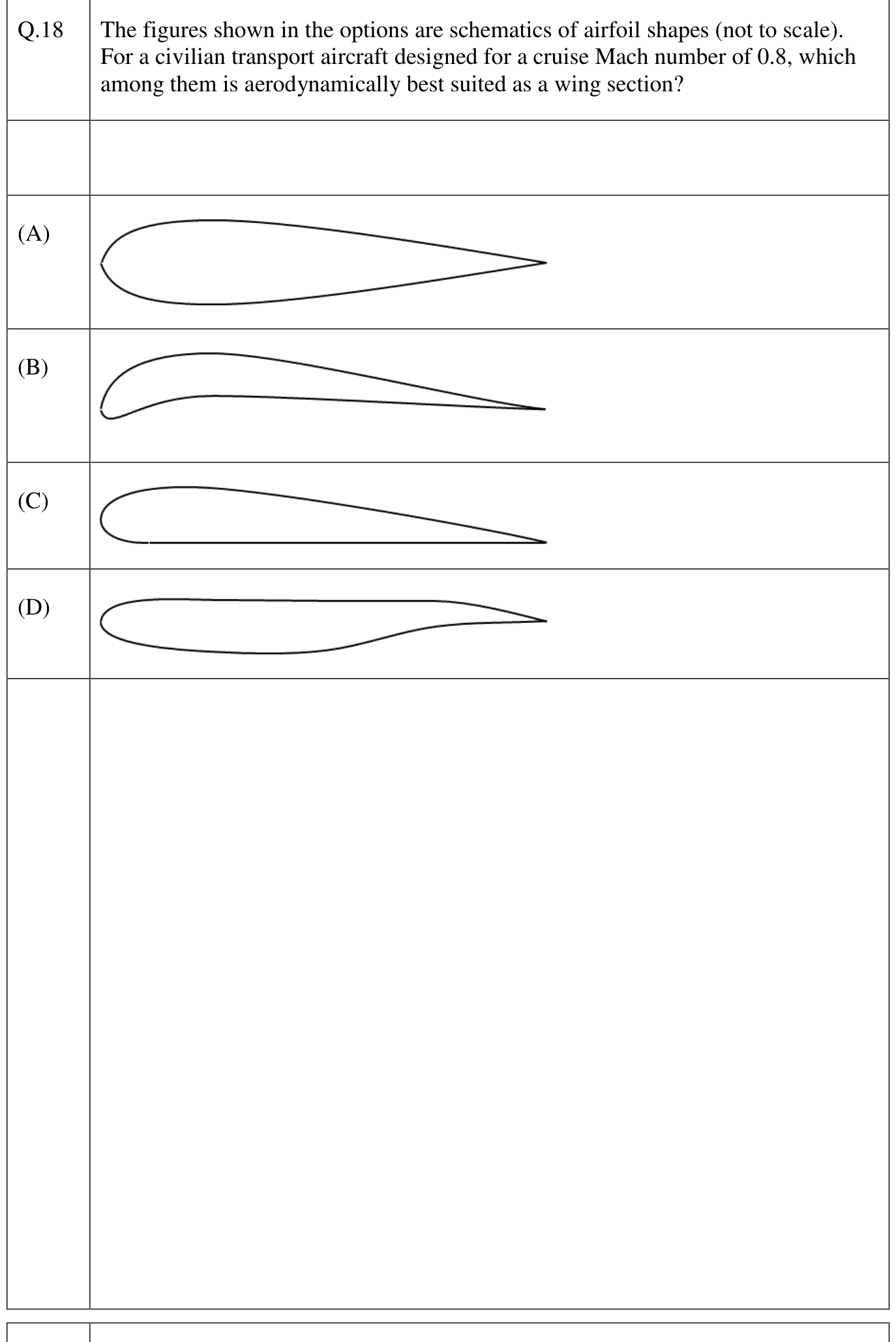
Official answer: D
GATE AE 2023, Question 46 (2 marks, MSQ)
Aerodynamics - Airfoils & Wings
For an airfoil, which of the relations given about the critical Mach number $M_{cr}$ and drag divergence Mach number $M_{dd}$ is/are correct?
- $M_{cr} < M_{dd}$
- $M_{cr} < 1.0$
- $M_{dd} < 1.0$
- $M_{cr} > 1.0$
Official answer: A, B, C
GATE AE 2023, Question 56 (2 marks, NAT)
Aerodynamics - Airfoils & Wings
A thin cambered airfoil has lift coefficient $c_l = 0$ at an angle of attack $\alpha = -1.1^\circ$. Assuming that stall occurs at much larger $\alpha$, the $c_l$ at $\alpha = 4^\circ$ is _______. (round off to two decimal places)
Official answer: 0.55 to 0.57
GATE AE 2022, Question 26 (1 mark, MSQ)
Aerodynamics - Airfoils & Wings
NACA 2412 airfoil has
- 4% maximum camber with respect to chord
- maximum camber at 40% chord
- 12% maximum thickness to chord ratio
- maximum camber at 20% chord
Official answer: B, C
GATE AE 2022, Question 40 (2 marks, MCQ)
Aerodynamics - Airfoils & Wings
Consider a conventional subsonic fixed-wing airplane. $e$ is the Oswald efficiency factor and $AR$ is the aspect ratio. Corresponding to the minimum $\left(\dfrac{C_D}{C_L^{3/2}}\right)$, which of the following relations is true?
- $\dfrac{C_D}{C_L^2} = \dfrac{1}{\pi e AR}$
- $\dfrac{C_D}{C_L^2} = \dfrac{4}{3\pi e AR}$
- $\dfrac{C_D}{C_L} = \dfrac{1}{\pi e AR}$
- $\dfrac{C_D}{\sqrt{C_L}} = \dfrac{1}{\sqrt{\pi e AR}}$
Official answer: B
GATE AE 2022, Question 51 (2 marks, NAT)
Aerodynamics - Airfoils & Wings
Consider a circulation distribution over a finite wing given by the equation below. $$\Gamma(y) = \begin{cases} \Gamma_0\left(1 - \dfrac{2y}{b}\right) & \text{if } 0 \le y \le \dfrac{b}{2} \\ \Gamma_0\left(1 + \dfrac{2y}{b}\right) & \text{if } -\dfrac{b}{2} \le y \le 0 \end{cases}$$ The wingspan $b$ is 10 m, the maximum circulation $\Gamma_0$ is 20 m$^2$/s, density of air is 1.2 kg/m$^3$ and the free stream speed is 80 m/s. The lift over the wing is ______ N (rounded off to the nearest integer).
Official answer: 9500 to 9800
GATE AE 2022, Question 54 (2 marks, NAT)
Aerodynamics - Airfoils & Wings
Consider a thin symmetric airfoil at 2 degree angle of attack in a uniform flow at 50 m/s. The pitching moment coefficient about its leading edge is _____ (rounded off to three decimal places).
Official answer: -0.057 to -0.053
GATE AE 2018, Question 16 (1 mark, MCQ)
Aerodynamics - Airfoils & Wings
A NACA 0012 airfoil has a trailing edge flap. The airfoil is operating at an angle of attack of 5 degrees with un-deflected flap. If the flap is now deflected by 5 degrees downwards, the $C_L$ versus $\alpha$ curve
- shifts right and slope increases.
- shifts left and slope increases.
- shifts left and slope stays the same.
- shifts right and slope stays the same.
Official answer: C
GATE AE 2018, Question 22 (1 mark, MCQ)
Aerodynamics - Airfoils & Wings
The pitching moment of a positively cambered NACA airfoil about its leading edge at zero- lift angle of attack is
- negative.
- positive.
- indeterminate.
- zero.
Official answer: A
GATE AE 2016, Question 11 (1 mark, MCQ)
Aerodynamics - Airfoils & Wings
With increase in airfoil thickness, the critical Mach number for an airfoil is likely to
- decrease.
- increase.
- remain unchanged.
- be undefined.
Official answer: A
GATE AE 2016, Question 13 (1 mark, MCQ)
Aerodynamics - Airfoils & Wings
Which of the following airfoil will have location of the maximum camber at half chord length from the leading edge?
- NACA 5212
- NACA 1225
- NACA 2215
- NACA 2512
Official answer: D
GATE AE 2016, Question 41 (2 marks, MCQ)
Aerodynamics - Airfoils & Wings
The rate of change of moment coefficient with respect to the angle of attack, $\dfrac{dC_m}{d\alpha}$, at half chord point of a thin airfoil, as per approximations from the thin airfoil theory is
- $\pi/4\ \text{radian}^{-1}$
- $\pi/2\ \text{radian}^{-1}$
- $\pi\ \text{radian}^{-1}$
- $2\pi\ \text{radian}^{-1}$
Official answer: B
GATE AE 2016, Question 42 (2 marks, MCQ)
Aerodynamics - Airfoils & Wings
An untwisted wing of elliptic planform and aspect ratio 6 consists of thin symmetric airfoil sections. The coefficient of lift ($C_L$) at $10^\circ$ angle of attack assuming inviscid incompressible flow is
- $\pi^2/16$
- $\pi^2/12$
- $\pi^2/8$
- $\pi/2$
Official answer: B
GATE AE 2014, Question 16 (1 mark, MCQ)
Aerodynamics - Airfoils & Wings
For a NACA 5-digit airfoil of chord $c$, the designed lift coefficient and location of maximum camber along the chord from the leading edge are denoted by $C_L$ and $X_m$ respectively. For NACA 12018 airfoil, which combination of $C_L$ and $X_m$ given below are correct?
- $C_L = 0.15$ and $X_m = 0.1c$
- $C_L = 0.12$ and $X_m = 0.2c$
- $C_L = 0.12$ and $X_m = 0.18c$
- $C_L = 0.15$ and $X_m = 0.2c$
Official answer: A
GATE AE 2014, Question 46 (2 marks, MCQ)
Aerodynamics - Airfoils & Wings
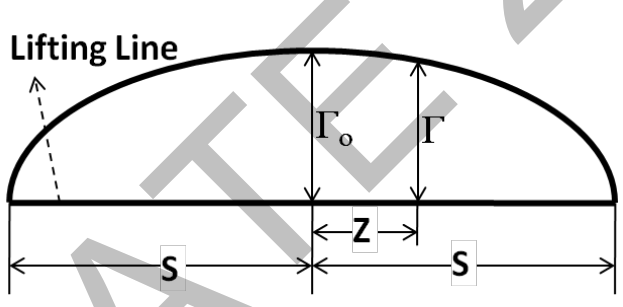
Induced velocity $w$ at a point $z = z_1$ along the lifting line can be calculated using the formula $w(z_1) = -\dfrac{1}{4\pi}\int_{-s}^{s}\dfrac{d\Gamma}{dz}\dfrac{1}{z - z_1}\,dz$. Given $\dfrac{\Gamma^2}{\Gamma_o^2} + \dfrac{z^2}{s^2} = 1$, where $z$, $\Gamma_o$ and $s$ are given in figure below. For the above semi-elliptic distribution of circulation, $\Gamma$, the downwash velocity at any point $z_1$ for symmetric flight can be obtained as, $w(z_1) = \dfrac{\Gamma_o}{4\pi s}\left[\pi + z_1 I\right]$, where $I = z_1\int_{-s}^{s}\dfrac{dz}{\sqrt{s^2 - z^2}(z - z_1)}$. Which of the following options is correct if the induced drag is $D_i$ (given $\int_{-s}^{s}\sqrt{1 - \dfrac{z^2}{s^2}}\,dz = \dfrac{\pi s}{2}$)?
- $I = 0$ and $D_i = \dfrac{8\rho\Gamma_o^2}{\pi}$
- $I = 1$ and $D_i = \dfrac{8\rho\Gamma_o^2}{\pi}$
- $I = 0$ and $D_i = \dfrac{\pi\rho\Gamma_o^2}{8}$
- $I = 1$ and $D_i = \dfrac{\pi\rho\Gamma_o^2}{8}$
Official answer: C