GATE AE Propulsion: Previous Year Questions
Practice GATE Aerospace Engineering Propulsion previous year questions from 8 papers, topic by topic, with the official answer key where available.
All GATE AE papers
GATE AE 2026, Question 14 (1 mark, MCQ)
Propulsion - Aerothermodynamics & Cycles
Which one of the following makes an ideal air-standard Stirling cycle?
- Two reversible isobars, and two reversible adiabatics
- Two reversible isotherms, and two reversible isobars
- Two reversible isotherms, and two reversible isochores
- Isentropic compression, constant volume heat addition, isentropic expansion, and constant volume heat rejection
Official answer: C
GATE AE 2026, Question 18 (1 mark, MCQ)
Propulsion - Aerothermodynamics & Cycles
The figure below depicts two ideal gas turbine cycles, cycle 1-2-3-4-1 and cycle 1-2-3'-4'-1, on a $T$-$s$ diagram. Which one of the following statements is FALSE?
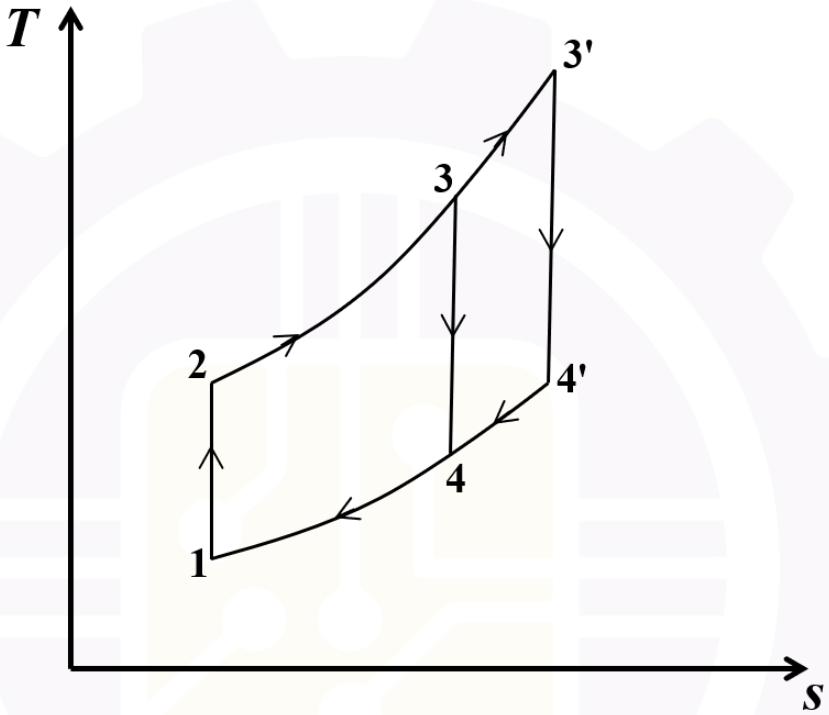
- The thermal efficiency of the two cycles is the same
- The specific work of the two cycles is the same
- The processes 2-3 and 2-3' are isobaric
- The amount of heat added in the combustion process is greater for the cycle 1-2-3'-4'-1
Official answer: B
GATE AE 2026, Question 24 (1 mark, MSQ)
Propulsion - Engine Performance
For a given air-standard power, the propulsive efficiency of a turbofan engine is more than that of a turbojet engine. Which of the following is/are the reason(s) for this?
- The mass flow rate is more for a turbofan engine
- The exit velocity is lower for a turbofan engine
- A turbofan engine operates at a lower altitude
- The fan of a turbofan engine consumes lesser power
Official answer: A, B
GATE AE 2026, Question 27 (1 mark, MSQ)
Propulsion - Turbomachinery
The figure below shows the blading of the rotors of two different axial turbomachines under their typical operating conditions, labelled as Configuration I and Configuration II. Which of the following statements is/are TRUE?
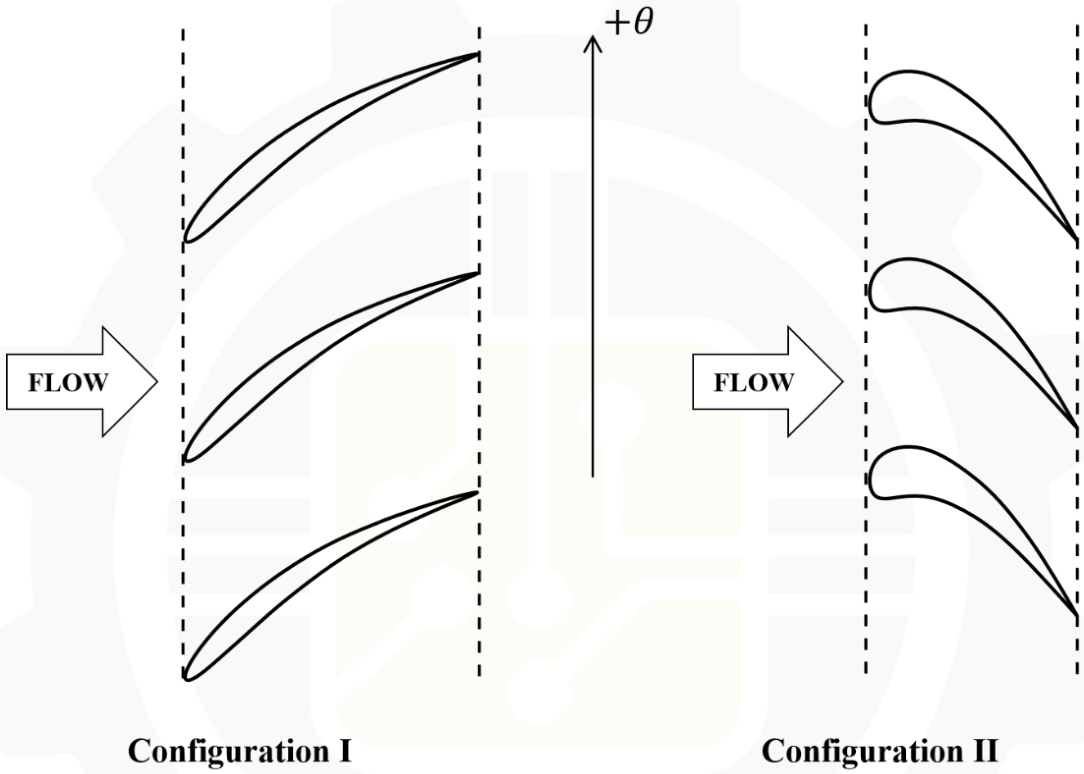
- Configuration I corresponds to the rotor of a compressor and Configuration II corresponds to the rotor of a turbine
- Configuration I corresponds to the rotor of a turbine and Configuration II corresponds to the rotor of a compressor
- The rotor blades of the turbomachine in Configuration I move along the $+\theta$ direction
- The rotor blades of the turbomachine in Configuration II move along the $+\theta$ direction
Official answer: A, D
GATE AE 2026, Question 28 (1 mark, MSQ)
Propulsion - Turbomachinery
A multi-stage axial compressor can be operated at two points, A and B, both of which lie on the same speed line, as shown in the figure below. If $\eta$ is the isentropic efficiency of the compressor, select the statements that is/are TRUE.
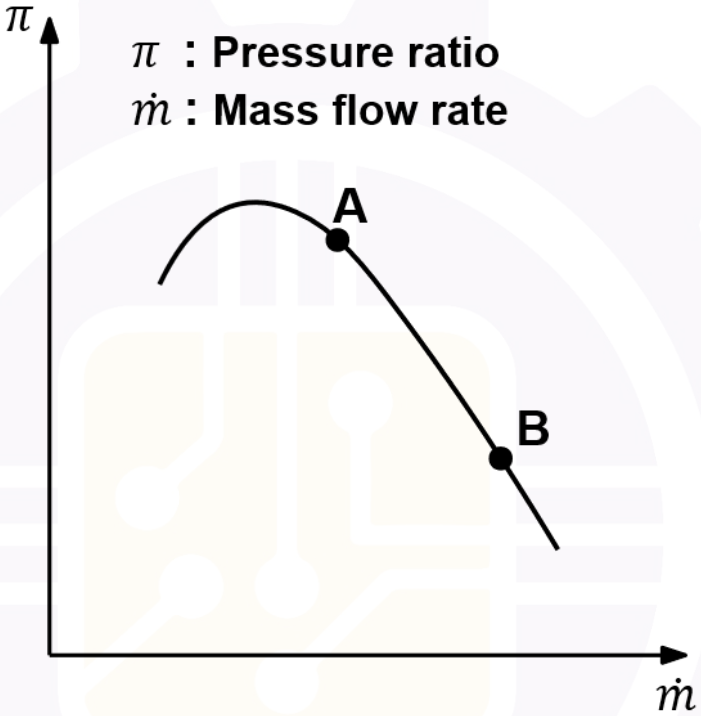
- $\eta_A > \eta_B$
- $\eta_B > \eta_A$
- In comparison to point B, point A is closer to the surge point
- In comparison to point A, point B is closer to the choke point
Official answer: A, C, D
GATE AE 2026, Question 38 (2 marks, MCQ)
Propulsion - Engine Performance
In an ideal turbofan engine shown in the figure below, the compressor is driven by the high pressure turbine, and the fan is driven by the low pressure turbine. The stations 0, 2, 3, 4, 4.5, and 5 refer to free-stream, compressor inlet, compressor outlet, combustor exit, high pressure turbine exit, and low pressure turbine exit, respectively, and the subscript 't' refers to the total condition. Also, $\tau_r = T_{t0}/T_0$, $\tau_c = T_{t3}/T_{t2}$ and $\tau_\lambda = T_{t4}/T_0$. The total temperature ratio of the high pressure turbine ($T_{t4.5}/T_{t4}$) is given by ______.
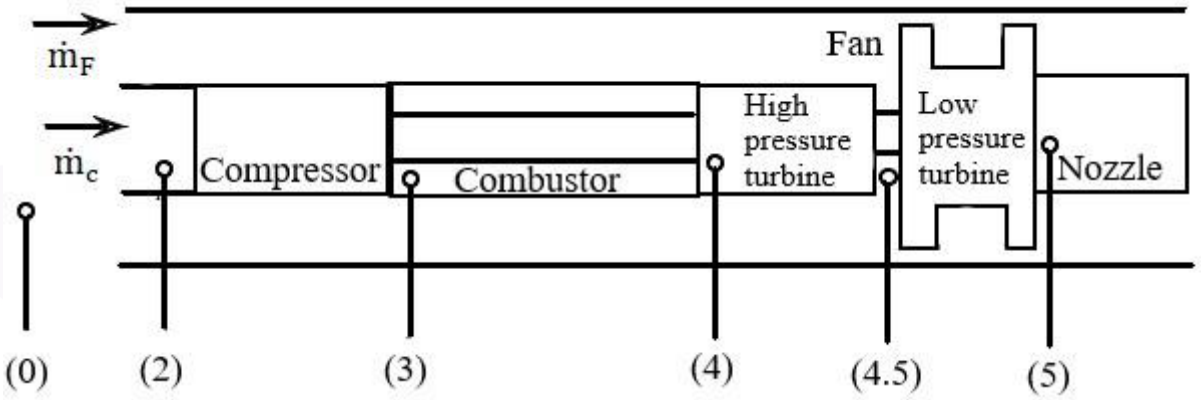
- $1 - \dfrac{\tau_r}{\tau_\lambda}(\tau_c - 1)$
- $1 + \dfrac{\tau_r}{\tau_\lambda}(\tau_c + 1)$
- $1 - \dfrac{\tau_r}{\tau_\lambda}(\tau_c + 1)$
- $1 + \dfrac{\tau_r}{\tau_\lambda}(\tau_c - 1)$
Official answer: A
GATE AE 2026, Question 39 (2 marks, MCQ)
Propulsion - Rockets
An ideal rocket has characteristic exhaust velocity of 1200 m/s, mass flow rate of 75 kg/s, thrust coefficient of 1.5, and nozzle throat area of 0.025 m$^2$. The chamber pressure in kPa and the specific impulse due to gravity in seconds are ________, respectively. Assume that the acceleration due to gravity is 9.8 m/s$^2$.
- 3600 and 183.67
- 4600 and 190.51
- 3600 and 175.23
- 3500 and 183.67
Official answer: A
GATE AE 2026, Question 41 (2 marks, MCQ)
Propulsion - Rockets
Consider a launch vehicle of mass 10 tons being launched vertically. The vehicle has 8 tons of propellant, which burns completely at a constant rate over 50 s. If the engine specific impulse is 250 s, and the acceleration due to gravity at sea level is $g_0$, the acceleration experienced by the vehicle at lift-off is ________.
- $g_0$
- $2g_0$
- $3g_0$
- $4g_0$
Official answer: C
GATE AE 2026, Question 42 (2 marks, MCQ)
Propulsion - Turbomachinery
The figure below shows a compressor stage with station numbers 1, 2, and 3 as indicated. If $p_{0i}$, $T_{0i}$, and $C_i$ refer to the average values of total pressure, total temperature, and absolute flow speed, respectively, at the $i^{\text{th}}$ station, select the CORRECT option considering losses.
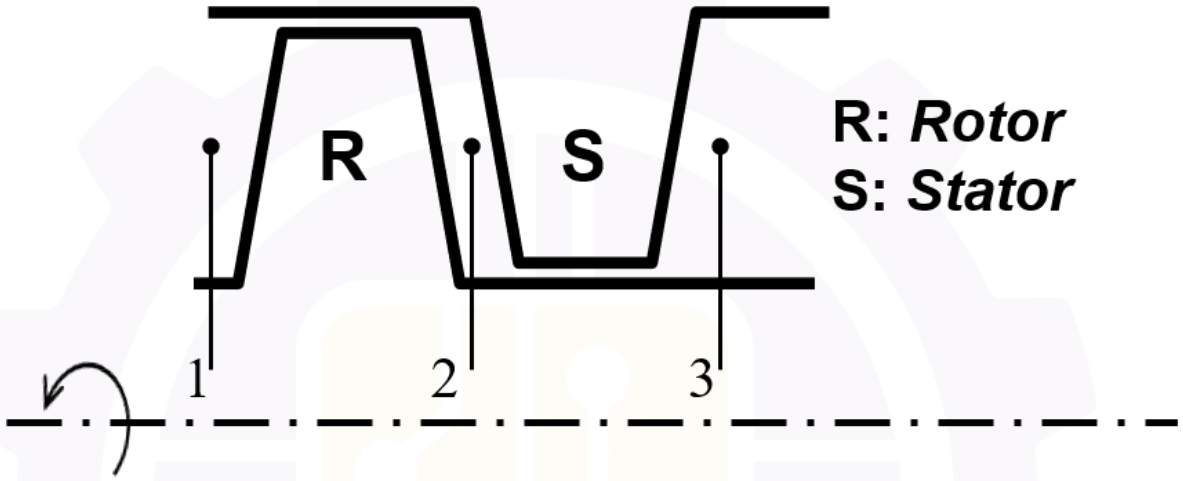
- $p_{01} < p_{02},\ p_{02} > p_{03};\ T_{01} < T_{02},\ T_{02} \approx T_{03};\ C_1 < C_2,\ C_2 > C_3$
- $p_{01} < p_{02},\ p_{02} = p_{03};\ T_{01} < T_{02},\ T_{02} \approx T_{03};\ C_1 < C_2,\ C_2 = C_3$
- $p_{01} < p_{02},\ p_{02} > p_{03};\ T_{01} < T_{02},\ T_{02} < T_{03};\ C_1 > C_2,\ C_2 > C_3$
- $p_{01} < p_{02},\ p_{02} < p_{03};\ T_{01} < T_{02},\ T_{02} < T_{03};\ C_1 = C_2 = C_3$
Official answer: A
GATE AE 2026, Question 44 (2 marks, MSQ)
Propulsion - Engine Performance
Which of the following process(es) is/are involved in the compression of air in an ideal ramjet engine?
- oblique shock
- mechanical compression
- normal shock
- subsonic diffusion
Official answer: A, C, D
GATE AE 2026, Question 46 (2 marks, MSQ)
Propulsion - Turbomachinery
The figure below shows the velocity triangles at the inlet and outlet of the rotor of a low hub-to-tip ratio axial compressor at the mid-span of the blade. The absolute and relative velocities of the flow are denoted by $\mathbf{C}$ and $\mathbf{W}$, respectively. The subscripts 1 and 2 refer to the locations before and after the rotor, respectively. The blade velocity is denoted by $\mathbf{U}$. Select the CORRECT statement(s) for this device.
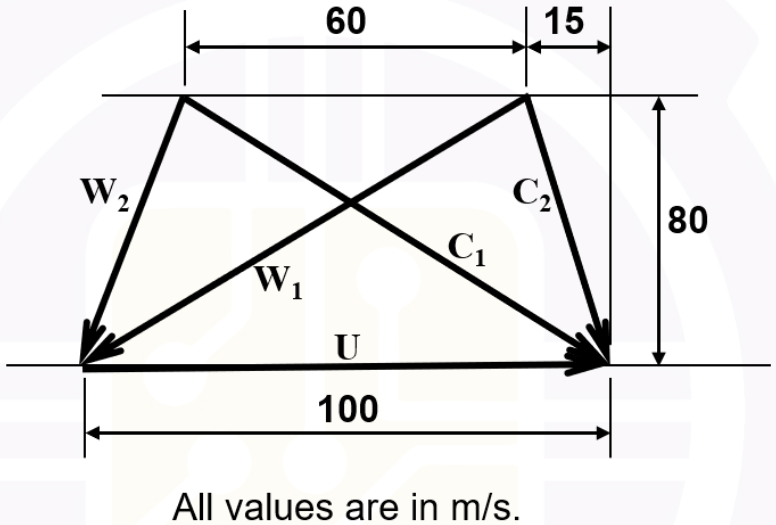
- The axial velocity is constant across the rotor
- The flow coefficient is 0.6
- The blade loading coefficient is 0.6
- If the acoustic velocity at the rotor inlet is 350 m/s, then the inlet relative Mach number is 0.333
GATE AE 2026, Question 52 (2 marks, NAT)
Propulsion - Combustors
Isobutane (C$_4$H$_{10}$) is burnt completely in pure oxygen as per the reaction given below. Given that the standard heats of formation (in kcal/mole) of isobutane, carbon dioxide, and water vapour are $-31.489$, $-94.052$, and $-60.150$, respectively, the heat of reaction is ________ kcal (rounded off to 2 decimal places). $$\text{C}_4\text{H}_{10} + 6.5\,\text{O}_2 \rightarrow 4\,\text{CO}_2 + 5\,\text{H}_2\text{O}$$
Official answer: -645.50 to -645.44
GATE AE 2026, Question 53 (2 marks, NAT)
Propulsion - Aerothermodynamics & Cycles
A furnace of 250 MW rating is used to melt and raise the temperature of aluminium from 25 °C to 900 °C. Aluminium has a solid-state specific heat, latent heat, and liquid-state specific heat of 0.9 kJ/kg-K, 390 kJ/kg, and 1.108 kJ/kg-K, respectively, and the furnace has 70% efficiency. The melting point of aluminium is 660 °C. The amount of aluminium that can be processed per hour is ________ kg (rounded off to 1 decimal place).
Official answer: 513270.0 to 513272.0
GATE AE 2026, Question 61 (2 marks, NAT)
Propulsion - Turbomachinery
A centrifugal compressor has a constant-width radial diffuser. The diameters at the diffuser inlet and outlet are 0.2 m and 0.3 m, respectively. The flow at the diffuser inlet and outlet is assumed to be steady and uniform. The average velocity at the diffuser inlet and outlet are $(60\,\hat{\mathbf{e}}_r + 75\,\hat{\mathbf{e}}_\theta)$ m/s and $(u\,\hat{\mathbf{e}}_r + 50\,\hat{\mathbf{e}}_\theta)$ m/s, respectively. If the flow through the diffuser is treated as steady and incompressible, the value of $u$ is ________ (rounded off to the nearest integer).
Official answer: 39 to 41
GATE AE 2026, Question 62 (2 marks, NAT)
Propulsion - Turbomachinery
A gas mixture at a pressure of 800 kPa and a density of 5 kg/m$^3$ enters a turbine stage. The temperature of the gas at the nozzle exit and the stage exit are 790 K and 750 K, respectively. Assume the specific heats are constant for the gas mixture in the range of temperatures considered. The specific heat at constant pressure is 0.72 kJ/kg-K and the ratio of specific heats is 1.33. The value of the degree of reaction of the turbine stage is ________ (rounded off to 2 decimal places).
Official answer: 0.26 to 0.29
GATE AE 2025, Question 31 (1 mark, MCQ)
Propulsion - Combustors
$\delta Q$ and $\delta W$ are the heat and work interactions of a system with its surroundings, and $dU$ is the change in the internal energy of the system. For an adiabatic process in a closed, constant pressure combustor, which one of the following options is correct?
- $|\delta Q| = |dU| \neq 0$ and $|\delta W| = 0$
- $|\delta Q| = |\delta W| = 0$ and $|dU| \neq 0$
- $|\delta Q| = |\delta W| = |dU| = 0$
- $|\delta W| = |dU| \neq 0$ and $|\delta Q| = 0$
Official answer: D
GATE AE 2025, Question 32 (1 mark, MCQ)
Propulsion - Rockets
An ideal two-stage rocket has identical specific impulse and structural coefficient for its two stages. For an optimized rocket, the two stages have identical payload ratio as well. The payload is 2 tons and the initial mass of the rocket is 200 tons. The mass of the second stage of the rocket (including the final payload mass) is ____ tons.
- 100
- 10
- 20
- 50
Official answer: C
GATE AE 2025, Question 33 (1 mark, MCQ)
Propulsion - Combustors
A gaseous fuel mixture comprising 3 moles of methane and 2 moles of ammonia is combusted in X moles of pure oxygen in stoichiometric amount. Assuming complete combustion, with only CO$_2$, H$_2$O and N$_2$ in the product gases, the value of X is ___. $$3\,\text{CH}_4 + 2\,\text{NH}_3 + X\,\text{O}_2 \rightarrow \text{Products (CO}_2\text{, H}_2\text{O, N}_2\text{)}$$
- 7.5
- 5.5
- 8.5
- 9.5
Official answer: A
GATE AE 2025, Question 35 (1 mark, NAT)
Propulsion - Turbomachinery
In a centrifugal compressor, the eye tip diameter is 10 cm. For a shaft rotational speed of 490 rotations per second, the tangential speed at the inducer tip is ___ m/s (rounded off to one decimal place).
Official answer: 151.0 to 154.0
GATE AE 2025, Question 61 (2 marks, NAT)
Propulsion - Engine Performance
An ideal turbofan with a bypass ratio of 5 has core mass flow rate, $\dot{m}_{a,c} = 100$ kg/s. The core and the fan exhausts are separate and optimally expanded. The core exhaust speed is 600 m/s and the fan exhaust speed is 120 m/s. If the fuel mass flow rate is negligible in comparison to $\dot{m}_{a,c}$, the static specific thrust ($T/\dot{m}_{a,c}$) developed by the engine is ____ Ns/kg (rounded off to the nearest integer).
Official answer: 1200
GATE AE 2025, Question 62 (2 marks, NAT)
Propulsion - Aerothermodynamics & Cycles
Air at temperature 300 K is compressed isentropically from a pressure of 1 bar to 10 bar in a compressor. Eighty percent of the compressed air is supplied to a combustor. In the combustor, 0.88 MJ of heat is added per kg of air. The specific heat at constant pressure is $C_p = 1005$ J/kg/K and the specific heat ratio is $\gamma = 1.4$. The temperature of the air leaving the combustor is ___ K (rounded off to one decimal place).
Official answer: 1454.0 to 1455.0
GATE AE 2025, Question 63 (2 marks, NAT)
Propulsion - Rockets
A monopropellant liquid rocket engine has 800 injectors of diameter 4 mm each, and with a discharge coefficient of 0.65. The liquid propellant of density 1000 kg/m$^3$ flows through the injectors. There is a pressure difference of 10 bar across the injectors. The specific impulse of the rocket is 1500 m/s. The thrust generated by the rocket is _____ kN (rounded off to one decimal place).
Official answer: 430.0 to 442.0
GATE AE 2025, Question 64 (2 marks, NAT)
Propulsion - Engine Performance
An ideal ramjet with an optimally expanded exhaust is travelling at Mach 3. The ambient temperature and pressure are 260 K and 60 kPa, respectively. The inlet air mass flow rate is 50 kg/s. Exit temperature of the exhaust gases is 700 K. Fuel mass flow rate is negligible compared to air mass flow rate. Gas constant is R = 287 J/kg/K, and specific heat ratio is $\gamma = 1.4$. The thrust generated by the engine is ___ kN (rounded off to one decimal place).
Official answer: 30.9 to 31.2
GATE AE 2025, Question 65 (2 marks, NAT)
Propulsion - Turbomachinery
A single-stage axial compressor, with a 50 % degree of reaction, runs at a mean blade speed of 250 m/s. The overall pressure ratio developed is 1.3. Inlet pressure and temperature are 1 bar and 300 K, respectively. Axial velocity is 200 m/s. Specific heat at constant pressure, $C_p = 1005$ J/kg/K and specific heat ratio, $\gamma = 1.4$. The rotor blade angle at the outlet is ___ degrees (rounded off to two decimal places).
Official answer: 21.00 to 22.00
GATE AE 2024, Question 16 (1 mark, MCQ)
Propulsion - Aerothermodynamics & Cycles
For an ideal gas, the specific heat at constant pressure is 1147 J/kg K and the ratio of specific heats is equal to 1.33. What is the value of the gas constant for this gas in J/kg K?
- 284.6
- 1005
- 862.4
- 8314
Official answer: A
GATE AE 2024, Question 17 (1 mark, MCQ)
Propulsion - Combustors
A surrogate liquid hydrocarbon fuel, approximated as C$_{10}$H$_{12}$, is being burned in a land-based gas turbine combustor with dry air (79% N$_2$ and 21% O$_2$ by volume). How many moles of dry air are required for the stoichiometric combustion of the surrogate fuel with dry air at atmospheric temperature and pressure?
- 61.9
- 30.95
- 13
- 10
Official answer: A
GATE AE 2024, Question 18 (1 mark, MCQ)
Propulsion - Aerothermodynamics & Cycles
In the figure shown below, various thermodynamics processes for an ideal gas are represented. Match each curve with the process that it best represents.
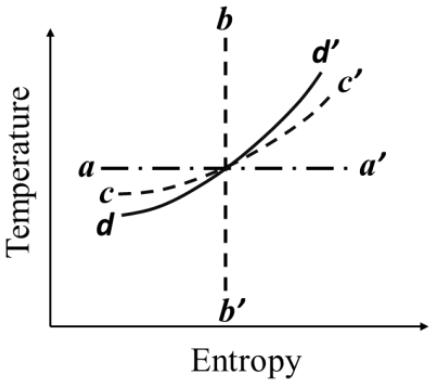
- $aa'$ – Isentropic; $bb'$ – Isothermal; $cc'$ – Isobaric; $dd'$ – Isochoric
- $aa'$ – Isothermal; $bb'$ – Isentropic; $cc'$ – Isochoric; $dd'$ – Isobaric
- $aa'$ – Isothermal; $bb'$ – Isentropic; $cc'$ – Isobaric; $dd'$ – Isochoric
- $aa'$ – Isothermal; $bb'$ – Isobaric; $cc'$ – Isentropic; $dd'$ – Isochoric
Official answer: C
GATE AE 2024, Question 19 (1 mark, MCQ)
Propulsion - Combustors
In an airbreathing gas turbine engine, the combustor inlet temperature is 600 K. The heating value of the fuel is $43.4 \times 10^6$ J/kg. Assume $C_p$ to be 1100 J/kg K for air and burned gases, and fuel-air ratio $f \ll 1.0$. Neglect kinetic energy at the inlet and exit of the combustor and assume 100% burner efficiency. What is the fuel-air ratio required to achieve 1300 K temperature at the combustor exit?
- 0.0177
- 0.0215
- 0.0127
- 0.0277
Official answer: A
GATE AE 2024, Question 34 (1 mark, NAT)
Propulsion - Engine Performance
An aircraft with a turbojet engine is flying with 250 m/s speed at an altitude, where the density of air is 1 kg/m$^3$. The inlet area of the engine is 1 m$^2$. The average velocity of the exhaust gases at the exit of the nozzle, with respect to aircraft, is 550 m/s. Assume the engine exit pressure is equal to the ambient pressure and the fuel-air ratio is negligible. The uninstalled thrust produced by the engine at these conditions is _________ N (rounded off to the nearest integer).
Official answer: 75000
GATE AE 2024, Question 40 (2 marks, MCQ)
Propulsion - Turbomachinery
A multistage axial compressor, with overall isentropic efficiency of 0.83, is used to compress air at a stagnation temperature of 300 K through a pressure ratio of 10:1. Each stage of the compressor is similar, and the stagnation temperature rise across each compressor stage is 20 K. Assume $C_p = 1005$ J/kg K and $\gamma = 1.4$ for air. How many stages are there in the compressor?
- 17
- 13
- 19
- 11
Official answer: A
GATE AE 2024, Question 41 (2 marks, MCQ)
Propulsion - Engine Performance
An aircraft with a turbojet engine is flying at 250 m/s. The uninstalled thrust produced by the engine is 60000 N. The heating value of the fuel is $44 \times 10^6$ J/kg. The engine has a thermal efficiency of 35% while burning the fuel at a rate of 3 kg/s. Assume the engine exit pressure to be equal to the ambient pressure. What is the propulsion efficiency of the engine under these conditions (in percentage)?
- 32.5
- 35.0
- 11.4
- 92.4
Official answer: A
GATE AE 2024, Question 49 (2 marks, MSQ)
Propulsion - Turbomachinery
Which of the following statements is/are TRUE for an axial turbine?
- For a fixed rotational speed, the mass flow rate increases with increase in the flow coefficient
- The absolute stagnation enthalpy of the flow decreases across the nozzle row
- The relative stagnation enthalpy remains unchanged through the rotor
- For a fixed rotational speed, the mass flow rate remains unchanged with a change in the flow coefficient
Official answer: A, C
GATE AE 2024, Question 50 (2 marks, MSQ)
Propulsion - Turbomachinery
Which of the following statements is/are TRUE for a single stage axial compressor?
- Starting from design condition and keeping the mass flow rate constant, if the blade RPM is increased, the compressor rotor may experience positive incidence flow separation (actual relative flow angle greater than the design blade angle)
- Starting from design condition at the same blade RPM, if the mass flow rate is increased, the compressor rotor may experience positive incidence flow separation (actual relative flow angle greater than the design blade angle)
- Keeping the mass flow rate constant, if the blade RPM is increased, the compressor may experience surge
- At the same blade RPM, if the mass flow rate is increased, the compressor may experience surge
Official answer: A, C
GATE AE 2024, Question 57 (2 marks, NAT)
Propulsion - Rockets
A chemical rocket with an ideally expanded flow through the nozzle produces $5 \times 10^6$ N thrust at sea level. The specific impulse of the rocket is 200 s and acceleration due to gravity at the sea level is 9.8 m/s$^2$. The propellant mass flow rate out of the rocket nozzle is _________ kg/s (rounded off to the nearest integer).
Official answer: 2500 to 2600
GATE AE 2024, Question 58 (2 marks, NAT)
Propulsion - Turbomachinery
A centrifugal compressor is designed to operate with air. At the leading edge of the tip of the inducer (eye of the impeller), the blade angle is $45^\circ$, and the relative Mach number is 1.0. The stagnation temperature of the incoming air is 300 K. Consider $\gamma = 1.4$. Neglect pre-whirl and slip. The inducer tip speed is ________ m/s (rounded off to the nearest integer).
Official answer: 230 to 240
GATE AE 2023, Question 20 (1 mark, MCQ)
Propulsion - Turbomachinery
In a single-spool aviation turbojet engine, which of the following is the correct relationship between the total work output $W_T$ of a 2-stage axial turbine and the total work required $W_C$ by a 6-stage axial compressor, neglecting losses?
- $W_T = 2W_C$
- $W_T = 6W_C$
- $W_T = W_C$
- $W_T = 3W_C$
Official answer: C
GATE AE 2023, Question 21 (1 mark, MCQ)
Propulsion - Turbomachinery
For a stage of a 50% reaction ideal axial flow compressor (symmetrical blading), select the correct statement from the options given.
- The stagnation enthalpy rise across the rotor is 50% of the rise across the stage.
- The static enthalpy rise across the rotor is 50% of the rise across the stage.
- Axial velocity component of the flow at the rotor exit is 50% of that at the rotor entry.
- The static pressure rise across the rotor is 50% of the rise across the stator.
Official answer: B
GATE AE 2023, Question 22 (1 mark, MCQ)
Propulsion - Engine Performance
An aircraft is cruising with a forward speed $V_a$ and the jet exhaust speed relative to the engine at the exit is $V_j$. If $V_j/V_a = 2$, what is the propulsive efficiency?
- 0.50
- 1.00
- 0.33
- 0.67
Official answer: D
GATE AE 2023, Question 28 (1 mark, MSQ)
Propulsion - Engine Performance
From the options given, select all that are true for turbofan engines with afterburners.
- Turning afterburner ON increases specific fuel consumption.
- Turbofan engines with afterburners have variable area nozzles.
- Turning afterburner ON decreases specific fuel consumption.
- Turning afterburner ON increases stagnation pressure across the engine.
Official answer: A, B
GATE AE 2023, Question 35 (1 mark, NAT)
Propulsion - Engine Performance
A supersonic vehicle powered by a ramjet engine is cruising at a speed of 1000 m/s. The ramjet engine burns hydrogen in a subsonic combustor to produce thrust. The heat of combustion for hydrogen is 120 MJ/kg. The overall efficiency of the engine $\eta_o$, defined as the ratio of propulsive power to the total heat release in the combustor, is 40%. Taking acceleration due to gravity $g_0 = 10$ m/s$^2$, the specific impulse of the engine is _____________ seconds. (round off to the nearest integer).
Official answer: 4800 to 4900
GATE AE 2023, Question 38 (2 marks, MCQ)
Propulsion - Rockets
Two missiles $A$ and $B$ powered by solid rocket motors have identical specific impulse, liftoff mass of 5600 kg each, and burn durations of $t_A = 30$ s and $t_B = 70$ s, respectively. The propellant mass flow rates, $\dot{m}_A$ and $\dot{m}_B$, for missiles $A$ and $B$, respectively, are given by $$\dot{m}_A = 120\ \text{kg/s},\quad 0 \le t \le 30$$ $$\dot{m}_B = 70\ \text{kg/s},\quad 0 \le t \le 70$$ Neglecting gravity and aerodynamic forces, the relationship between the final velocities $V_A$ and $V_B$ of missiles $A$ and $B$, respectively, is given by
- $V_A = 4.1\,V_B$
- $V_A = V_B$
- $V_A = 0.5\,V_B$
- $V_A = 0.7\,V_B$
Official answer: C
GATE AE 2023, Question 41 (2 marks, MCQ)
Propulsion - Engine Performance
A scramjet engine features an intake, isolator, combustor, and a nozzle, as shown in the schematic. Station 3 indicates the combustor entry point. Assume stagnation enthalpy to be constant between Stations 1 and 3, and air to be a calorically perfect gas with specific heat ratio $\gamma$. Select the correct expression for Mach number $M_3$ at the inlet to the combustor from the options given.
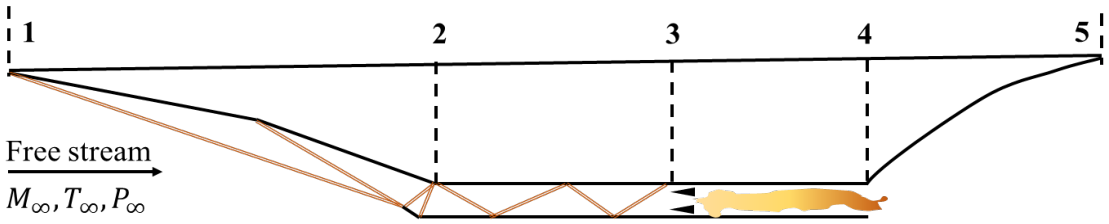
- $M_3 = M_\infty\sqrt{\left(\dfrac{2}{\gamma-1}\right)\left(\dfrac{T_\infty}{T_3} - 1\right)}$
- $M_3 = \sqrt{\left(\dfrac{2}{\gamma-1}\right)\left\{\dfrac{T_\infty}{T_3}\left[1 + \left(\dfrac{\gamma-1}{2}\right)M_\infty^2\right] - 1\right\}}$
- $M_3 = M_\infty\sqrt{\dfrac{T_\infty}{T_3}}$
- $M_3 = \sqrt{\left(\dfrac{\gamma+1}{2}\right)\left(\dfrac{T_\infty}{T_3} - 1\right)M_\infty^2 - 1}$
Official answer: B
GATE AE 2023, Question 55 (2 marks, NAT)
Propulsion - Turbomachinery
The operating characteristics of a pump were measured to be $C_P = a\Phi^2$, where power coefficient $C_P = \dfrac{P}{\rho\omega^3D^5}$, $\Phi$ is the flow coefficient, $a$ is a constant, $D$ is a length scale, $\omega$ is the rotation rate, $\rho$ is fluid density, and $P$ is the power required. The flow coefficient is a dimensionless volume flow rate scaled with $\omega$ and $D$. Assuming that the flow rate remains the same, if the rotation rate is increased to $1.25\,\omega$, the power changes to $\alpha P$. The value of $\alpha$ is ________. (round off to two decimal places)
Official answer: 1.24 to 1.26
GATE AE 2023, Question 61 (2 marks, NAT)
Propulsion - Combustors
A gas turbine combustor is burning methane and air at an equivalence ratio $\phi = 0.5$, where $\phi = \dfrac{F/A}{[F/A]_{stoich}}$ and $[F/A]_{stoich}$ is the ratio of mass flow rate of fuel to the mass flow rate of air at stoichiometry. If the air flow rate is $\dot{m}_{air} = 20$ kg/s then the mass flow rate of methane is ______ kg/s. (round off to two decimal places)
Official answer: 0.57 to 0.60
GATE AE 2023, Question 64 (2 marks, NAT)
Propulsion - Turbomachinery
A centrifugal air compressor has inlet root diameter of 0.25 m and the outlet diameter of the impeller is 0.6 m. The pressure ratio is 5.0. The air at the inlet of the rotor is at 1 atm and 25 °C. The polytropic efficiency is 0.8 and slip factor is 0.92. Use $C_p = 1.004$ kJ/kg-K and $\gamma = 1.4$. The impeller speed in revolutions per minute (RPM) is _________. (round off to the nearest integer)
Official answer: 15948 to 16048
GATE AE 2023, Question 65 (2 marks, NAT)
Propulsion - Combustors
Consider a cryogenic liquid rocket engine using an expander cycle with liquid hydrogen and liquid oxygen as the two propellants. The mass flow rate of hydrogen $\dot{m}_{H_2}$ into the combustion chamber is 32 kg/s, and the mass flow rate of oxygen $\dot{m}_{O_2}$ into the chamber is such that $\dot{m}_{O_2}/\dot{m}_{H_2} = 8$. The combustion of hydrogen and oxygen is at stoichiometry. Assuming that the rate of the forward reaction is much larger than that of the reverse reaction, the rate of formation of H$_2$O is ________ kmol/s. (round off to the nearest integer)
Official answer: 16
GATE AE 2022, Question 23 (1 mark, MCQ)
Propulsion - Rockets
The region of highest static temperature in a rocket engine and the region of highest heat flux are ____________, respectively.
- nozzle throat and nozzle entry
- combustion chamber and nozzle throat
- nozzle exit and nozzle throat
- nozzle throat and combustion chamber
Official answer: B
GATE AE 2022, Question 30 (1 mark, MSQ)
Propulsion - Turbomachinery
A high-pressure-ratio multistage axial compressor encounters an extreme loading mismatch during starting. Which of the following technique(s) can be used to alleviate this problem?
- Blade cooling
- Variable angle stator vanes
- Blow-off valves
- Multi-spool shaft
Official answer: B, C, D
GATE AE 2022, Question 34 (1 mark, NAT)
Propulsion - Engine Performance
In a static test, a turbofan engine with bypass ratio of 9 has core hot exhaust speed 1.5 times that of fan exhaust speed. The engine is operated at a fuel to air ratio of $f = 0.03$. Both the fan and the core streams have no pressure thrust. The ratio of fan thrust to thrust from the core engine is _____ (round off to one decimal place).
Official answer: 5.7 to 6.0
GATE AE 2022, Question 35 (1 mark, NAT)
Propulsion - Turbomachinery
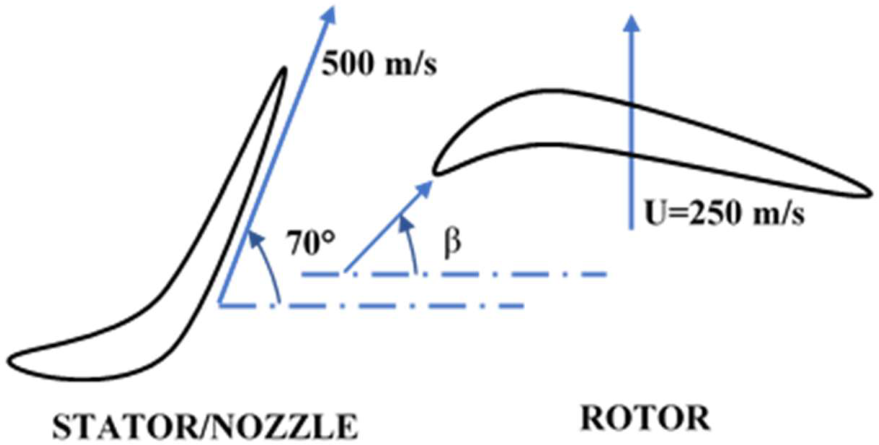
In a single stage turbine, the hot gases come out of stator/ nozzle at a speed of 500 m/s and at an angle of 70 degrees with the turbine axis as shown. The design speed of the rotor blade is 250 m/s at the mean blade radius. The rotor blade angle, $\beta$, at the leading edge is ________ degrees (round off to one decimal place).
Official answer: 51.5 to 52.6
GATE AE 2022, Question 42 (2 marks, MCQ)
Propulsion - Combustors
Which of the following is NOT always true for a combustion process taking place in a closed system?
- Total number of atoms is conserved
- Total number of molecules is conserved
- Total number of atoms of each element is conserved
- Total mass is conserved
Official answer: B
GATE AE 2022, Question 47 (2 marks, MSQ)
Propulsion - Rockets
A rocket operates at an absolute chamber pressure of 20 bar to produce thrust, $F_1$. The hot exhaust is optimally expanded to 1 bar (absolute pressure) using a convergent-divergent nozzle with exit to throat area ratio $\left(\dfrac{A_e}{A_t}\right)$ of 3.5 and thrust coefficient, $C_{F,1} = 1.42$. The same rocket when operated at an absolute chamber pressure of 50 bar produces thrust $F_2$ and the thrust coefficient is $C_{F,2}$. Which of the following statement(s) is/are correct?
- $\dfrac{F_2}{F_1} = 2.5$
- $\dfrac{F_2}{F_1} > 2.5$
- $\dfrac{C_{F,2}}{C_{F,1}} = 1$
- $\dfrac{C_{F,2}}{C_{F,1}} > 1$
Official answer: B, D
GATE AE 2022, Question 64 (2 marks, NAT)
Propulsion - Engine Performance
An ideal ramjet is to operate with exhaust gases optimally expanded to ambient pressure at an altitude where temperature is 220 K. The exhaust speed at the nozzle exit is 1200 m/s at a temperature of 1100 K. Given: $\gamma = 1.4$ at 220 K; $R = 287$ J/(kg-K) for air; $\gamma = 1.33$ at 1100 K; $R = 287$ J/(kg-K) for exhaust gases. The cruise speed of this ramjet is ________ m/s (rounded off to nearest integer).
Official answer: 545 to 555
GATE AE 2022, Question 65 (2 marks, NAT)
Propulsion - Turbomachinery
A multistage axial compressor takes in air at 1 atm, 300 K and compresses it to a minimum of 5 atm. The mean blade speed is 245 m/s and work coefficient, $\dfrac{\Delta C_\theta}{U}$ is 0.55 for each stage. For air, use $C_p = 1005$ J/(kg-K), $R = 287$ J/(kg-K) and $\gamma = 1.4$. If the compression is isentropic, the number of stages required is ____________ (rounded off to the next higher integer).
GATE AE 2018, Question 28 (1 mark, MCQ)
Propulsion - Aerothermodynamics & Cycles
The first law of thermodynamics is also known as conservation of
- mass.
- momentum.
- energy.
- species.
Official answer: C
GATE AE 2018, Question 29 (1 mark, MCQ)
Propulsion - Aerothermodynamics & Cycles
In an ideal gas turbine cycle, the expansion in a turbine is represented by
- an isenthalpic process.
- an isentropic process.
- an isobaric process.
- an isochoric process.
Official answer: B
GATE AE 2018, Question 31 (1 mark, NAT)
Propulsion - Aerothermodynamics & Cycles
The theoretical maximum velocity (in m/s) of air expanding from a reservoir at 700 K is __________ (accurate to two decimal places). Specific heat of air at constant pressure is 1005 J/(kg-K).
Official answer: 1185.00 to 1186.50
GATE AE 2018, Question 34 (1 mark, NAT)
Propulsion - Engine Performance
The stagnation pressures at the inlet and exit of a subsonic intake are 100 kPa and 98 kPa, respectively. The pressure recovery of this intake will be ______ (accurate to two decimal places).
Official answer: 0.98
GATE AE 2018, Question 35 (1 mark, NAT)
Propulsion - Combustors
A combustor is operating with a fuel-air ratio of 0.03. If the stoichiometric fuel-air ratio of the fuel used is 0.06, the equivalence ratio of the combustor will be _______ (accurate to two decimal places).
Official answer: 0.5
GATE AE 2018, Question 42 (2 marks, MCQ)
Propulsion - Engine Performance
An aircraft with a turbojet engine flies at a velocity of 100 m/s. If the jet exhaust velocity is 300 m/s, the propulsive efficiency of the engine, assuming a negligible fuel-air ratio, is
- 0.33
- 0.50
- 0.67
- 0.80
Official answer: B
GATE AE 2018, Question 43 (2 marks, MCQ)
Propulsion - Engine Performance
An aircraft with a turboprop engine produces a thrust of 500 N and flies at 100 m/s. If the propeller efficiency is 0.5, the shaft power produced by the engine is
- 50 kW
- 100 kW
- 125 kW
- 500 kW
Official answer: B
GATE AE 2018, Question 44 (2 marks, MCQ)
Propulsion - Turbomachinery
An axial compressor that generates a stagnation pressure ratio of 4.0, operates with inlet and exit stagnation temperatures of 300 K and 480 K, respectively. If the ratio of specific heats ($\gamma$) is 1.4, the isentropic efficiency of the compressor is
- 0.94
- 0.81
- 0.72
- 0.63
Official answer: B
GATE AE 2018, Question 45 (2 marks, MCQ)
Propulsion - Rockets
A rocket has an initial mass of 150 kg. After operating for a duration of 10 s, its final mass is 50 kg. If the acceleration due to gravity is 9.81 m/s$^2$ and the thrust produced by the rocket is 19.62 kN, the specific impulse of the rocket is
- 400 s
- 300 s
- 200 s
- 100 s
Official answer: C
GATE AE 2018, Question 63 (2 marks, NAT)
Propulsion - Turbomachinery
An axial compressor rotor with 50 % degree of reaction, operates with an axial velocity of 200 m/s. The absolute flow angle at the inlet of the rotor is $22^\circ$ with reference to the axial direction. If the axial velocity is assumed to remain constant through the rotor, the magnitude of the relative velocity (in m/s) at the rotor exit is ___________ (accurate to one decimal place).
Official answer: 215.0 to 216.5
GATE AE 2018, Question 64 (2 marks, NAT)
Propulsion - Turbomachinery
The relative velocity of air leaving a straight radial impeller of a centrifugal compressor is 100 m/s. If the impeller tip speed is 200 m/s, for a slip free operation, the absolute velocity (in m/s) at the impeller exit is _________ (accurate to one decimal place).
Official answer: 222.0 to 225.0
GATE AE 2016, Question 17 (1 mark, MCQ)
Propulsion - Engine Performance
Which of the following aircraft engines has the highest propulsive efficiency at a cruising Mach number of less than 0.5?
- Turbofan engine
- Turbojet engine
- Turboprop engine
- Ramjet engine
Official answer: C
GATE AE 2016, Question 29 (1 mark, MCQ)
Propulsion - Combustors
Combustion in gas turbine engines is ideally represented as the following process:
- Adiabatic
- Isentropic
- Isobaric
- Isochoric
Official answer: C
GATE AE 2016, Question 30 (1 mark, MCQ)
Propulsion - Rockets
For a given chamber pressure, the thrust of a rocket engine is highest when
- the rocket is operating at its design altitude.
- the rocket is operating in vacuum.
- the rocket is operating at sea-level.
- there is a normal shock in the rocket nozzle.
Official answer: B
GATE AE 2016, Question 36 (2 marks, NAT)
Propulsion - Engine Performance
An un-mixed turbofan engine with a bypass ratio of 6.0, flies with a velocity of 200 m/s. The core and the bypass nozzles of the engine, that are both convergent nozzles, operate under choked condition and have exhaust static temperatures of 580 K and 295 K, respectively. The specific gas constant and the ratio of specific heats for both the streams are 287 J/kgK and 1.4, respectively. If the fuel-air ratio is negligible, the thrust per unit mass flow rate generated by the engine is _______ Ns/kg.
GATE AE 2016, Question 37 (2 marks, MCQ)
Propulsion - Turbomachinery
A single-stage gas turbine operates with an axial absolute flow at the entry and exit from the stage. The absolute flow angle at the nozzle exit is $70^\circ$. The turbine stage generates a specific work of 228 kJ/kg when operating with a mean blade speed of 440 m/s. The absolute velocity at the rotor entry is
- 275.7 m/s
- 551.5 m/s
- 1103.0 m/s
- 1654.5 m/s
Official answer: B
GATE AE 2016, Question 38 (2 marks, NAT)
Propulsion - Turbomachinery
An axial compressor operates such that it has an inlet and an exit total temperature of 300 K and 430 K, respectively. The isentropic efficiency of the compressor is 85 %. If the ratio of specific heats is 1.4, then the total pressure ratio across the compressor is ____________.
Official answer: 2.9 to 3.1
GATE AE 2016, Question 43 (2 marks, NAT)
Propulsion - Combustors
A gaseous mixture of air and fuel enters a constant area combustion chamber at a velocity of 100 m/s and at a static temperature of 300 K. The heat release due to combustion is 1000 kJ/kg. The specific heat at constant pressure of the calorically perfect gas is 1000 J/kgK. The total temperature of air-fuel mixture after combustion is ______ K.
Official answer: 1305
GATE AE 2016, Question 55 (2 marks, NAT)
Propulsion - Aerothermodynamics & Cycles
A wall of thickness 5 mm is heated by a hot gas flowing along the wall. The gas is at a temperature of 3000 K, and the convective heat transfer coefficient is 160 W/m$^2$K. The wall thermal conductivity is 40 W/mK. If the colder side of the wall is held at 500 K, the temperature of the side exposed to the hot gas is _______ K.
Official answer: 548 to 550
GATE AE 2016, Question 56 (2 marks, NAT)
Propulsion - Rockets
A launch vehicle has a main rocket engine with two identical strap-on motors, all of which fire simultaneously during the operation. The main engine delivers a thrust of 6300 kN with a specific impulse of 428 s. Each strap-on motor delivers a thrust of 12000 kN with specific impulse of 292 s. The acceleration due to gravity is 9.81 m/s$^2$. The effective (combined) specific impulse of the vehicle is _______ s.
Official answer: 310 to 315
GATE AE 2016, Question 57 (2 marks, MCQ)
Propulsion - Aerothermodynamics & Cycles
A substance experiences an entropy change of $\Delta s > 0$ in a quasi-steady process. The rise in temperature (corresponding to the entropy change $\Delta s$) is highest for the following process:
- isenthalpic
- isobaric
- isochoric
- isothermal
Official answer: C
GATE AE 2016, Question 58 (2 marks, NAT)
Propulsion - Rockets
In a particular rocket engine, helium propellant is heated to 6000 K and 95% of its total enthalpy is recovered as kinetic energy of the nozzle exhaust. Consider helium to be a calorically perfect gas with specific heat at constant pressure of 5200 J/kgK. The exhaust velocity for such a rocket for an optimum expansion is _____ m/s.
Official answer: 7690 to 7710
GATE AE 2016, Question 64 (2 marks, MCQ)
Propulsion - Rockets
A rocket, with a total lift-off mass of 10000 kg, moves vertically upward from rest under a constant gravitational acceleration of 9.81 m/s$^2$. The propellant mass of 8400 kg burns at a constant rate of 1200 kg/s. If the specific impulse of the rocket engine is 240 s, neglecting drag, the burnout velocity in m/s is
- 3933.7
- 4314.6
- 4245.9
- 4383.3
Official answer: C
GATE AE 2014, Question 26 (1 mark, MCQ)
Propulsion - Engine Performance
Match the appropriate engine (in right column) with the corresponding aircraft (in left column) for most efficient performance of the engine. a. Low speed transport aircraft; b. High subsonic civilian aircraft; c. Supersonic fighter aircraft; d. Hypersonic aircraft. i. Ramjet; ii. Turboprop; iii. Turbojet; iv. Turbofan.
- a - iv, b - iii, c - i, d - ii
- a - ii, b - i, c - iii, d - iv
- a - i, b - ii, c - iv, d - iii
- a - ii, b - iv, c - iii, d - i
Official answer: D
GATE AE 2014, Question 27 (1 mark, MCQ)
Propulsion - Engine Performance
For a given fuel flow rate and thermal efficiency, the take-off thrust for a gas turbine engine burning aviation turbine fuel (considering fuel-air ratio $f \ll 1$) is
- Directly proportional to exhaust velocity
- Inversely proportional to exhaust velocity
- Independent of exhaust velocity
- Directly proportional to the square of the exhaust velocity
Official answer: B
GATE AE 2014, Question 28 (1 mark, MCQ)
Propulsion - Turbomachinery
For a fifty percent reaction axial compressor stage, following statements are given: I. Velocity triangles at the entry and exit of the rotor are symmetrical. II. The whirl or swirl component of absolute velocity at the entry of rotor and entry of stator are same. Which of the following options are correct?
- Both I and II are correct statements
- I is correct but II is incorrect
- I is incorrect but II is correct
- Both I and II are incorrect
Official answer: B
GATE AE 2014, Question 29 (1 mark, MCQ)
Propulsion - Rockets
A small rocket having a specific impulse of 200 s produces a total thrust of 98 kN, out of which 10 kN is the pressure thrust. Considering the acceleration due to gravity to be 9.8 m/s$^2$, the propellant mass flow rate in kg/s is
- 55.1
- 44.9
- 50
- 60.2
Official answer: C
GATE AE 2014, Question 30 (1 mark, MCQ)
Propulsion - Engine Performance
The thrust produced by a turbojet engine
- Increases with increasing compressor pressure ratio
- Decreases with increasing compressor pressure ratio
- Remains constant with increasing compressor pressure ratio
- First increases and then decreases with increasing compressor pressure ratio
Official answer: D
GATE AE 2014, Question 55 (2 marks, NAT)
Propulsion - Engine Performance
A cruise missile with an ideal ramjet engine is flying at Mach 4.0 at an altitude where the ambient temperature is 100 K. Consider ratio of specific heats $\gamma = 1.4$ and specific gas constant $R = 287$ J/kgK. If the stagnation temperature in the combustion chamber is equal to 2310 K, the speed of the exhaust gases (in m/s) is ______________.
Official answer: 1880 to 1881
GATE AE 2014, Question 56 (2 marks, NAT)
Propulsion - Turbomachinery
A gas turbine engine is operating under the following conditions: stagnation temperature at turbine inlet 1350 K; stagnation pressure at turbine inlet 10 bar; static temperature at turbine exit 800 K; velocity at turbine exit 200 m/s; total-to-total efficiency of turbine 0.96; $\gamma$ (ratio of specific heats) 1.33; $C_p$ (specific heat at constant pressure) 1.147 kJ/kgK. The stagnation pressure (in bar) in the nozzle (considering isentropic nozzle) is equal to _______.
Official answer: 1.10 to 1.25
GATE AE 2014, Question 57 (2 marks, NAT)
Propulsion - Turbomachinery
Air at a stagnation temperature of 300 K (ratio of specific heats, $\gamma = 1.4$ and specific gas constant $R = 287$ J/kgK) enters the impeller of a centrifugal compressor in axial direction. The stagnation pressure ratio between the diffuser outlet and impeller inlet is 4.0. The impeller blade radius is 0.3 m and it is rotating at 15000 rev/min. If the slip factor $\sigma_s$ (Ratio of tangential component of air velocity at the blade tip to the blade tip speed) is 0.88, the overall efficiency (total-to-total) of the compressor (in %) is ___________.
Official answer: 74 to 76
GATE AE 2014, Question 58 (2 marks, NAT)
Propulsion - Rockets
A stationary two stage rocket with initial mass of 16000 kg, carrying a payload of 1000 kg, is fired in a vertical trajectory from the surface of the earth. Both the stages of the rocket have same specific impulse, $I_{sp}$, of 300 s and same structural coefficient of 0.14. The acceleration due to gravity is 9.8 m/s$^2$. Neglecting drag and gravity effects and considering both the stages with same payload ratio, the terminal velocity attained by the payload in m/s is __________________.
Official answer: 6050 to 6250
GATE AE 2014, Question 60 (2 marks, MCQ)
Propulsion - Rockets
A cryogenic rocket has a specific impulse of 455 s and characteristic velocity of 2386 m/s. The value of thrust coefficient for this rocket is
- 1.78
- 1.73
- 1.87
- 1.95
Official answer: C