GATE AE Flight Mechanics & Space Dynamics: Previous Year Questions
Practice GATE Aerospace Engineering Flight Mechanics & Space Dynamics previous year questions from 8 papers, topic by topic, with the official answer key where available.
All GATE AE papers
GATE AE 2026, Question 23 (1 mark, MSQ)
Flight Mechanics & Space Dynamics - Static Stability & Control
Which of the following statements is/are TRUE about the stability of an aircraft?
- Static stability of an aircraft is sufficient to guarantee its dynamic stability
- Static stability of an aircraft is related only to its initial tendency to return towards the equilibrium position from which it is disturbed
- An aircraft may be dynamically unstable even if it is statically stable
- Dynamic stability is related to the time history of aircraft motion after being disturbed from its equilibrium position
Official answer: B, C, D
GATE AE 2026, Question 31 (1 mark, NAT)
Flight Mechanics & Space Dynamics - Airplane Performance
An aircraft starts gliding in power-off condition at an altitude of 4 km. Given that the maximum lift to drag ratio of the aircraft is 15, the maximum glide range that the aircraft can cover, measured along the ground, is ________ km (rounded off to the nearest integer).
Official answer: 60
GATE AE 2026, Question 36 (2 marks, MCQ)
Flight Mechanics & Space Dynamics - Space Dynamics
An earth satellite has the instantaneous position vector $\vec{r}$ and velocity vector $\vec{v}$ as given below. Here $\hat{p}$ and $\hat{q}$ denote the unit vectors along the $x$ and $y$ axes of the perifocal frame, respectively. Assume that the value of gravitational parameter is 398600 km$^3$/s$^2$. Which one of the following trajectories does the satellite follow? $$\vec{r} = (8000\hat{p} + 9000\hat{q})\ \text{km and } \vec{v} = (-6\hat{p} + 6\hat{q})\ \text{km/s}$$
- Circle
- Hyperbola
- Parabola
- Straight line
Official answer: B
GATE AE 2026, Question 55 (2 marks, NAT)
Flight Mechanics & Space Dynamics - Space Dynamics
An earth satellite moves in an elliptical orbit with a perigee altitude of 300 km and an apogee altitude of 3000 km. Assume that the radius of the earth is 6378 km. The eccentricity of the orbit is __________ (rounded off to three decimal places).
Official answer: 0.167 to 0.169
GATE AE 2026, Question 57 (2 marks, NAT)
Flight Mechanics & Space Dynamics - Airplane Performance
$W_A$ and $W_B$ are the respective maximum take-off weights of an aircraft for two ambient air conditions given below. Condition A: $p = 1$ bar, $T = 50\,^\circ$C; Condition B: $p = 0.66$ bar, $T = -30\,^\circ$C. If all other parameters relevant for take-off are kept the same in these two conditions, the ratio $W_B/W_A$ is ________ (rounded off to 3 decimal places).
Official answer: 0.860 to 0.890
GATE AE 2025, Question 22 (1 mark, MCQ)
Flight Mechanics & Space Dynamics - Static Stability & Control
A general aviation airplane is in steady and level flight. The airplane is prone to adverse yaw. Which one of the following options best describes the deflections of aileron and rudder to achieve a coordinated right turn?
- Left aileron: down; Right aileron: up; Rudder: left
- Left aileron: down; Right aileron: up; Rudder: right
- Left aileron: up; Right aileron: down; Rudder: left
- Left aileron: up; Right aileron: down; Rudder: right
Official answer: B
GATE AE 2025, Question 23 (1 mark, MCQ)
Flight Mechanics & Space Dynamics - Static Stability & Control
For a general aviation airplane, which one of the following has a destabilizing effect on its static roll stability?
- Wing with a positive dihedral angle
- Fuselage with a high wing
- Fuselage with a low wing
- Swept back wing
Official answer: C
GATE AE 2025, Question 24 (1 mark, MCQ)
Flight Mechanics & Space Dynamics - Atmosphere & Flight Instruments
A general aviation airplane is flying at an altitude of 5000 m. The indicated airspeed is 250 km/h. Assume that there are no instrument errors and position errors. Neglecting compressibility effects, which one of the following options is FALSE?
- The true airspeed is greater than 250 km/h.
- The calibrated airspeed is 250 km/h.
- The true airspeed is 250 km/h.
- The equivalent airspeed is 250 km/h.
Official answer: C
GATE AE 2025, Question 25 (1 mark, MCQ)
Flight Mechanics & Space Dynamics - Static Stability & Control
To achieve longitudinal static stability of a general aviation airplane, which one of the following conditions should be satisfied?
- The center of gravity of the airplane should be aft of the neutral point.
- The center of gravity of the airplane should be forward of the neutral point.
- The stability coefficient $\dfrac{\partial C_m}{\partial \alpha}$ ($C_m$ is the airplane pitching moment coefficient and $\alpha$ is the angle of attack) is positive.
- The static margin is negative.
Official answer: B
GATE AE 2025, Question 38 (2 marks, MSQ)
Flight Mechanics & Space Dynamics - Flight Dynamics
A general aviation airplane is initially in steady and level flight. The stability coefficient $\dfrac{\partial C_m}{\partial q}$ ($C_m$ is the airplane pitching moment coefficient and $q$ is the pitch rate) is negative. The airplane is perturbed with a small nose-up constant pitch rate. Assume that the horizontal tail does not stall during the perturbation, and unsteady effects are neglected. When compared to steady and level flight condition, which of the following statements is/are true during the perturbed motion?
- The angle of attack of the horizontal tail increases.
- The contribution of the horizontal tail to the airplane's pitching moment about the center of gravity is more stabilizing.
- The lift generated by the horizontal tail increases.
- The contribution of the horizontal tail to the airplane's pitching moment about the center of gravity is less stabilizing.
Official answer: A, B, C
GATE AE 2025, Question 39 (2 marks, MSQ)
Flight Mechanics & Space Dynamics - Airplane Performance
A general aviation airplane is gliding with a speed $V_g$ at minimum glide angle. Which of the following statements is/are true?
- $V_g$ is equal to the speed corresponding to the maximum lift to drag ratio of the airplane.
- $V_g$ increases with decreasing wing loading when all other parameters remain constant.
- $V_g$ increases with decreasing altitude when all other parameters remain constant.
- $V_g$ increases with increasing altitude when all other parameters remain constant.
Official answer: A, D
GATE AE 2025, Question 52 (2 marks, NAT)
Flight Mechanics & Space Dynamics - Airplane Performance
A jet-powered airplane is steadily climbing at a rate of 10 m/s. The air density is 0.8 kg/m$^3$, and the thrust force is aligned with the flight path. Using the information provided in the table below, the airplane's thrust to weight ratio is ______ (rounded off to one decimal place). $$\begin{array}{|l|r|}\hline \text{Airplane speed} & 80\\ \text{m/s} \\ \text{Lift coefficient, } C_L & 0.8 \\ \text{Aspect ratio} & 6 \\ \text{Oswald efficiency factor} & 0.8 \\ \text{Zero-lift drag coefficient} & 0.02 \\ \hline\end{array}$$
Official answer: 0.2
GATE AE 2025, Question 53 (2 marks, NAT)
Flight Mechanics & Space Dynamics - Space Dynamics
F and G denote two points on a spacecraft's orbit around a planet, as indicated in the figure. O is the center of the planet, P is the periapsis, and the angles are as indicated in the figure. If OF = 8000 km, OG = 10000 km, $\theta_F = 0$ deg, and $\theta_G = 60$ deg, the eccentricity of the spacecraft's orbit is ____ (rounded off to two decimal places).
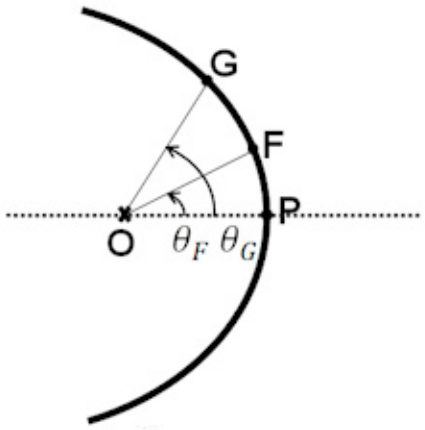
Official answer: 0.66 to 0.67
GATE AE 2025, Question 54 (2 marks, NAT)
Flight Mechanics & Space Dynamics - Airplane Performance
While taking off, the net external force acting on an airplane during the ground roll segment can be assumed to be constant. The airplane starts from rest. $S_{LO}$ and $V_{LO}$ are the ground roll distance and the lift-off speed, respectively. $\alpha V_{LO}$ ($\alpha > 0$) denotes the airplane speed at $0.5\,S_{LO}$. Neglecting changes in the airplane mass during the ground roll segment, the value of $\alpha$ is _____ (rounded off to two decimal places).
Official answer: 0.70 to 0.71
GATE AE 2024, Question 20 (1 mark, MCQ)
Flight Mechanics & Space Dynamics - Airplane Performance
Which one of the following figures represents the drag polar of a general aviation aircraft?
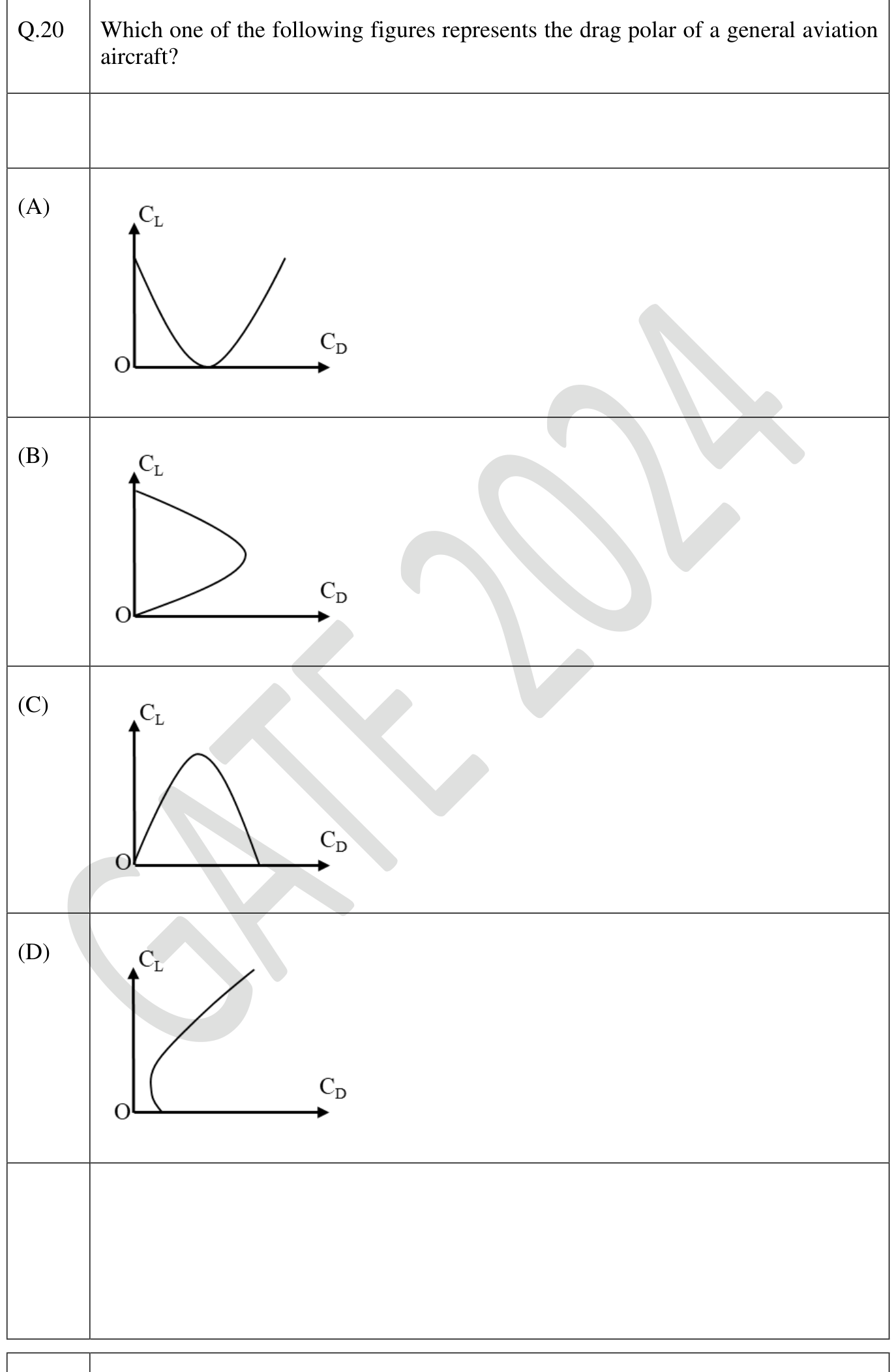
Official answer: D
GATE AE 2024, Question 26 (1 mark, MSQ)
Flight Mechanics & Space Dynamics - Space Dynamics
Which of the following statements is/are correct about a satellite moving in a geostationary orbit?
- The orbit lies in the equatorial plane
- The orbit is circular about the center of the Earth
- The time period of motion is 90 minutes
- The satellite is visible from all parts of the Earth
Official answer: A, B
GATE AE 2024, Question 27 (1 mark, MSQ)
Flight Mechanics & Space Dynamics - Static Stability & Control
In a conventional configuration airplane, the rudder can be used:
- to overcome adverse yaw during a turning maneuver
- to overcome yawing moment due to failure of one engine in a multi engine airplane
- for landing the airplane in crosswind conditions
- for enhancing longitudinal stability
Official answer: A, B, C
GATE AE 2024, Question 28 (1 mark, MSQ)
Flight Mechanics & Space Dynamics - Airplane Performance
Which of the following statements about a general aviation aircraft, while operating at point $Q$ in the $V$-$n$ diagram, is/are true?
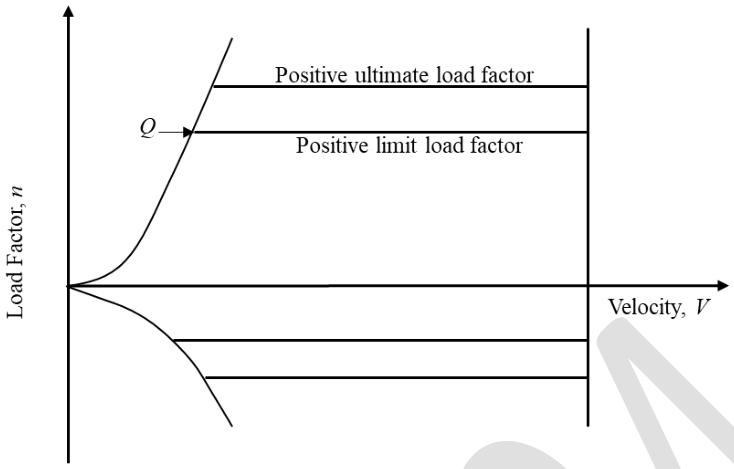
- The aircraft has the highest turn rate
- The aircraft has the smallest turn radius
- The aircraft is flying with minimum drag
- The aircraft is operating at $C_{L,max}$
Official answer: A, B, D
GATE AE 2024, Question 33 (1 mark, NAT)
Flight Mechanics & Space Dynamics - Airplane Performance
An airplane experiences a net vertical ground reaction of 15000 N during landing. The weight of the airplane is 10000 N. The landing vertical load factor, defined as the ratio of inertial load to the weight of the aircraft, is __________ (rounded off to 1 decimal place).
Official answer: 1.5
GATE AE 2024, Question 38 (2 marks, MCQ)
Flight Mechanics & Space Dynamics - Atmosphere & Flight Instruments
As per the International Standard Atmosphere model, which one of the following options about density variation with increase in altitude in the isothermal layer is correct?
- remains constant
- increases linearly
- decreases linearly
- decreases exponentially
Official answer: D
GATE AE 2024, Question 39 (2 marks, MCQ)
Flight Mechanics & Space Dynamics - Space Dynamics
At a point in the trajectory of an unpowered space vehicle moving about the Earth, the altitude above the mean sea level is 600 km, and the speed with reference to a coordinate system fixed to the center of mass of the Earth is 9 km/s. Assume that the Earth is a sphere with a radius of 6400 km and $GM_{Earth} = 3.98 \times 10^{14}$ m$^3$/s$^2$, where, $G$ is the universal gravitational constant and $M_{Earth}$ is mass of the Earth. The trajectory is:
- Circular
- Elliptic
- Parabolic
- Hyperbolic
Official answer: B
GATE AE 2024, Question 47 (2 marks, MSQ)
Flight Mechanics & Space Dynamics - Airplane Performance
Which of the following statements about absolute ceiling and service ceiling for a piston-propeller aircraft is/are correct?
- The altitude corresponding to absolute ceiling is higher than that for service ceiling
- At the absolute ceiling, the power required for cruise equals the maximum power available
- The altitude corresponding to absolute ceiling is lower than that for service ceiling
- At the service ceiling, the maximum rate of climb is 50 ft/min
Official answer: A, B
GATE AE 2024, Question 48 (2 marks, MSQ)
Flight Mechanics & Space Dynamics - Static Stability & Control
For an airplane having directional / weathercock static stability, which of the following options is/are correct?
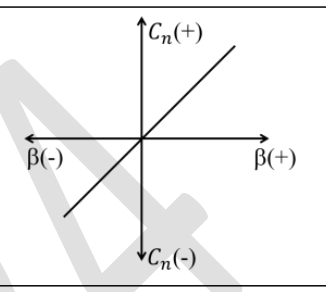
- The airplane when disturbed in yaw, from an equilibrium state, will experience a restoring moment
- The variation of yawing moment coefficient ($C_n$) with sideslip angle ($\beta$) for the airplane will look like a straight line of positive slope through the origin in the $C_n$–$\beta$ plane (see figure)
- The airplane will always tend to point into the relative wind
- The airplane when disturbed in yaw will return to equilibrium state in a finite amount of time after removing the disturbance
Official answer: A, B, C
GATE AE 2024, Question 60 (2 marks, NAT)
Flight Mechanics & Space Dynamics - Space Dynamics
Consider an artificial satellite moving around the Moon in an elliptic orbit. The altitude of the satellite from the Moon’s surface at the perigee is 25 km and that at the apogee is 134 km. Assume the Moon to be spherical with a radius of 1737 km. The trajectory is considered with reference to a coordinate system fixed to the center of mass of the Moon. The ratio of the speed of the satellite at the perigee to that at the apogee is ___________ (rounded off to 2 decimal places).
Official answer: 1.05 to 1.07
GATE AE 2024, Question 61 (2 marks, NAT)
Flight Mechanics & Space Dynamics - Atmosphere & Flight Instruments
For an aircraft moving at 4 km altitude above mean sea level at a Mach number of 0.2, the ratio of equivalent air speed to true air speed is _______ (rounded off to 2 decimal places). The density of air at mean sea level is 1.225 kg/m$^3$ and at 4 km altitude is 0.819 kg/m$^3$.
Official answer: 0.80 to 0.84
GATE AE 2024, Question 62 (2 marks, NAT)
Flight Mechanics & Space Dynamics - Flight Dynamics
For a general aviation airplane, one of the complex conjugate pair of eigenvalues for longitudinal dynamics is given by $-0.039 \pm 0.0567\,i$ (in SI units). If the system is disturbed to excite only this mode, the time taken for the amplitude of response to become half in magnitude is _______ s (rounded off to 1 decimal place).
Official answer: 17.7 to 17.9
GATE AE 2023, Question 17 (1 mark, MCQ)
Flight Mechanics & Space Dynamics - Airplane Performance
An ideal glider has drag characteristics given by $C_D = C_{D_0} + C_{D_i}$, where $C_{D_i} = KC_L^2$ is the induced drag coefficient, $C_L$ is the lift coefficient, and $K$ is a constant. For maximum range of the glider, the ratio $C_{D_0}/C_{D_i}$ is
- 1
- $\dfrac{1}{3}$
- 3
- $\dfrac{3}{2}$
Official answer: A
GATE AE 2023, Question 19 (1 mark, MCQ)
Flight Mechanics & Space Dynamics - Static Stability & Control
For a longitudinally statically stable aircraft, which one of the following represents the relationship between the coefficient of pitching moment about the center of gravity $C_{m_{cg}}$ and absolute angle of attack $\alpha_a$? (Note: nose-up moment is positive.)
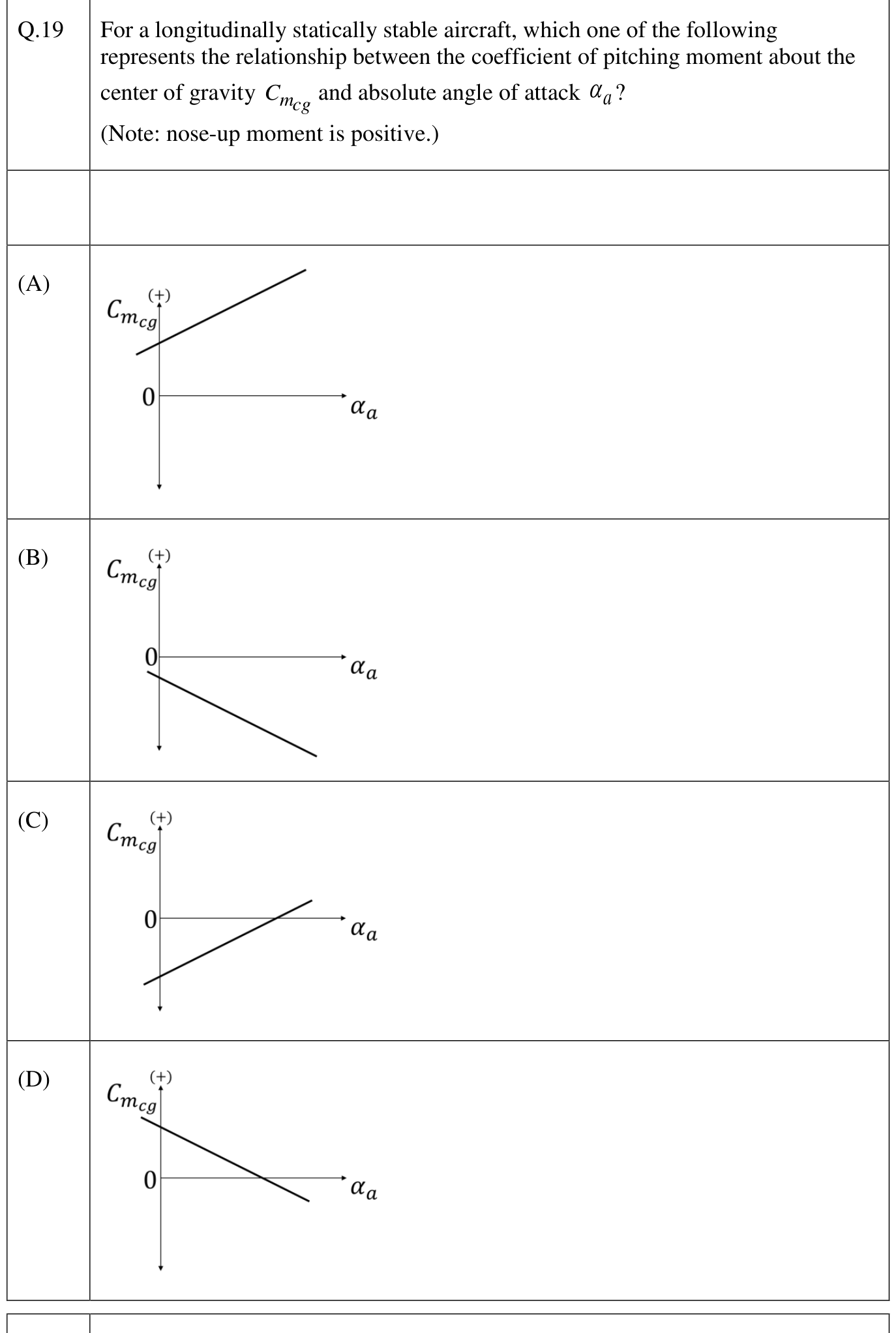
Official answer: D
GATE AE 2023, Question 24 (1 mark, MCQ)
Flight Mechanics & Space Dynamics - Space Dynamics
Which one of the following figures represents the qualitative variation of absolute deceleration $\left|\dfrac{dV}{dt}\right|$ with altitude $h$ (measured from the mean sea level) for a space vehicle undergoing a ballistic entry into the Earth's atmosphere?
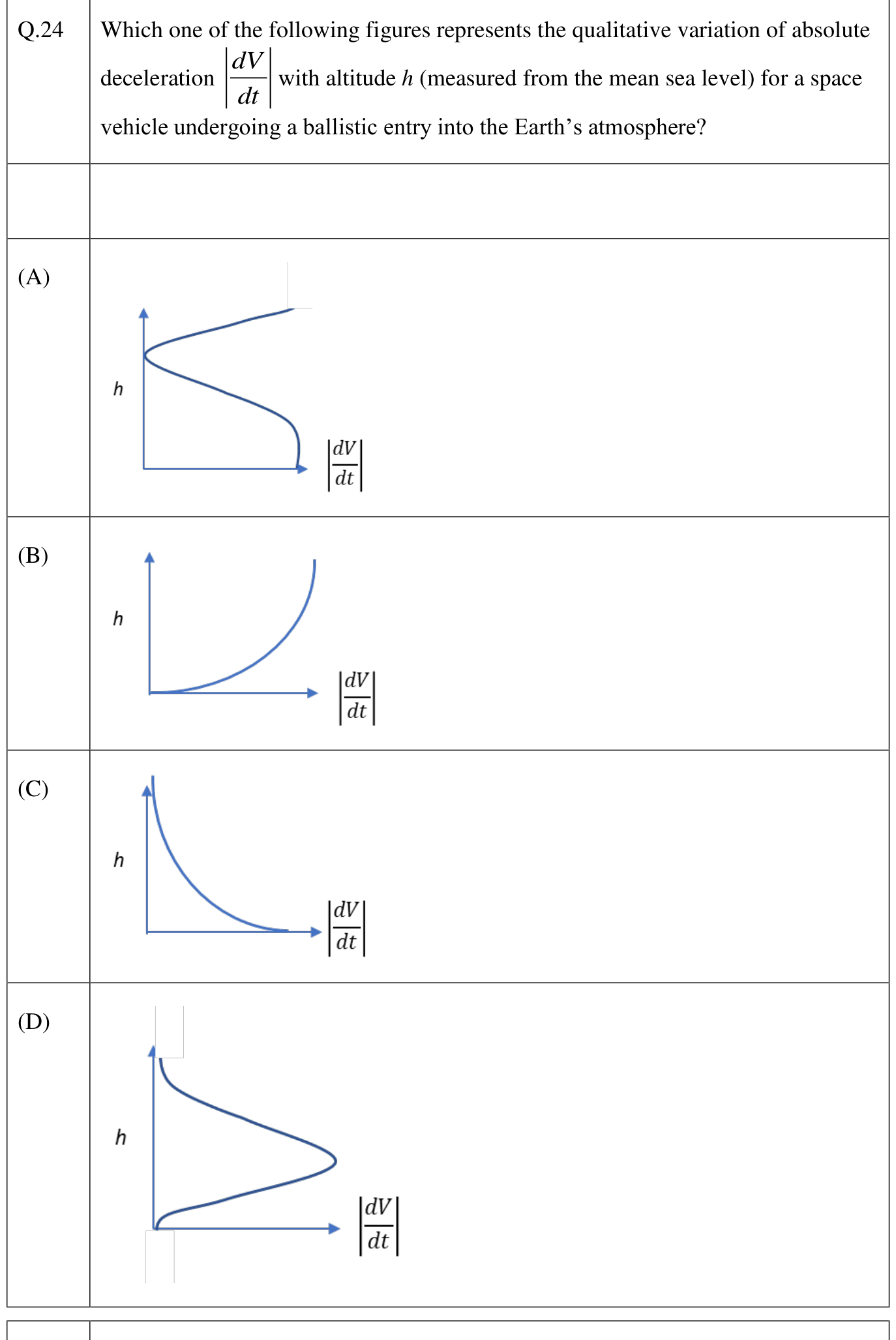
Official answer: D
GATE AE 2023, Question 32 (1 mark, NAT)
Flight Mechanics & Space Dynamics - Airplane Performance
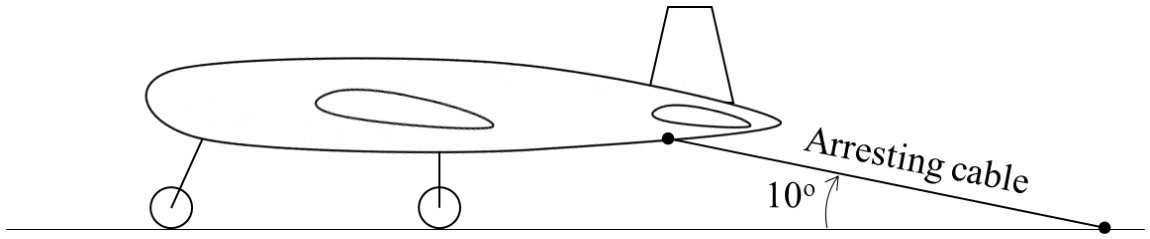
An airplane weighing 40 kN is landing on a horizontal runway during which it is retarded by an arresting cable mechanism. The tension in the arresting cable at a given instant, as shown in the figure, is 100 kN. Assuming that the thrust from the engine continues to balance airplane drag, the magnitude of horizontal load factor is ________. (round off to one decimal place)
Official answer: 2.4 to 2.6
GATE AE 2023, Question 34 (1 mark, NAT)
Flight Mechanics & Space Dynamics - Atmosphere & Flight Instruments
Airplane A and Airplane B are cruising at altitudes of 2 km and 4 km, respectively. The free stream density and static pressure at altitude 2 km are 1.01 kg/m$^3$ and 79.50 kPa, respectively, and at altitude 4 km, they are 0.82 kg/m$^3$ and 61.70 kPa, respectively. The differential pressure reading from the pitot-static tubes is 3 kPa for both the airplanes. Assuming incompressible flow, the ratio of cruise speeds of Airplane A to Airplane B is ______. (round off to two decimal places)
Official answer: 0.89 to 0.91
GATE AE 2023, Question 40 (2 marks, MCQ)
Flight Mechanics & Space Dynamics - Airplane Performance
Consider a general aviation airplane with weight 10 kN and a wing planform area of 15 m$^2$. The drag coefficient of the airplane is given as $C_D = C_{D_0} + KC_L^2$ with $C_{D_0} = 0.025$ and $K = 0.05$. For level flight at an altitude where the density is 0.60 kg/m$^3$ and thrust 1 kN, the maximum cruise speed is (rounded off to the nearest integer)
- 87 m/s
- 30 m/s
- 36 m/s
- 101 m/s
Official answer: A
GATE AE 2023, Question 45 (2 marks, MSQ)
Flight Mechanics & Space Dynamics - Atmosphere & Flight Instruments
Consider the International Standard Atmosphere (ISA) with $h$ being the geopotential altitude (in km) and $\dfrac{dT}{dh}$ being the temperature gradient (in K/m). Which of the following combination(s) of $\left(h, \dfrac{dT}{dh}\right)$ is/are as per ISA?
- $(7,\ -6.5 \times 10^{-3})$
- $(9,\ 4 \times 10^{-3})$
- $(15,\ 0)$
- $(35,\ 3 \times 10^{-3})$
Official answer: A, C, D
GATE AE 2023, Question 59 (2 marks, NAT)
Flight Mechanics & Space Dynamics - Airplane Performance
An airplane with wing planform area of 20 m$^2$ and weight 8 kN is flying straight and level with a speed of 100 m/s. The total drag coefficient is 0.026 and the air density is 0.7 kg/m$^3$. The total thrust required to introduce a steady climb angle of 0.1 radians is ____ N. (round off to the nearest integer)
Official answer: 2615 to 2625
GATE AE 2023, Question 60 (2 marks, NAT)
Flight Mechanics & Space Dynamics - Airplane Performance
The maximum permissible load factor and the maximum lift force coefficient for an airplane is 7 and 2, respectively. For a wing loading of 6500 N/m$^2$ and air density 1.23 kg/m$^3$, the speed yielding the highest possible turn rate in the vertical plane is ___________ m/s. (round off to the nearest integer)
Official answer: 190 to 195
GATE AE 2023, Question 62 (2 marks, NAT)
Flight Mechanics & Space Dynamics - Space Dynamics
The universal gravitational constant is $6.67 \times 10^{-11}$ Nm$^2$/kg$^2$. For a planet of mass $6.4169 \times 10^{23}$ kg and radius 3390 km, the escape velocity is _____ km/s. (round off to one decimal place).
Official answer: 4.9 to 5.1
GATE AE 2023, Question 63 (2 marks, NAT)
Flight Mechanics & Space Dynamics - Space Dynamics
A satellite is in a circular orbit around Earth with a time period of 90 minutes. The radius of Earth is 6370 km, mass of Earth is $5.98 \times 10^{24}$ kg and the universal gravitational constant is $6.67 \times 10^{-11}$ Nm$^2$/kg$^2$. The altitude of the satellite above mean sea level is ____ km. (round off to the nearest integer)
Official answer: 260 to 300
GATE AE 2022, Question 18 (1 mark, MCQ)
Flight Mechanics & Space Dynamics - Airplane Performance
The service ceiling of an airplane is the altitude
- at which maximum rate of climb is 100 m/min
- beyond which theoretically the airplane cannot sustain level flight
- at which maximum power is required for flight
- at which maximum rate of climb is 100 ft/min
Official answer: D
GATE AE 2022, Question 19 (1 mark, MCQ)
Flight Mechanics & Space Dynamics - Static Stability & Control
Regarding the horizontal tail of a conventional airplane, which one of the following statements is true?
- It contributes to $C_{m_\alpha} < 0$
- It makes $C_{m_\alpha} = 0$
- It makes $C_{m_\alpha} > 0$
- It makes $C_{m0} > 0$ and $C_{m_\alpha} > 0$
Official answer: A
GATE AE 2022, Question 27 (1 mark, MSQ)
Flight Mechanics & Space Dynamics - Atmosphere & Flight Instruments
For International Standard Atmosphere (ISA) up to 11 km, which of the following statement(s) is/are true?
- The hydrostatic/ aerostatic equation is used
- The temperature lapse rate is taken as $-10^{-2}$ K/m
- The sea level conditions are taken as: pressure, $p_s = 1.01325 \times 10^5$ Pa; temperature, $T_s = 300$ K; density, $\rho_s = 1.225$ kg/m$^3$
- Air is treated as a perfect gas
Official answer: A, D
GATE AE 2022, Question 32 (1 mark, NAT)
Flight Mechanics & Space Dynamics - Airplane Performance
An unpowered glider is flying at a glide angle of 10 degrees. Its lift-to-drag ratio is ________ (round off to two decimal places).
Official answer: 5.55 to 5.80
GATE AE 2022, Question 45 (2 marks, MSQ)
Flight Mechanics & Space Dynamics - Flight Dynamics
For a conventional airplane in straight, level, constant velocity flight condition, which of the following condition(s) is/are possible on Euler angles $(\phi, \theta, \psi)$, angle of attack ($\alpha$) and the sideslip angle ($\beta$)?
- $\phi = 0^o, \theta = 2^o, \psi = 0^o, \alpha = 2^o, \beta = 0^o$
- $\phi = 5^o, \theta = 0^o, \psi = 0^o, \alpha = 2^o, \beta = 0^o$
- $\phi = 0^o, \theta = 3^o, \psi = 0^o, \alpha = 3^o, \beta = 5^o$
- $\phi = 0^o, \theta = 5^o, \psi = 0^o, \alpha = 2^o, \beta = 5^o$
Official answer: A
GATE AE 2022, Question 46 (2 marks, MSQ)
Flight Mechanics & Space Dynamics - Space Dynamics
Consider a high Earth-orbiting satellite of angular momentum per unit mass $\vec{h}$ and eccentricity $e$. The mass of the Earth is $M$ and $G$ is the universal gravitational constant. The distance between the satellite's center of mass and the Earth's center of mass is $r$, the true anomaly is $\theta$, and the phase angle is zero. Which of the following statements is/are true?
- The trajectory equation is $r = r(\theta) = \dfrac{|\vec{h}|}{GM(1 + e\cos\theta)}$
- The trajectory equation is $r = r(\theta) = \dfrac{|\vec{h}|^2}{GM(1 + e\cos\theta)}$
- $\vec{h}$ is conserved
- The sum of potential energy and kinetic energy of the satellite is conserved
Official answer: B, C, D
GATE AE 2022, Question 56 (2 marks, NAT)
Flight Mechanics & Space Dynamics - Airplane Performance
A conventional airplane of mass 5000 kg is doing a level turn of radius 1000 m at a constant speed of 100 m/s at sea level. Taking the acceleration due to gravity as 10 m/s$^2$, the bank angle of the airplane is ______________ degrees.
Official answer: 44 to 46
GATE AE 2018, Question 14 (1 mark, MCQ)
Flight Mechanics & Space Dynamics - Airplane Performance
A jet aircraft is initially flying steady and level at its maximum endurance condition. For the aircraft to fly steady and level, but faster at the same altitude, the pilot should
- increase thrust alone.
- increase thrust and increase angle of attack.
- increase thrust and reduce angle of attack.
- reduce angle of attack alone.
Official answer: C
GATE AE 2018, Question 15 (1 mark, MCQ)
Flight Mechanics & Space Dynamics - Static Stability & Control
The pilot of a conventional airplane that is flying steady and level at some altitude, deflects the port side aileron up and the starboard aileron down. The aircraft will then
- pitch, nose up.
- roll with the starboard wing up.
- pitch, nose down.
- roll with the port wing up.
Official answer: B
GATE AE 2018, Question 17 (1 mark, MCQ)
Flight Mechanics & Space Dynamics - Airplane Performance
An airplane requires a longer ground roll to lift-off on hot summer days because
- the thrust is directly proportional to free-stream density.
- the thrust is directly proportional to weight of the aircraft.
- the lift-off distance is directly proportional to free-stream density.
- the runway friction is high on hot summer days.
Official answer: A
GATE AE 2018, Question 19 (1 mark, MCQ)
Flight Mechanics & Space Dynamics - Space Dynamics
The tangential velocity component 'V' of a spacecraft, which is in a circular orbit of radius 'R' around a spherical Earth ($\mu = GM$, gravitational parameter of Earth) is given by the following expression.
- $V = \sqrt{\dfrac{\mu}{2R}}$
- $V = \sqrt{\dfrac{\mu}{R}}$
- $V = \dfrac{2\pi}{\sqrt{\mu}}R^{3/2}$
- $V = \dfrac{2\pi}{\sqrt{\mu}}R^{2/3}$
Official answer: B
GATE AE 2018, Question 20 (1 mark, MCQ)
Flight Mechanics & Space Dynamics - Space Dynamics
Equation of the trajectory of a typical space object around any planet, in polar coordinates $(r, \tau)$ (i.e. a general conic section geometry), is given as follows. ($h$ is angular momentum, $\mu$ is gravitational parameter, $e$ is eccentricity, $r$ is radial distance from the planet center, $\tau$ is angle between vectors $\vec{e}$ and $\vec{r}$.
- $r = \dfrac{h^2/\mu}{1 - e\cos\tau}$
- $r = \dfrac{h^2/\mu}{e - \cos\tau}$
- $r = \dfrac{h^2/\mu}{1 + e\cos\tau}$
- $r = \dfrac{h^2/\mu}{e + \cos\tau}$
Official answer: C
GATE AE 2018, Question 21 (1 mark, MCQ)
Flight Mechanics & Space Dynamics - Space Dynamics
In an elliptic orbit around any planet, the location at which a spacecraft has the maximum angular velocity is
- apoapsis.
- periapsis.
- a point at $+45^\circ$ from periapsis.
- a point at $90^\circ$ from apoapsis.
Official answer: B
GATE AE 2018, Question 26 (1 mark, MCQ)
Flight Mechanics & Space Dynamics - Airplane Performance
The highest limit load factor experienced by a civil transport aircraft is in the range
- 0.0 – 2.0
- 2.0 – 5.0
- 5.0 – 8.0
- 8.0 – 10.0
Official answer: B
GATE AE 2018, Question 48 (2 marks, NAT)
Flight Mechanics & Space Dynamics - Atmosphere & Flight Instruments
Assuming ISA standard sea level conditions (288.16 K, density 1.225 kg/m$^3$, $g = 9.81$ m/s$^2$, $R = 287$ J/(kg-K)), the density (in kg/m$^3$) of air at Leh, which is at an altitude of 3500 m above mean sea level is ________ (accurate to two decimal places).
Official answer: 0.85 to 0.88
GATE AE 2018, Question 50 (2 marks, NAT)
Flight Mechanics & Space Dynamics - Airplane Performance
An aircraft with mass of 400,000 kg cruises at 240 m/s at an altitude of 10 km. Its lift to drag ratio at cruise is 15. Assuming $g$ as 9.81 m/s$^2$, the power (in MW) needed for it to cruise is _______ (accurate to two decimal places).
Official answer: 62.00 to 63.50
GATE AE 2018, Question 51 (2 marks, NAT)
Flight Mechanics & Space Dynamics - Static Stability & Control
A statically-stable aircraft has a $C_{L_\alpha} = 5$ (where the angle of attack, $\alpha$, is measured in radians). The coefficient of moment of the aircraft about the center of gravity is given as $C_{M,c.g} = 0.05 - 4\alpha$. The mean aerodynamic chord of the aircraft wing is 1 m. The location (positive towards the nose) of the neutral point of the aircraft from the center of gravity is ______ (in m, accurate to two decimal places).
Official answer: -0.81 to -0.79
GATE AE 2018, Question 52 (2 marks, NAT)
Flight Mechanics & Space Dynamics - Atmosphere & Flight Instruments
An aircraft with a gross weight of 2000 kg, has a speed of 130 m/s at sea level, where the conditions are: 1 atmosphere (pressure), 288 K (temperature), and 1.23 kg/m$^3$ (density). The speed (in m/s) required by the aircraft at an altitude of 9000 m, where the conditions are: 0.31 atmosphere, 230 K, and 0.47 kg/m$^3$, to maintain a steady, level flight is ________ (accurate to two decimal places).
Official answer: 209.00 to 211.00
GATE AE 2018, Question 53 (2 marks, NAT)
Flight Mechanics & Space Dynamics - Atmosphere & Flight Instruments
A pitot probe on an aircraft in a steady, level flight records a pressure of 55,000 N/m$^2$. The static pressure and density are 45,280 N/m$^2$ and 0.6 kg/m$^3$, respectively. The wing area and the lift coefficient are 16 m$^2$ and 2, respectively. The wing loading (in N/m$^2$) on this aircraft is _________ (accurate to one decimal place).
Official answer: 18000 to 19440
GATE AE 2018, Question 54 (2 marks, NAT)
Flight Mechanics & Space Dynamics - Space Dynamics
A spacecraft forms a circular orbit at an altitude of 150 km above the surface of a spherical Earth. Assuming the gravitational parameter, $\mu = 3.986 \times 10^{14}$ m$^3$/s$^2$ and radius of earth, $R_E = 6{,}400$ km, the velocity required for the injection of the spacecraft, parallel to the local horizon, is _______________ (accurate to two decimal places).
GATE AE 2018, Question 58 (2 marks, NAT)
Flight Mechanics & Space Dynamics - Airplane Performance
Gross weight of an airplane is 7000 N, wing area is 16 m$^2$, and the maximum lift coefficient is 2.0. Assuming density at the altitude as 1.23 kg/m$^3$, the stall speed (in m/s) of the aircraft is _________ (accurate to two decimal places).
Official answer: 18.80 to 18.90
GATE AE 2018, Question 65 (2 marks, NAT)
Flight Mechanics & Space Dynamics - Flight Dynamics
An aircraft wind tunnel model, having a pitch axis mass moment of inertia ($I_{yy}$) of 0.014 kg-m$^2$, is mounted in such a manner that it has pure pitching motion about its centre of gravity, where it is supported through a frictionless hinge. If the pitching moment ($M$) derivative with respect to angle of attack ($\alpha$), denoted by $M_\alpha$, is $-0.504$ N-m/rad and the pitching moment ($M$) derivative with respect to pitch rate ($q$), denoted by $M_q$, is $-0.0336$ N-m/(rad/s), the damping ratio of the resulting motion due to an initial disturbance in pitch angle is approximately _________ (accurate to three decimal places).
Official answer: 0.195 to 0.205
GATE AE 2016, Question 31 (1 mark, MCQ)
Flight Mechanics & Space Dynamics - Flight Dynamics
The damping ratio in phugoid motion for gliders is usually less compared to powered aircraft because
- gliders are unpowered.
- gliders are light.
- lift to drag ratio is higher for gliders.
- gliders fly at low speed.
Official answer: C
GATE AE 2016, Question 32 (1 mark, MCQ)
Flight Mechanics & Space Dynamics - Atmosphere & Flight Instruments
During an aircraft cruising flight, the altitude above the ground is usually measured using
- dynamic pressure.
- static pressure.
- radar.
- laser range finder.
Official answer: B
GATE AE 2016, Question 33 (1 mark, MCQ)
Flight Mechanics & Space Dynamics - Atmosphere & Flight Instruments
Indicated airspeed is used by a pilot during
- take-off.
- navigation.
- setting the engine RPM.
- setting the elevator angle.
Official answer: A
GATE AE 2016, Question 34 (1 mark, MCQ)
Flight Mechanics & Space Dynamics - Airplane Performance
The pitch angle and the angle of attack for a fixed wing aircraft are equal during
- wings level constant altitude flight.
- unaccelerated climb.
- unaccelerated descent.
- landing.
Official answer: A
GATE AE 2016, Question 35 (1 mark, MCQ)
Flight Mechanics & Space Dynamics - Airplane Performance
The load factor of an aircraft turning at a constant altitude is 2. The coefficient of lift required for turning flight as compared to level flight at the same speed will be
- same
- half
- double
- four times
Official answer: C
GATE AE 2016, Question 59 (2 marks, NAT)
Flight Mechanics & Space Dynamics - Static Stability & Control
An aircraft is flying level in the North direction at a velocity of 55 m/s under cross wind from East to West of 5 m/s. For the given aircraft $C_{n\beta} = 0.012$/deg and $C_{n\delta r} = -0.0072$/deg, where $\delta r$ is the rudder deflection and $\beta$ is the side slip angle. The rudder deflection exerted by pilot is __________ degrees.
Official answer: 8.6 to 8.7
GATE AE 2016, Question 60 (2 marks, NAT)
Flight Mechanics & Space Dynamics - Airplane Performance
An aircraft weighing 10000 N is flying level at 100 m/s and it is powered by a jet engine. The thrust required for level flight is 1000 N. The maximum possible thrust produced by the jet engine is 5000 N. The minimum time required to climb 1000 m, when flight speed is 100 m/s, is ________ s.
Official answer: 25
GATE AE 2016, Question 61 (2 marks, MCQ)
Flight Mechanics & Space Dynamics - Flight Dynamics
The aircraft velocity (m/s) components in body axes are given as $[u, v, w] = [100, 10, 10]$. The air velocity (m/s), angle of attack (deg) and sideslip angle (deg) in that order are
- [120, 0.1, 0.1]
- [100, 0.1, 0.1]
- [100.995, 0.1, 5.73]
- [100.995, 5.71, 5.68]
Official answer: D
GATE AE 2016, Question 62 (2 marks, MCQ)
Flight Mechanics & Space Dynamics - Flight Dynamics
The Dutch roll motion of the aircraft is described by following relationship $$\begin{bmatrix}\Delta\dot{\beta}\\ \Delta\dot{r}\end{bmatrix} = \begin{bmatrix} -0.26 & -1 \\ 4.49 & -0.76 \end{bmatrix}\begin{bmatrix}\Delta\beta\\ \Delta r\end{bmatrix}$$ The undamped natural frequency (rad/s) and damping ratio for the Dutch roll motion in that order are:
- 4.68, 1.02
- 4.49, 1.02
- 2.165, 0.235
- 2.165, 1.02
Official answer: C
GATE AE 2016, Question 63 (2 marks, NAT)
Flight Mechanics & Space Dynamics - Airplane Performance
A glider weighing 3300 N is flying at 1000 m above sea level. The wing area is 14.1 m$^2$ and the air density is 1.23 kg/m$^3$. Under zero wind conditions, the velocity for maximum range is __________ m/s. $$\begin{array}{|c|c|c|c|}\hline \alpha\\ (\deg) & C_L & C_D & C_L/C_D \\ \hline 11 & 1.46 & 0.0865 & 16.9 \\ 9 & 1.36 & 0.0675 & 20.1 \\ 7 & 1.23 & 0.0535 & 22.9 \\ 5 & 1.08 & 0.0440 & 24.5 \\ 3 & 0.90 & 0.0350 & 25.7 \\ 1 & 0.70 & 0.0275 & 25.4 \\ -1 & 0.49 & 0.0220 & 22.2 \\ -3 & 0.25 & 0.0180 & 13.8 \\ \hline \end{array}$$
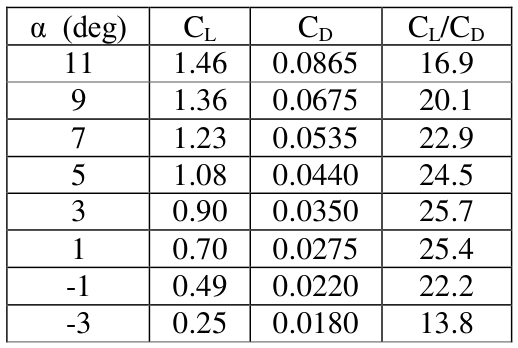
Official answer: 20.0 to 21.0
GATE AE 2016, Question 65 (2 marks, MCQ)
Flight Mechanics & Space Dynamics - Space Dynamics
A satellite is injected at an altitude of 350 km above the Earth's surface, with a velocity of 8.0 km/s parallel to the local horizon. (Earth radius = 6378 km, $\mu_E$ ($GM$ = Gravitational constant $\times$ Earth mass) = $3.986 \times 10^{14}$ m$^3$s$^{-2}$). The satellite
- forms a circular orbit.
- forms an elliptic orbit.
- escapes from Earth's gravitational field.
- falls back to earth.
Official answer: B
GATE AE 2014, Question 31 (1 mark, NAT)
Flight Mechanics & Space Dynamics - Static Stability & Control
The moment coefficient measured about the centre of gravity and about aerodynamic centre of a given wing-body combination are 0.0065 and -0.0235 respectively. The aerodynamic centre lies 0.06 chord lengths ahead of the centre of gravity. The lift coefficient for this wing-body is _____.
Official answer: 0.45 to 0.55
GATE AE 2014, Question 32 (1 mark, MCQ)
Flight Mechanics & Space Dynamics - Atmosphere & Flight Instruments
The vertical ground load factor on a stationary aircraft parked in its hangar is:
- 0
- -1
- Not defined
- 1
Official answer: D
GATE AE 2014, Question 33 (1 mark, MCQ)
Flight Mechanics & Space Dynamics - Airplane Performance
Under what condition should a glider be operated to ensure minimum sink rate?
- Maximum $C_L/C_D$
- Minimum $C_L/C_D$
- Maximum $C_D/C_L^{3/2}$
- Minimum $C_D/C_L^{3/2}$
Official answer: D
GATE AE 2014, Question 34 (1 mark, MCQ)
Flight Mechanics & Space Dynamics - Flight Dynamics
In most airplanes, the Dutch roll mode can be excited by applying
- a step input to the elevators
- a step input to the rudder
- a sinusoidal input to the aileron
- an impulse input to the elevators
Official answer: B
GATE AE 2014, Question 35 (1 mark, NAT)
Flight Mechanics & Space Dynamics - Space Dynamics
Considering $R$ as the radius of the moon, the ratio of the velocities of two spacecraft orbiting moon in circular orbit at altitudes $R$ and $2R$ above the surface of the moon is ________.
Official answer: 1.2 to 1.25
GATE AE 2014, Question 61 (2 marks, MCQ)
Flight Mechanics & Space Dynamics - Airplane Performance
For a given airplane with a given wing loading executing a turn in the vertical plane, under what conditions will the turn radius be minimum and the turn rate be maximum?
- Highest possible $C_L$ and lowest possible load factor
- Lowest possible $C_L$ and lowest possible load factor
- Lowest possible $C_L$ and highest possible load factor
- Highest possible $C_L$ and highest possible load factor
Official answer: D
GATE AE 2014, Question 62 (2 marks, NAT)
Flight Mechanics & Space Dynamics - Airplane Performance
Lift-off distance for a given aircraft of weight $W$ is $S_{LO}$. If the take-off weight is reduced by 10%, then the magnitude of percentage change in the lift-off distance (assume all other parameters to remain constant) is _______.
Official answer: 18 to 20
GATE AE 2014, Question 63 (2 marks, MCQ)
Flight Mechanics & Space Dynamics - Airplane Performance
Which of the following design parameters influence the maximum rate-of-climb for a jet-propelled airplane? P. Wing loading; Q. Maximum thrust-to-weight ratio; R. Zero-lift drag coefficient; S. Aspect ratio.
- P and Q alone
- P, Q, R and S
- P, Q and S alone
- Q, R, and S alone
Official answer: B
GATE AE 2014, Question 64 (2 marks, MCQ)
Flight Mechanics & Space Dynamics - Static Stability & Control
Consider the following four statements regarding aircraft longitudinal stability: P. $C_{M,cg}$ at zero lift must be positive. Q. $\partial C_{M,cg}/\partial\alpha_a$ must be negative ($\alpha_a$ is absolute angle of attack). R. $C_{M,cg}$ at zero lift must be negative. S. Slope of $C_L$ versus $\alpha_a$ must be negative. Which of the following combination is the necessary criterion for stick fixed longitudinal balance and static stability?
- Q and R only
- Q, R, and S only
- P and Q only
- Q and S only
Official answer: C
GATE AE 2014, Question 65 (2 marks, MCQ)
Flight Mechanics & Space Dynamics - Airplane Performance
Data for a light, single-engine, propeller driven aircraft in steady level flight at sea-level is as follows: velocity $V_\infty = 40$ m/s, weight $W = 13000$ N, lift coefficient $C_L = 0.65$, drag coefficient $C_D = 0.025 + 0.04C_L^2$ and power available $P_{av} = 100{,}000$ J/s. The rate of climb possible for this aircraft under the given conditions (in m/s) is
- 7.20
- 5.11
- 6.32
- 4.23
Official answer: B