GATE AE Aerodynamics: Previous Year Questions
Practice GATE Aerospace Engineering Aerodynamics previous year questions from 8 papers, topic by topic, with the official answer key where available.
All GATE AE papers
GATE AE 2026, Question 15 (1 mark, MCQ)
Aerodynamics - Potential Flow
In fluid dynamics, d'Alembert's paradox refers to which one of the following?
- Deviation of drag from $D \propto v^2$ at very low speeds
- Deviation of drag from $D \propto v^2$ at high subsonic speeds
- Prediction of zero drag by potential flow theory
- Presence of shocks in transonic flows
Official answer: C
GATE AE 2026, Question 19 (1 mark, MCQ)
Aerodynamics - Potential Flow
The velocity potential function ($\varphi$) given below represents which one of the following? $$\varphi = 5x - 12y$$
- Doublet
- Irrotational vortex
- Source
- Uniform flow
Official answer: D
GATE AE 2026, Question 20 (1 mark, MCQ)
Aerodynamics - Airfoils & Wings
The fundamental purpose of the Kutta condition in the thin airfoil theory is ________.
- to determine the total strength of the source distribution
- to determine the speed of the uniform flow
- to incorporate the essential effect of viscosity in the potential flow theory
- to incorporate the concept of induced drag in the inviscid theory
Official answer: C
GATE AE 2026, Question 21 (1 mark, MCQ)
Aerodynamics - Compressible Flows
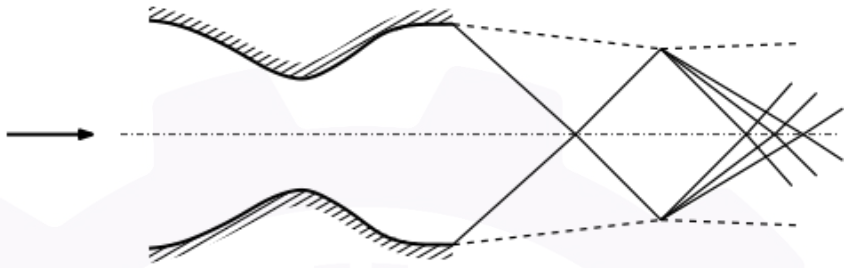
In the figure shown below, the flow at the nozzle exit is ________.
- overexpanded
- underexpanded
- ideally expanded
- subsonic
Official answer: A
GATE AE 2026, Question 25 (1 mark, MSQ)
Aerodynamics - Airfoils & Wings
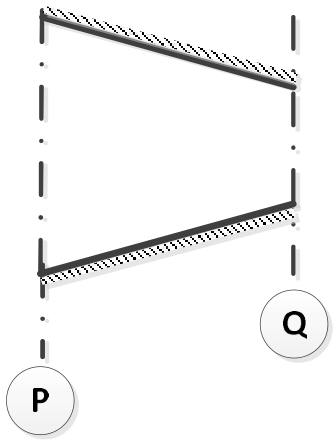
Shown below are qualitative illustrations of the lift curve for an airfoil when two different control surfaces are in their respective retracted and deployed configurations. Which of the following is/are TRUE?
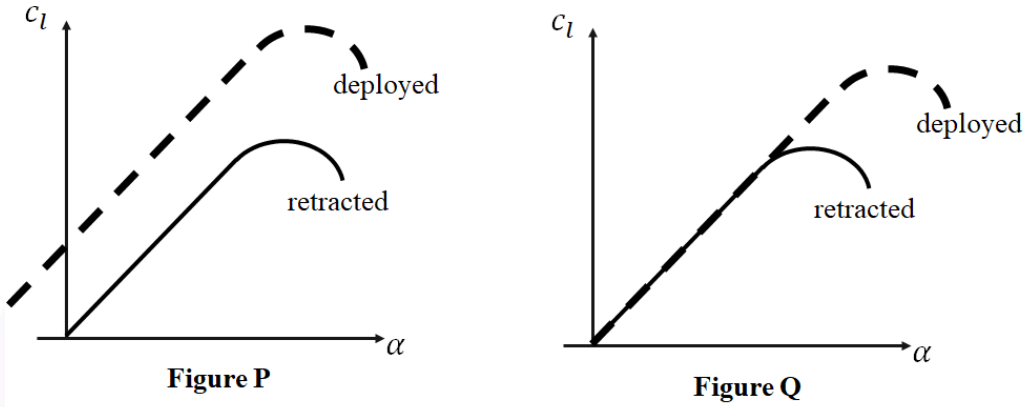
- Figure P is for a flap
- Figure P is for a slat
- Figure Q is for a slat
- Figure Q is for a flap
Official answer: A, C
GATE AE 2026, Question 29 (1 mark, MSQ)
Aerodynamics - Compressible Flows
Which of the following statements is/are TRUE regarding critical and drag divergence Mach numbers of a wing?
- Critical Mach number is the minimum freestream Mach number for which sonic condition is attained somewhere over the wing
- Drag divergence Mach number is always higher than the critical Mach number
- Drag divergence Mach number is the local Mach number over the wing at which the drag increases drastically
- Critical Mach number is independent of the angle of attack
Official answer: A, B
GATE AE 2026, Question 30 (1 mark, MSQ)
Aerodynamics - Compressible Flows
A flow is steady, inviscid and one-dimensional, with no shaft work or body forces. Which of the following is/are possible under the given conditions?
- Oblique shocks
- Sound propagation
- Rayleigh flow
- Fanno flow
Official answer: B, C
GATE AE 2026, Question 34 (1 mark, NAT)
Aerodynamics - Basic Fluid Mechanics
The vortex shedding frequency behind a landing gear model is found to be 50 Hz when tested in a wind tunnel operating at 5 m/s. If the actual landing gear size is 10 times that of the model, and it is designed to operate at 50 m/s, then the expected vortex shedding frequency behind it is ________ Hz (rounded off to the nearest integer).
Official answer: 50
GATE AE 2026, Question 35 (1 mark, NAT)
Aerodynamics - Airfoils & Wings
An elliptic wing has a span of 6 m and a planform area of 6 m$^2$. When generating a lift coefficient of 0.6, the induced drag it incurs is ________ $\times 10^{-3}$ (rounded off to 1 decimal place).
GATE AE 2026, Question 43 (2 marks, MCQ)
Aerodynamics - Basic Fluid Mechanics
An experimental study is planned to map out the low-Reynolds number incompressible steady two-dimensional aerodynamic characteristics of a promising novel airfoil. The operational parameters of the problem are the speed, density and viscosity of the freestream, the chord of the airfoil and its angle of attack. If the objective is to achieve this with the minimum number of test runs $N_{min}$ while taking 10 equally-spaced test values of each independent parameter of the problem in a suitable range, then $N_{min}$ is ________.
- 10
- 100
- 10,000
- 1,00,000
Official answer: B
GATE AE 2026, Question 47 (2 marks, MSQ)
Aerodynamics - Potential Flow
Consider the flow over an oval modeled using the elementary potential flows as shown below. $U$ represents uniform flow velocity and $\Gamma$ represents circulation around an irrotational line vortex. Which of the following statements is/are TRUE for this model?
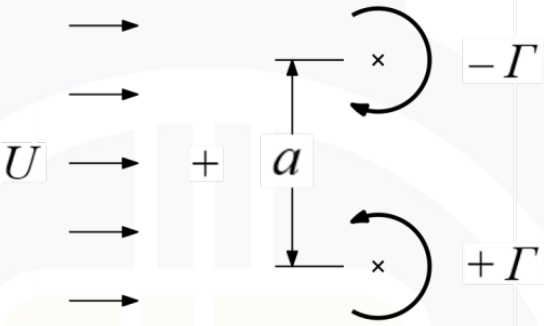
- Increasing $U$ enlarges the oval
- Increasing $\Gamma$ enlarges the oval
- Interchanging the sense of the two vortices does not alter the oval
- Moving the vortices too far apart causes the oval to break up
Official answer: B, D
GATE AE 2026, Question 48 (2 marks, MSQ)
Aerodynamics - Airfoils & Wings
What is/are the use(s) of the single horseshoe vortex model of finite wing aerodynamic theory?
- It can approximate the wing pitching moment coefficient
- It can approximate the wing induced drag coefficient
- It can approximate the effect of the wing on the induced drag coefficient of a typical horizontal tail
- It can approximate the aerodynamic benefit/penalty of formation flight compared to isolated flight
Official answer: C, D
GATE AE 2026, Question 54 (2 marks, NAT)
Aerodynamics - Airfoils & Wings
For an airfoil section the pitching moment coefficient is determined about a reference point that is 0.3 times the chord behind the leading edge. It varies with the lift coefficient as shown in the table below. The distance of the aerodynamic center from the leading edge of the airfoil as a fraction of the chord is ________ (rounded off to one decimal place). $$\begin{array}{|c|c|c|c|c|}\hline c_l & 0.2 & 0.4 & 0.6 & 0.8 \\ \hline c_m & -0.02 & 0 & 0.02 & 0.04 \\ \hline\end{array}$$
Official answer: 0.2
GATE AE 2026, Question 56 (2 marks, NAT)
Aerodynamics - Airfoils & Wings
Consider a finite wing of aspect ratio 10 with span effectiveness factor 0.95. Its airfoil section has a lift slope of 0.106 per degree and a zero-lift angle of attack of –1.5°. The lift coefficient of the wing at an angle of attack of 3.5° is ________ (rounded off to 2 decimal places).
Official answer: 0.43 to 0.45
GATE AE 2026, Question 63 (2 marks, NAT)
Aerodynamics - Airfoils & Wings
Thin airfoil theory predicts the zero-lift angle of attack $\alpha_{L=0}$ of NACA 2412 airfoil as $-2.1^\circ$. The corresponding prediction of $\alpha_{L=0}$ for NACA 5410 airfoil is ________ degrees (rounded off to 1 decimal place).
Official answer: -5.5 to -5.0
GATE AE 2026, Question 64 (2 marks, NAT)
Aerodynamics - Compressible Flows
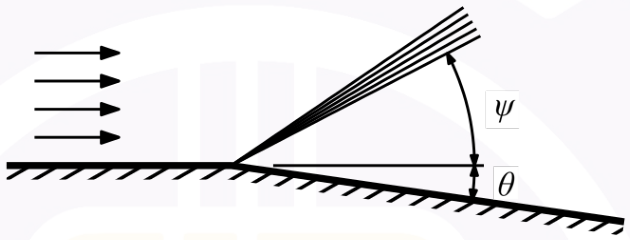
Consider a centered Prandtl-Meyer expansion fan at a $\theta = 4^\circ$ corner in a Mach 1.78 air flow, as shown in the figure below. The angle $\psi$ (see figure) made by the ending wave of the fan with respect to the incoming stream is ________ degrees (rounded off to 1 decimal place). An excerpt from the table of Prandtl-Meyer function for air is provided below. $$\begin{array}{|c|c||c|c||c|c|}\hline M & \nu\,[\deg] & M & \nu\,[\deg] & M & \nu\,[\deg] \\ \hline 1.72 & 18.40 & 1.82 & 21.30 & 1.92 & 24.15 \\ 1.74 & 18.98 & 1.84 & 21.88 & 1.94 & 24.71 \\ 1.76 & 19.56 & 1.86 & 22.45 & 1.96 & 25.27 \\ 1.78 & 20.15 & 1.88 & 23.02 & 1.98 & 25.83 \\ 1.80 & 20.73 & 1.90 & 23.59 & 2.00 & 26.38 \\ \hline\end{array}$$
Official answer: 27.2 to 27.6
GATE AE 2026, Question 65 (2 marks, NAT)
Aerodynamics - Compressible Flows
A Mach 1.5 air flow enters a round duct of length 20 cm and diameter 3 cm. If the flow exits with Mach number 1.1, the average Fanning friction factor $f$ of the duct is ________ $\times 10^{-3}$ (rounded off to 1 decimal place). An excerpt from the Fanno flow table for air is given below. $$\begin{array}{|c|c|c|c|c|c|c|}\hline M & 1.1 & 1.2 & 1.3 & 1.4 & 1.5 & 1.6 \\ \hline \dfrac{4fL^*}{D}\times 10^4 & 99.35 & 336.4 & 648.3 & 997.4 & 1361 & 1724 \\ \hline\end{array}$$
Official answer: 4.5 to 5.0
GATE AE 2025, Question 17 (1 mark, MCQ)
Aerodynamics - Viscous Flows & Boundary Layers
For a two-dimensional incompressible flow over a flat plate, the laminar boundary layer thickness at a distance $x$ from the leading edge is $\delta$. If $Re_x$ is the Reynolds number defined based on length scale $x$, $\left(\dfrac{\delta}{x}\right)$ is proportional to ______.
- $Re_x^{-1/2}$
- $Re_x^{-1}$
- $Re_x^{-3/2}$
- $Re_x^{-2}$
Official answer: A
GATE AE 2025, Question 18 (1 mark, MCQ)
Aerodynamics - Airfoils & Wings
For a NACA 4415 airfoil, the location of maximum camber, as a fraction of the chord length from the leading edge, is ______.
- 0.44
- 0.40
- 0.15
- 0.04
Official answer: B
GATE AE 2025, Question 19 (1 mark, MCQ)
Aerodynamics - Airfoils & Wings
A positively cambered airfoil is placed in a uniform flow (velocity, $U_\infty$) at its zero-lift angle of attack. M is the corresponding pitching moment. Which one of the following representations accurately describes this scenario?
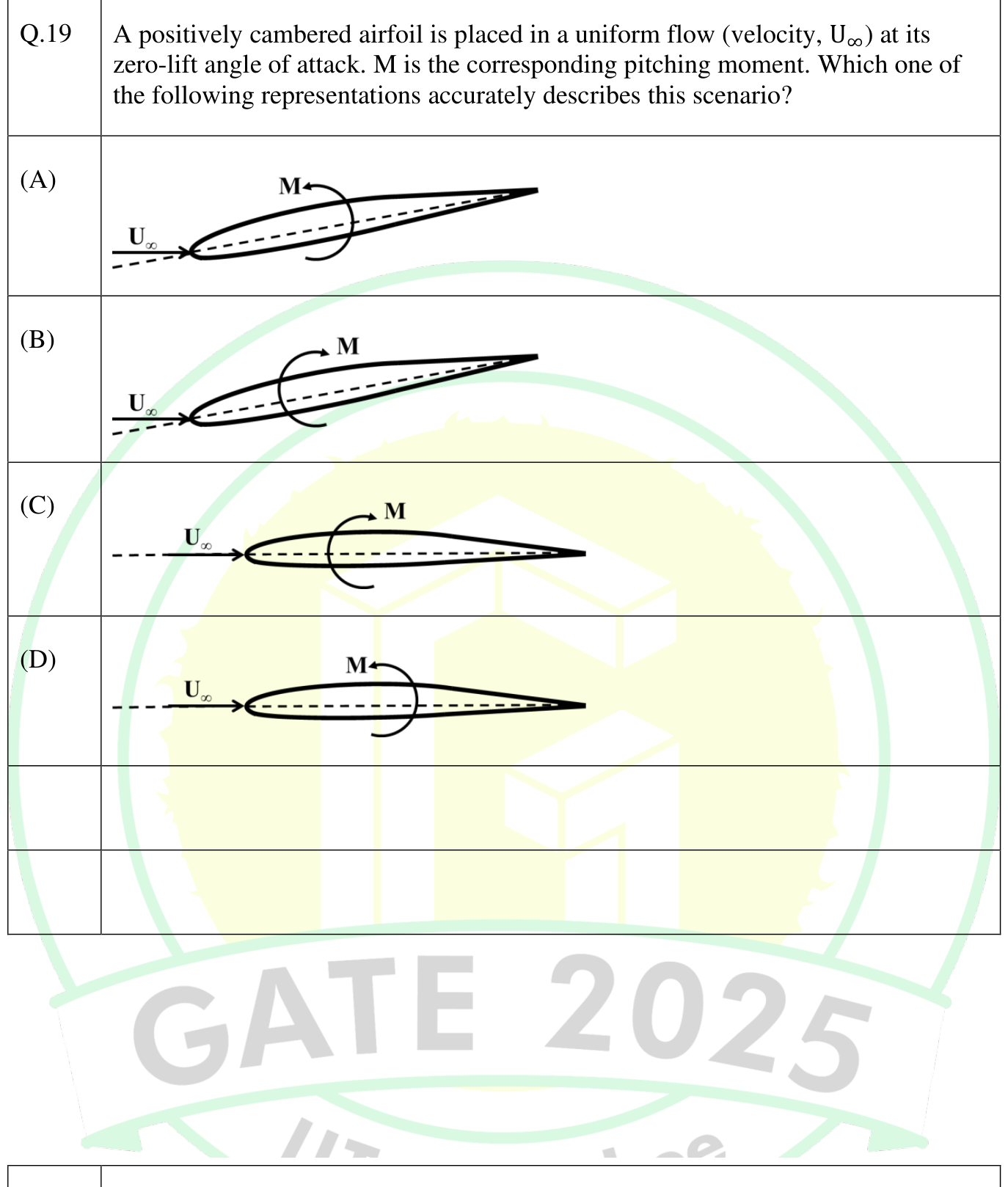
Official answer: A
GATE AE 2025, Question 20 (1 mark, MCQ)
Aerodynamics - Potential Flow
Consider a pair of point vortices with clockwise circulation $\Gamma$ each. The distance between their centers is $a$, as shown in the figure. Assume two-dimensional, incompressible, inviscid flow. Which one of the following options is correct?
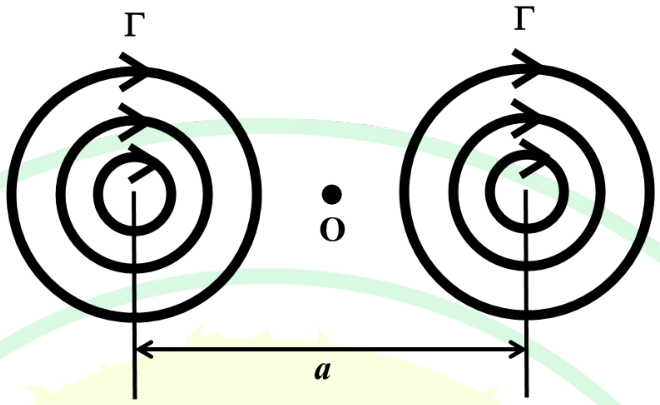
- The vortices translate downwards together with a velocity $\dfrac{\Gamma}{2\pi a}$.
- The vortices translate upwards together with a velocity $\dfrac{\Gamma}{2\pi a}$.
- The vortices rotate clockwise around each other about their centroid O.
- The vortices rotate counter-clockwise around each other about their centroid O.
Official answer: C
GATE AE 2025, Question 21 (1 mark, MCQ)
Aerodynamics - Basic Fluid Mechanics
In a fluid flow, Mach number is an estimate of _____.
- $\sqrt{\dfrac{\text{inertia force}}{\text{viscous force}}}$
- $\sqrt{\dfrac{\text{inertia force}}{\text{elastic force}}}$
- $\sqrt{\dfrac{\text{elastic force}}{\text{viscous force}}}$
- $\sqrt{\dfrac{\text{viscous force}}{\text{inertia force}}}$
Official answer: B
GATE AE 2025, Question 34 (1 mark, NAT)
Aerodynamics - Potential Flow
The lift per unit span for a spinning circular cylinder in a potential flow is 6 N/m. The free-stream velocity is 30 m/s, and the density of air is 1.225 kg/m$^3$. The circulation around the cylinder is ____ m$^2$/s (rounded off to two decimal places).
Official answer: 0.16 to 0.17
GATE AE 2025, Question 36 (2 marks, MCQ)
Aerodynamics - Airfoils & Wings
A lifting surface has a spanwise circulation distribution of $\Gamma(\theta) = A\sin 3\theta$ (where $A \neq 0$) over its span $-\frac{b}{2} \leq y \leq \frac{b}{2}$, and $y = -\frac{b}{2}\cos\theta$ is the spanwise coordinate. Furthermore, the downwash varies along the span as $w(\theta) = V_\infty\left(\frac{3A\sin 3\theta}{\sin\theta}\right)$, where $V_\infty$ is the freestream velocity. Which one of the following options represents the total lift ($L$) and induced drag ($D_i$)?
- $L = 0$ and $D_i = 0$
- $L = 0$ and $D_i \neq 0$
- $L \neq 0$ and $D_i = 0$
- $L \neq 0$ and $D_i \neq 0$
Official answer: B
GATE AE 2025, Question 46 (2 marks, NAT)
Aerodynamics - Compressible Flows
An aircraft is flying at an altitude of 4500 m above sea level, where the ambient pressure, temperature and density are 57 kPa, 259 K and 0.777 kg/m$^3$, respectively. The speed of the aircraft ($V$) is 230 m/s. Gas constant R = 287 J/kg/K, and specific heat ratio $\gamma = 1.4$. If the stagnation pressure is $p_o$, and static pressure is $p$, the value of $\left[\dfrac{p_o - p}{\frac{1}{2}\rho V^2}\right]$ is ________ (rounded off to two decimal places).
Official answer: 1.08 to 1.14
GATE AE 2025, Question 47 (2 marks, NAT)
Aerodynamics - Basic Fluid Mechanics
A rectangular wing of 1.2 m chord length and aspect ratio 5 is tested in a wind tunnel at an air speed of 60 m/s. The density and the dynamic viscosity of air are 1.3 kg/m$^3$ and $1.8 \times 10^{-5}$ kg/m-s, respectively. A second rectangular wing of the same span, but with an aspect ratio of 6, is to be tested in the same tunnel at the same Reynolds number. The air speed at which the second test should be performed is _______ m/s (answer in integer).
Official answer: 72
GATE AE 2025, Question 48 (2 marks, NAT)
Aerodynamics - Basic Fluid Mechanics
In a low-speed airplane, a venturimeter with 1.3:1 area ratio is used for airspeed measurement. The airplane's maximum speed at sea level is 90 m/s. If the density of air at sea level is 1.225 kg/m$^3$, the maximum pressure difference between the inlet and the throat of the venturimeter is ________ kPa (rounded off to two decimal places).
Official answer: 3.20 to 3.45
GATE AE 2025, Question 49 (2 marks, NAT)
Aerodynamics - Compressible Flows
A supersonic stream of an ideal gas at Mach number $M_1 = 5$ is turned by a ramp, as shown in the figure. The ramp angle is $20^\circ$. The pressure ratio is $\dfrac{p_2}{p_1} = 7.125$ and the specific heat ratio is $\gamma = 1.4$. The pressure coefficient on the ramp surface is ________ (rounded off to two decimal places).
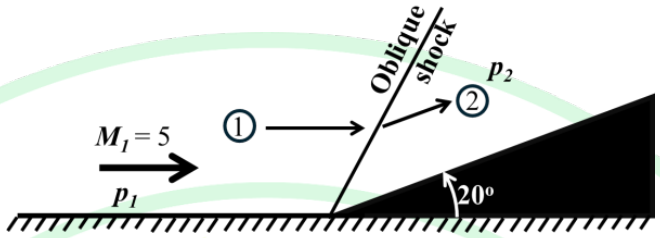
Official answer: 0.31 to 0.37
GATE AE 2025, Question 50 (2 marks, NAT)
Aerodynamics - Compressible Flows
A perfect gas flows through a frictionless constant-area duct with heat addition. The inlet conditions are as follows: pressure 100 kPa, density 1 kg/m$^3$, and velocity 100 m/s. At a particular downstream location, the gas velocity is 200 m/s. The static pressure at the downstream location is ______ kPa (answer in integer).
Official answer: 90
GATE AE 2025, Question 51 (2 marks, NAT)
Aerodynamics - Compressible Flows
The mass flow rate in a supersonic wind tunnel is 2 kg/s when the stagnation pressure and stagnation temperature are 1 MPa and 800 K, respectively. If the stagnation pressure and stagnation temperature are changed to 3 MPa and 200 K, the mass flow rate in the tunnel changes to _______ kg/s (answer in integer).
Official answer: 12
GATE AE 2024, Question 21 (1 mark, MCQ)
Aerodynamics - Potential Flow
In the context of steady, inviscid, incompressible flows, consider the superposition of a uniform flow with speed $U$ along the positive $x$-axis (from left to right), and a source of strength $\Lambda$ located at the origin. Which one of the following statements is **NOT** true regarding the location of the stagnation point of the resulting flow?
- It is located to the left of the origin
- It moves closer to the origin for increasing $\Lambda$, while $U$ is held constant
- It moves closer to the origin for increasing $U$, while $\Lambda$ is held constant
- It is located along the $x$-axis
Official answer: B
GATE AE 2024, Question 22 (1 mark, MCQ)
Aerodynamics - Compressible Flows
On Day 1, an aircraft flies with a speed of $V_1$ m/s at an altitude where the temperature is $T_1$ K. On Day 2, the same aircraft flies with a speed of $\sqrt{1.2}\,V_1$ m/s at an altitude where the temperature is $1.2\,T_1$ K. How does the Mach number $M_2$ on Day 2 compare with the Mach number $M_1$ on Day 1? Assume ideal gas behavior for air. Also assume the ratio of specific heats and molecular weight of air to be the same on both the days.
- $M_2 = 0.6\,M_1$
- $M_2 = M_1$
- $M_2 = \dfrac{1}{\sqrt{1.2}}M_1$
- $M_2 = \sqrt{1.2}\,M_1$
Official answer: B
GATE AE 2024, Question 23 (1 mark, MCQ)
Aerodynamics - Compressible Flows
Consider a steady, isentropic, supersonic flow (Mach number $M > 1$) entering a Convergent-Divergent (CD) duct as shown in the figure. Which one of the options correctly describes the flow at the throat?
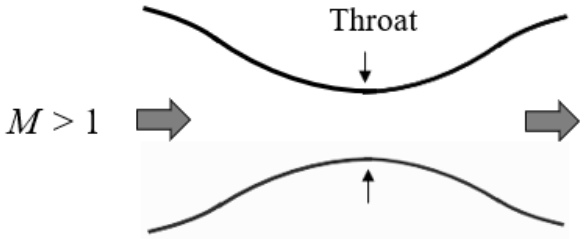
- Can only be supersonic
- Can only be sonic
- Can either be sonic or supersonic
- Can only be subsonic
Official answer: C
GATE AE 2024, Question 24 (1 mark, MCQ)
Aerodynamics - Airfoils & Wings
Consider steady, incompressible, inviscid flow past two airfoils shown in the figure. The coefficient of pressure at the trailing edge of the airfoil with finite angle, shown in figure (I), is $C_{P_I}$ while that at the trailing edge of the airfoil with cusp, shown in figure (II), is $C_{P_{II}}$. Which one of the following options is TRUE?

- $C_{P_I} < 1,\ C_{P_{II}} < 1$
- $C_{P_I} = 1,\ C_{P_{II}} = 1$
- $C_{P_I} = 1,\ C_{P_{II}} < 1$
- $C_{P_I} < 1,\ C_{P_{II}} = 1$
Official answer: C
GATE AE 2024, Question 35 (1 mark, NAT)
Aerodynamics - Airfoils & Wings
Using thin airfoil theory, the lift coefficient of a NACA 0012 airfoil placed at $5^\circ$ angle of attack in a uniform flow is _____________ (rounded off to 2 decimal places).
Official answer: 0.54 to 0.56
GATE AE 2024, Question 42 (2 marks, MCQ)
Aerodynamics - Viscous Flows & Boundary Layers
Consider a flat plate, with a sharp leading edge, placed in a uniform flow of speed $U$. The direction of the free-stream flow is aligned with the plate. Assume that the flow is steady, incompressible and laminar. The thickness of the boundary layer at a fixed stream-wise location $L$ from the leading edge of the plate is $\delta$. Which one of the following correctly describes the variation of $\delta$ with $U$?
- $\delta \propto U$
- $\delta \propto U^{3/2}$
- $\delta \propto U^{1/2}$
- $\delta \propto U^{-1/2}$
Official answer: D
GATE AE 2024, Question 43 (2 marks, MCQ)
Aerodynamics - Compressible Flows
Shock structures for flow at three different Mach numbers over a given wedge are shown in the figure. Assuming that only the weak shock solutions are possible for the attached oblique shocks, which one of the following options is TRUE?
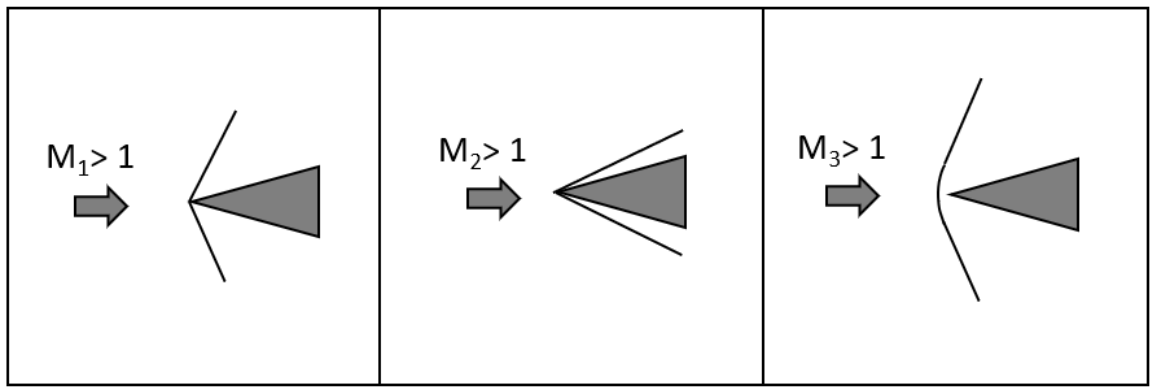
- $M_1 < M_2 < M_3$
- $M_1 > M_2 > M_3$
- $M_1 < M_3 < M_2$
- $M_3 < M_1 < M_2$
Official answer: D
GATE AE 2024, Question 44 (2 marks, MCQ)
Aerodynamics - Compressible Flows
Air flowing at Mach number $M = 2$ from left to right accelerates to $M = 3$ across an expansion corner as shown in the figure. What is the value of $\delta$ (the angle between the Forward and Rearward Mach lines) in degrees? The values of the Prandtl-Meyer functions are $\nu(3) = 49.76^\circ$ and $\nu(2) = 26.38^\circ$.
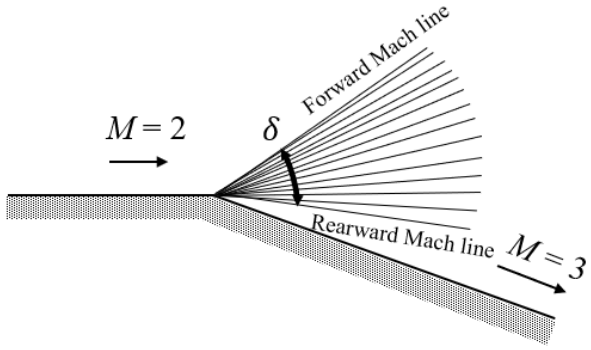
- 23.38
- 19.47
- 53.38
- 33.91
Official answer: D
GATE AE 2024, Question 59 (2 marks, NAT)
Aerodynamics - Compressible Flows
Consider the following Fanno flow problem: Flow enters a constant area duct at a temperature of 273 K and a Mach number 0.2 and eventually reaches sonic condition (Mach number $= 1$) due to friction. Assume $\gamma = 1.4$. The static temperature at the location where sonic condition is reached is _____________ K (rounded off to 2 decimal places).
Official answer: 227.0 to 231.0
GATE AE 2024, Question 63 (2 marks, NAT)
Aerodynamics - Basic Fluid Mechanics
The figure (not to scale) shows a control volume to estimate the forces on the airfoil with elliptic cross-section. Surfaces 2 and 3 are streamlines. Velocity profiles are measured at the upstream end (surface 1) and at the downstream end (surface 4) of the control volume. The drag coefficient for the airfoil is defined as $C_d = \dfrac{D}{\frac{1}{2}\rho U_\infty^2 c}$, where $D$ is the drag force on the airfoil per unit span and $\rho$ is the density of the air. The static pressure, $p_\infty$, is constant over the entire surface of the control volume. Assuming the flow to be incompressible, two-dimensional and steady, the $C_d$ for the airfoil is _________ (rounded off to 3 decimal places).
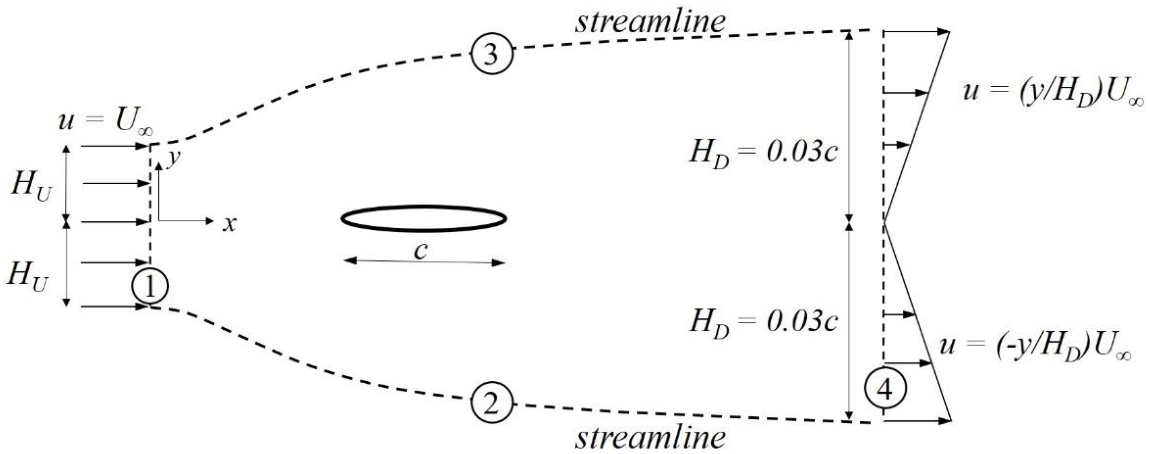
Official answer: 0.018 to 0.022
GATE AE 2024, Question 64 (2 marks, NAT)
Aerodynamics - Airfoils & Wings
An airplane of mass 1000 kg is in a steady level flight with a speed of 50 m/s. The wing has an elliptic planform with a span of 20 m and planform area 31.4 m$^2$. Assuming the density of air at that altitude to be 1 kg/m$^3$ and acceleration due to gravity to be 10 m/s$^2$, the induced drag on the wing is _________ N (rounded off to 1 decimal place).
Official answer: 62.0 to 66.0
GATE AE 2024, Question 65 (2 marks, NAT)
Aerodynamics - Basic Fluid Mechanics
It is desired to estimate the aerodynamic drag, $D$, on a car traveling at a speed of 30 m/s. A one-third scale model of the car is tested in a wind-tunnel following the principles of dynamic similarity. The drag on the scaled model is measured to be $D_m$. The ratio $D/D_m$ is _________ (rounded off to 1 decimal place).
Official answer: 1
GATE AE 2023, Question 14 (1 mark, MCQ)
Aerodynamics - Airfoils & Wings
A two-dimensional potential flow solution for flow past an airfoil has a streamline pattern as shown in the figure. Which of the following conditions is additionally required to satisfy the Kutta condition?
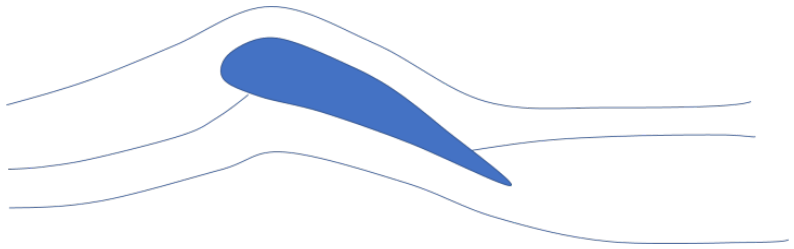
- Addition of a source of strength $Q > 0$
- Addition of a source of strength $Q < 0$
- Addition of a circulation of strength $\Gamma > 0$ (counter-clockwise)
- Addition of a circulation of strength $\Gamma < 0$ (clockwise)
Official answer: D
GATE AE 2023, Question 15 (1 mark, MCQ)
Aerodynamics - Viscous Flows & Boundary Layers
Consider the Blasius solution for the incompressible laminar flat plate boundary layer. Among the following options, select the correct relation for the development of the momentum thickness $\theta$ with distance $x$ from the leading edge along the length of the plate.
- $\theta \propto x^{2/3}$
- $\theta \propto x^{1/2}$
- $\theta \propto x^{1/7}$
- $\theta \propto x^{-2/3}$
Official answer: B
GATE AE 2023, Question 16 (1 mark, MCQ)
Aerodynamics - Potential Flow
In a two-dimensional potential flow, the doublet is a limit of the superposition of
- a uniform stream and a source
- a source and a sink of equal strength
- a uniform stream and a sink
- a source and a vortex
Official answer: B
GATE AE 2023, Question 18 (1 mark, MCQ)
Aerodynamics - Airfoils & Wings
The figures shown in the options are schematics of airfoil shapes (not to scale). For a civilian transport aircraft designed for a cruise Mach number of 0.8, which among them is aerodynamically best suited as a wing section?
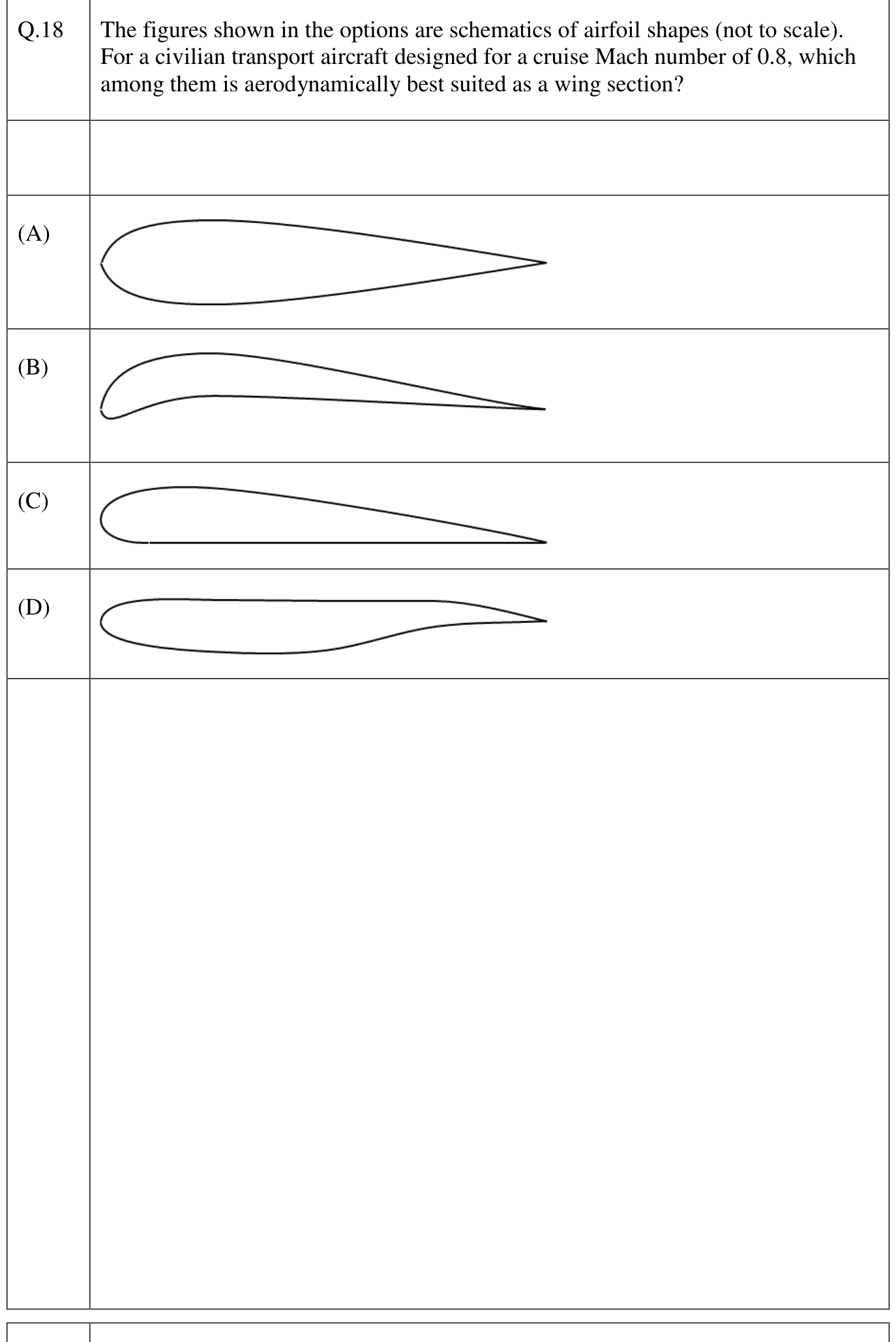
Official answer: D
GATE AE 2023, Question 33 (1 mark, NAT)
Aerodynamics - Compressible Flows
The ratio of the speed of sound in H$_2$ (molecular weight 2 kg/kmol) to that in N$_2$ (molecular weight 28 kg/kmol) at temperature 300 K and pressure 2 bar is ____. (round off to two decimal places)
Official answer: 3.5 to 4.0
GATE AE 2023, Question 37 (2 marks, MCQ)
Aerodynamics - Compressible Flows
A supersonic aircraft has an air intake ramp that can be rotated about the leading edge $\mathbf{O}$ such that the shock from the leading edge meets the cowl lip as shown in the figure. Select all the correct statement(s) as per oblique shock theory when the flight Mach number $M$ is increased.
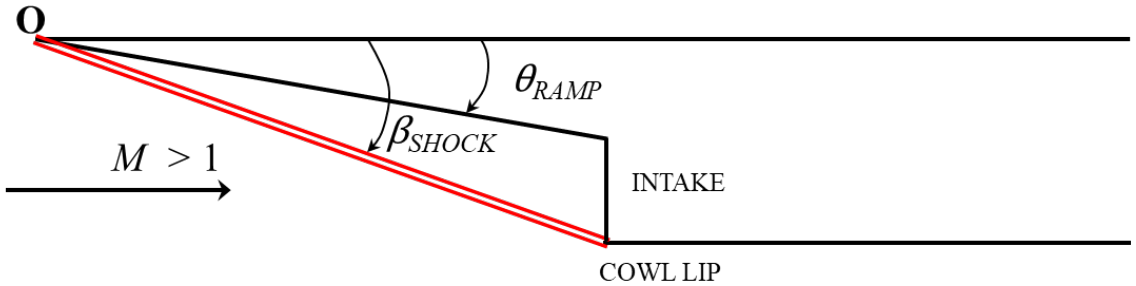
- It is always possible to find a ramp setting $\theta_{RAMP}$ such that the shock still meets the cowl lip ($\beta_{SHOCK}$ remains the same).
- If $\theta_{RAMP}$ is held fixed, the shock angle $\beta_{SHOCK}$ will increase.
- If $M$ exceeds a critical value, it would NOT be possible to find a ramp setting $\theta_{RAMP}$ such that the shock still meets the cowl lip ($\beta_{SHOCK}$ remains the same).
- Shock angle $\beta_{SHOCK} < \sin^{-1}\left(\dfrac{1}{M}\right)$
Official answer: A
GATE AE 2023, Question 39 (2 marks, MCQ)
Aerodynamics - Compressible Flows
A perfect gas stored in a large reservoir exhausts into the atmosphere through a convergent duct. The reservoir pressure is $P_0$ and temperature is $T_0$. The jet emerges from the nozzle with average velocity $u$, Mach number $M$, pressure $p$, temperature $T$, and density $\rho$. If the reservoir pressure is increased, then
- $u$, $M$, $p$, $T$, and $\rho$ increase
- $u$, $p$, $T$, and $\rho$ increase, but $M$ remains the same
- $u$, $M$, and $T$ remain the same, but $p$ and $\rho$ increase
- $u$, $M$, $T$ and $\rho$ remain the same, but $p$ increases
Official answer: C
GATE AE 2023, Question 44 (2 marks, MSQ)
Aerodynamics - Compressible Flows
Consider a one-dimensional inviscid supersonic flow in a diverging duct with heat addition ($Q_{in}$) as shown. Which of the following statement(s) is/are always TRUE?
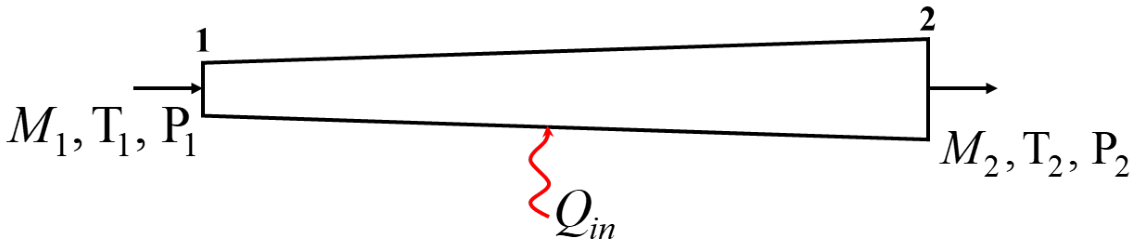
- Mach number, $M_2 > M_1$
- Stagnation pressure, $P_1^o > P_2^o$
- Static pressure, $P_2 > P_1$
- Stagnation temperature, $T_1^o < T_2^o$
Official answer: B, D
GATE AE 2023, Question 46 (2 marks, MSQ)
Aerodynamics - Airfoils & Wings
For an airfoil, which of the relations given about the critical Mach number $M_{cr}$ and drag divergence Mach number $M_{dd}$ is/are correct?
- $M_{cr} < M_{dd}$
- $M_{cr} < 1.0$
- $M_{dd} < 1.0$
- $M_{cr} > 1.0$
Official answer: A, B, C
GATE AE 2023, Question 56 (2 marks, NAT)
Aerodynamics - Airfoils & Wings
A thin cambered airfoil has lift coefficient $c_l = 0$ at an angle of attack $\alpha = -1.1^\circ$. Assuming that stall occurs at much larger $\alpha$, the $c_l$ at $\alpha = 4^\circ$ is _______. (round off to two decimal places)
Official answer: 0.55 to 0.57
GATE AE 2023, Question 57 (2 marks, NAT)
Aerodynamics - Potential Flow
In a potential flow, a uniform stream of strength $U$ directed along the $x$-axis and four line sources (2-dimensional) of strengths $\dfrac{\pi}{2}, \dfrac{-\pi}{3}, \dfrac{\pi}{4}, \dfrac{-\pi}{5}$ are placed along the $x$-axis at $x = 0, 1, 2$ and $3$, respectively. The strength of an additional line source to be placed at $x = 4$ such that a closed streamline encircles all five sources is _____. (round off to two decimal places).
Official answer: -0.69 to -0.67
GATE AE 2023, Question 58 (2 marks, NAT)
Aerodynamics - Basic Fluid Mechanics
Enstrophy is defined as the square of the magnitude of vorticity. For the three-dimensional velocity field $$\vec{V} = (4x - 1.5y + 2.5z)\hat{i} + (1.5x - 1.5y)\hat{j} + (0.7xy)\hat{k},$$ the enstrophy at location (1, 1, 1) is ________. (round off to two decimal places)
Official answer: 12.61 to 12.81
GATE AE 2022, Question 14 (1 mark, MCQ)
Aerodynamics - Compressible Flows
The point of maximum entropy on a Fanno-curve in a Temperature-Entropy (T-s) diagram represents the
- maximum flow Mach number
- minimum flow Mach number
- sonic Mach number
- normal shock in the flow
Official answer: C
GATE AE 2022, Question 15 (1 mark, MCQ)
Aerodynamics - Potential Flow
Consider a two-dimensional potential flow over a cylinder. If the freestream speed is $U_\infty$, the maximum speed on the cylinder surface is
- $\dfrac{U_\infty}{2}$
- $\dfrac{3U_\infty}{2}$
- $2U_\infty$
- $\dfrac{4U_\infty}{3}$
Official answer: C
GATE AE 2022, Question 16 (1 mark, MCQ)
Aerodynamics - Basic Fluid Mechanics
Consider steady, two-dimensional, incompressible flow over a non-porous flat plate as shown in the figure. For the control volume PQRS, the speed, $u_\infty$, at section PQ is uniform and the speed at section RS is given by $u(y) = A_0\left(\dfrac{y}{h}\right)^n$, where $n$ is a positive integer. The value of $A_0$ for which the flow through section PS will vanish is:

- $\dfrac{u_\infty}{n+1}$
- $u_\infty(n+1)$
- $\dfrac{u_\infty}{n-1}$
- $u_\infty(n-1)$
Official answer: B
GATE AE 2022, Question 17 (1 mark, MCQ)
Aerodynamics - Viscous Flows & Boundary Layers
Consider the velocity distribution, $u(y)$ shown in the figure. For two adjacent fluid layers L1 and L2, the viscous force exerted by L1 on L2 is
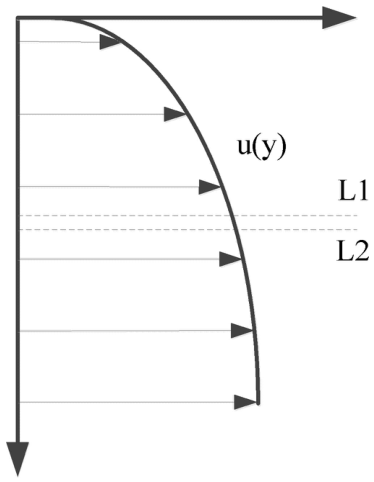
- to the right
- to the left
- vertically upwards
- vertically downwards
Official answer: B
GATE AE 2022, Question 25 (1 mark, MSQ)
Aerodynamics - Compressible Flows
Across an oblique shock wave in a calorifically perfect gas,
- the stagnation enthalpy changes
- the stagnation entropy changes
- the stagnation temperature changes
- the speed of sound changes
Official answer: B, D
GATE AE 2022, Question 26 (1 mark, MSQ)
Aerodynamics - Airfoils & Wings
NACA 2412 airfoil has
- 4% maximum camber with respect to chord
- maximum camber at 40% chord
- 12% maximum thickness to chord ratio
- maximum camber at 20% chord
Official answer: B, C
GATE AE 2022, Question 39 (2 marks, MCQ)
Aerodynamics - Basic Fluid Mechanics
A cylindrical object of diameter 900 mm is designed to move axially in air at 60 m/s. Its drag is estimated on a geometrically half-scaled model in water, assuming flow similarity. Coefficients of dynamic viscosity and densities for air and water are $1.86 \times 10^{-5}$ Pa-s, 1.2 kg/m$^3$ and $1.01 \times 10^{-3}$ Pa-s, 1000 kg/m$^3$ respectively. Drag measured for the model is 2280 N. Drag experienced by the full-scale object is ____ N (rounded off to the nearest integer).
- 322
- 644
- 1288
- 2576
Official answer: B
GATE AE 2022, Question 40 (2 marks, MCQ)
Aerodynamics - Airfoils & Wings
Consider a conventional subsonic fixed-wing airplane. $e$ is the Oswald efficiency factor and $AR$ is the aspect ratio. Corresponding to the minimum $\left(\dfrac{C_D}{C_L^{3/2}}\right)$, which of the following relations is true?
- $\dfrac{C_D}{C_L^2} = \dfrac{1}{\pi e AR}$
- $\dfrac{C_D}{C_L^2} = \dfrac{4}{3\pi e AR}$
- $\dfrac{C_D}{C_L} = \dfrac{1}{\pi e AR}$
- $\dfrac{C_D}{\sqrt{C_L}} = \dfrac{1}{\sqrt{\pi e AR}}$
Official answer: B
GATE AE 2022, Question 44 (2 marks, MSQ)
Aerodynamics - Compressible Flows
A convergent nozzle fed from a constant pressure, constant temperature reservoir, is discharging air to atmosphere at 1 bar (absolute) with choked flow at the exit (marked as $Q$). Flow through the nozzle can be assumed to be isentropic. If the exit area of the nozzle is increased while all the reservoir parameters and ambient conditions remain the same, then at steady state
- the nozzle will remain choked
- the nozzle will be un-choked
- the Mach number at section P will increase
- the Mach number at section P will decrease
Official answer: A, C
GATE AE 2022, Question 50 (2 marks, NAT)
Aerodynamics - Basic Fluid Mechanics
A rotational velocity field in an air flow is given as $\vec{V} = ay\hat{i} + bx\hat{j}$, with $a = 10\ \text{s}^{-1}$, $b = 20\ \text{s}^{-1}$. The air density is 1.0 kg/m$^3$ and the pressure at $(x,y) = (0\ \text{m}, 0\ \text{m})$ is 100 kPa. Neglecting gravity, the pressure at $(x,y) = (6\ \text{m}, 8\ \text{m})$ is _____ kPa (rounded off to nearest integer).
Official answer: 88 to 91
GATE AE 2022, Question 51 (2 marks, NAT)
Aerodynamics - Airfoils & Wings
Consider a circulation distribution over a finite wing given by the equation below. $$\Gamma(y) = \begin{cases} \Gamma_0\left(1 - \dfrac{2y}{b}\right) & \text{if } 0 \le y \le \dfrac{b}{2} \\ \Gamma_0\left(1 + \dfrac{2y}{b}\right) & \text{if } -\dfrac{b}{2} \le y \le 0 \end{cases}$$ The wingspan $b$ is 10 m, the maximum circulation $\Gamma_0$ is 20 m$^2$/s, density of air is 1.2 kg/m$^3$ and the free stream speed is 80 m/s. The lift over the wing is ______ N (rounded off to the nearest integer).
Official answer: 9500 to 9800
GATE AE 2022, Question 52 (2 marks, NAT)
Aerodynamics - Viscous Flows & Boundary Layers
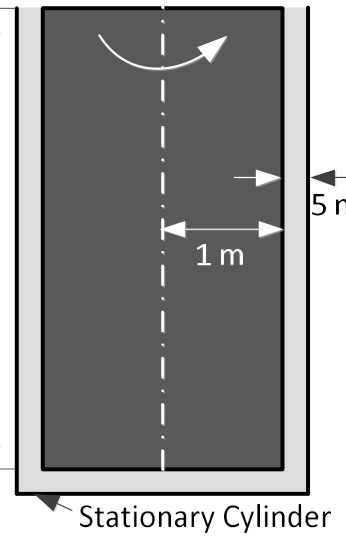
Consider a solid cylinder housed inside another cylinder as shown in the figure. Radius of the inner cylinder is 1 m and its height is 2 m. The gap between the cylinders is 5 mm and is filled with a fluid of viscosity $10^{-4}$ Pa-s. The inner cylinder is rotating at a constant angular speed of 5 rad/s while the outer cylinder is stationary. Friction at the bottom surfaces can be ignored. Velocity profile in the vertical gap between the cylinders can be assumed to be linear. The driving moment required for the rotating motion of the inner cylinder is ____________ Nm (rounded off to two decimal places).
Official answer: 1.24 to 1.28
GATE AE 2022, Question 53 (2 marks, NAT)
Aerodynamics - Compressible Flows
In a converging duct, area and velocity at section P are 1 m$^2$ and 15 m/s, respectively. The temperature of the fluid is 300 K. Air flow through the nozzle can be assumed to be inviscid and isothermal. Characteristic gas constant is 287 J/(kg-K) and ratio of specific heats is 1.4 for air. To ensure that the air flow remains incompressible (Mach number, $M \le 0.3$) in the duct, the minimum area required at section Q is _____ m$^2$ (rounded off to two decimal places).
Official answer: 0.14 to 0.15
GATE AE 2022, Question 54 (2 marks, NAT)
Aerodynamics - Airfoils & Wings
Consider a thin symmetric airfoil at 2 degree angle of attack in a uniform flow at 50 m/s. The pitching moment coefficient about its leading edge is _____ (rounded off to three decimal places).
Official answer: -0.057 to -0.053
GATE AE 2022, Question 55 (2 marks, NAT)
Aerodynamics - Compressible Flows
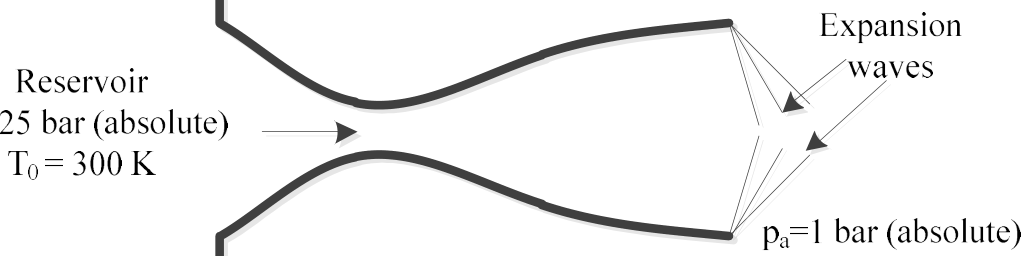
A convergent-divergent nozzle with adiabatic walls is designed for an exit Mach number of 2.3. It is discharging air to atmosphere under the conditions indicated in the figure. Flow through the nozzle is inviscid, the characteristic gas constant for air is 287 J/(kg-K), and $\gamma = 1.4$. When the reservoir pressure is 25 bar (absolute), and temperature is 300 K, Prandtl-Meyer expansion waves appear at the nozzle exit as shown. The minimum percentage change in the reservoir pressure required to eliminate the wave system at the nozzle exit under steady state is _______%.
GATE AE 2018, Question 16 (1 mark, MCQ)
Aerodynamics - Airfoils & Wings
A NACA 0012 airfoil has a trailing edge flap. The airfoil is operating at an angle of attack of 5 degrees with un-deflected flap. If the flap is now deflected by 5 degrees downwards, the $C_L$ versus $\alpha$ curve
- shifts right and slope increases.
- shifts left and slope increases.
- shifts left and slope stays the same.
- shifts right and slope stays the same.
Official answer: C
GATE AE 2018, Question 18 (1 mark, MCQ)
Aerodynamics - Viscous Flows & Boundary Layers
The velocity profile in an incompressible, laminar boundary layer is shown in the figure below. $U$ is the free-stream velocity, $u(y)$ is the stream-wise velocity component. The area of the black shaded region in the figure below represents the
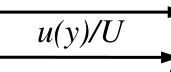
- boundary layer thickness.
- momentum thickness.
- displacement thickness.
- shape factor.
Official answer: C
GATE AE 2018, Question 22 (1 mark, MCQ)
Aerodynamics - Airfoils & Wings
The pitching moment of a positively cambered NACA airfoil about its leading edge at zero- lift angle of attack is
- negative.
- positive.
- indeterminate.
- zero.
Official answer: A
GATE AE 2018, Question 23 (1 mark, MCQ)
Aerodynamics - Potential Flow
In a low-speed wind tunnel, the angular location(s) from the front stagnation point on a circular cylinder where the static pressure equals the free-stream static pressure, is
- $\pm 38^\circ$
- $\pm 30^\circ$
- $\pm 60^\circ$
- $0^\circ$
Official answer: B
GATE AE 2018, Question 24 (1 mark, MCQ)
Aerodynamics - Compressible Flows
A thermocouple, mounted flush in an insulated flat surface in a supersonic laminar flow of air measures the
- static temperature.
- temperature greater than static but less than total temperature.
- total temperature.
- temperature greater than total temperature.
Official answer: B
GATE AE 2018, Question 25 (1 mark, MCQ)
Aerodynamics - Compressible Flows
A shock wave is moving into still air in a shock tube. Which one of the following happens to the air?
- static temperature increases, total temperature remains constant.
- static temperature increases, total temperature increases.
- static temperature increases, total temperature decreases.
- static pressure increases, total temperature remains constant.
Official answer: B
GATE AE 2018, Question 37 (2 marks, MCQ)
Aerodynamics - Compressible Flows
The relation between pressure ($p$) and velocity ($V$) for a steady, isentropic flow at two points along a streamline is, ($c$ is a constant)
- $c\left(p_2^{\gamma} - p_1^{\gamma}\right) = \dfrac{V_1^2}{2} - \dfrac{V_2^2}{2}$
- $c\left(p_2^{\frac{\gamma}{\gamma-1}} - p_1^{\frac{\gamma}{\gamma-1}}\right) = \dfrac{V_1^2}{2} - \dfrac{V_2^2}{2}$
- $c\left(p_2^{\frac{\gamma-1}{\gamma}} - p_1^{\frac{\gamma-1}{\gamma}}\right) = \dfrac{V_1^2}{2} - \dfrac{V_2^2}{2}$
- $c\left(p_2^{\gamma-1} - p_1^{\gamma-1}\right) = \dfrac{V_1^2}{2} - \dfrac{V_2^2}{2}$
Official answer: C
GATE AE 2018, Question 38 (2 marks, MCQ)
Aerodynamics - Compressible Flows
A thin airfoil is mounted in a low-speed, subsonic wind tunnel, in which the Mach number is 0.1. At a point on the airfoil, the pressure coefficient is measured to be $-1.2$. If the flow velocity is increased such that the free-stream Mach number is 0.6, the pressure coefficient at the same point on the airfoil will approximately be:
- -3.5
- -2.9
- -1.5
- -0.75
Official answer: C
GATE AE 2018, Question 49 (2 marks, NAT)
Aerodynamics - Basic Fluid Mechanics
Consider a cubical tank of side 2 m with its top open. It is filled with water up to a height of 1 m. Assuming the density of water to be 1000 kg/m$^3$, $g$ as 9.81 m/s$^2$ and the atmospheric pressure to be 100 kPa, the net hydrostatic force (in kN) on the side face of the tank due to the air and water is ______ (accurate to two decimal places).
Official answer: 9.80 to 9.81
GATE AE 2018, Question 55 (2 marks, NAT)
Aerodynamics - Compressible Flows
Air at 50 kPa pressure and 400 K temperature flows in a duct at Mach 3.0. A part of the flow leaks through an opening on the duct wall into the ambient, where the pressure is 30 kPa. The maximum Mach number achieved in the discharge is _______ (accurate to two decimal places). (Ratio of specific heats of air is $\gamma = 1.4$).
Official answer: 3.30 to 3.40
GATE AE 2018, Question 56 (2 marks, NAT)
Aerodynamics - Compressible Flows
Consider a $20^\circ$ half-angle wedge in a supersonic flow at Mach 3.0 at standard sea-level conditions. If the shock-wave angle on the wedge is $36^\circ$, the Mach number of the tangential component of the flow post-shock is _______ (accurate to two decimal places).
Official answer: 1.90 to 2.20
GATE AE 2018, Question 57 (2 marks, NAT)
Aerodynamics - Viscous Flows & Boundary Layers
The boundary layer thickness at the location of a sensor on a flat plate in an incompressible, laminar flow of air is required to be restricted to 1 mm for an effective measurement. If the flow velocity is 20 m/s with 1 bar pressure, 300 K temperature, and $1.789 \times 10^{-5}$ kg/(m-s) viscosity, the maximum distance (in mm) of the sensor location from the leading edge is ________ (accurate to one decimal place).
Official answer: 47.0 to 55.0
GATE AE 2016, Question 11 (1 mark, MCQ)
Aerodynamics - Airfoils & Wings
With increase in airfoil thickness, the critical Mach number for an airfoil is likely to
- decrease.
- increase.
- remain unchanged.
- be undefined.
Official answer: A
GATE AE 2016, Question 12 (1 mark, NAT)
Aerodynamics - Potential Flow
Due to a body in potential flow, the velocity at a point A in the flow field is 20 m/s while the free stream velocity is only 10 m/s. The value of coefficient of pressure ($C_p$) at the point A is _________.
Official answer: -3
GATE AE 2016, Question 13 (1 mark, MCQ)
Aerodynamics - Airfoils & Wings
Which of the following airfoil will have location of the maximum camber at half chord length from the leading edge?
- NACA 5212
- NACA 1225
- NACA 2215
- NACA 2512
Official answer: D
GATE AE 2016, Question 14 (1 mark, MCQ)
Aerodynamics - Viscous Flows & Boundary Layers
For a laminar incompressible flow past a flat plate at zero angle of attack, the variation of skin friction drag coefficient ($C_f$) with Reynolds number based on the chord length ($Re_c$) can be expressed as
- $C_f \propto \sqrt{Re_c}$
- $C_f \propto Re_c$
- $C_f \propto \dfrac{1}{\sqrt{Re_c}}$
- $C_f \propto \dfrac{1}{Re_c}$
Official answer: C
GATE AE 2016, Question 15 (1 mark, MCQ)
Aerodynamics - Compressible Flows
Which of the following statement is NOT TRUE across an oblique shock wave?
- Static temperature increases, total temperature remains constant.
- Static pressure increases, static temperature increases.
- Static temperature increases, total pressure decreases.
- Static pressure increases, total temperature decreases.
Official answer: D
GATE AE 2016, Question 16 (1 mark, MCQ)
Aerodynamics - Compressible Flows
For a completely subsonic isentropic flow through a convergent nozzle, which of the following statement is TRUE?
- Pressure at the nozzle exit > back pressure.
- Pressure at the nozzle exit < back pressure.
- Pressure at the nozzle exit = back pressure.
- Pressure at the nozzle exit = total pressure.
Official answer: C
GATE AE 2016, Question 18 (1 mark, MCQ)
Aerodynamics - Viscous Flows & Boundary Layers
Air, with a Prandtl number of 0.7, flows over a flat plate at a high Reynolds number. Which of the following statement is TRUE?
- Thermal boundary layer is thicker than the velocity boundary layer.
- Thermal boundary layer is thinner than the velocity boundary layer.
- Thermal boundary layer is as thick as the velocity boundary layer.
- There is no relationship between the thicknesses of thermal and velocity boundary layers.
Official answer: A
GATE AE 2016, Question 39 (2 marks, MCQ)
Aerodynamics - Potential Flow
The maximum value of coefficient of lift ($C_l$) for a 2D circular cylinder, provided at least one stagnation point lies on the cylinder surface, is predicted by the potential flow theory to be
- $\pi/2$
- $\pi$
- $2\pi$
- $4\pi$
Official answer: D
GATE AE 2016, Question 40 (2 marks, NAT)
Aerodynamics - Basic Fluid Mechanics
The nozzle AB, as shown below, leading to the test section of a low speed subsonic wind tunnel, has a contraction ratio of 10:1. The pressure difference across the nozzle is maintained at 1000 N/m$^2$ and the density of air is 1.23 kg/m$^3$. Assuming one-dimensional, steady, inviscid flow, the velocity in the test section as measured at point B is ___________ m/s.
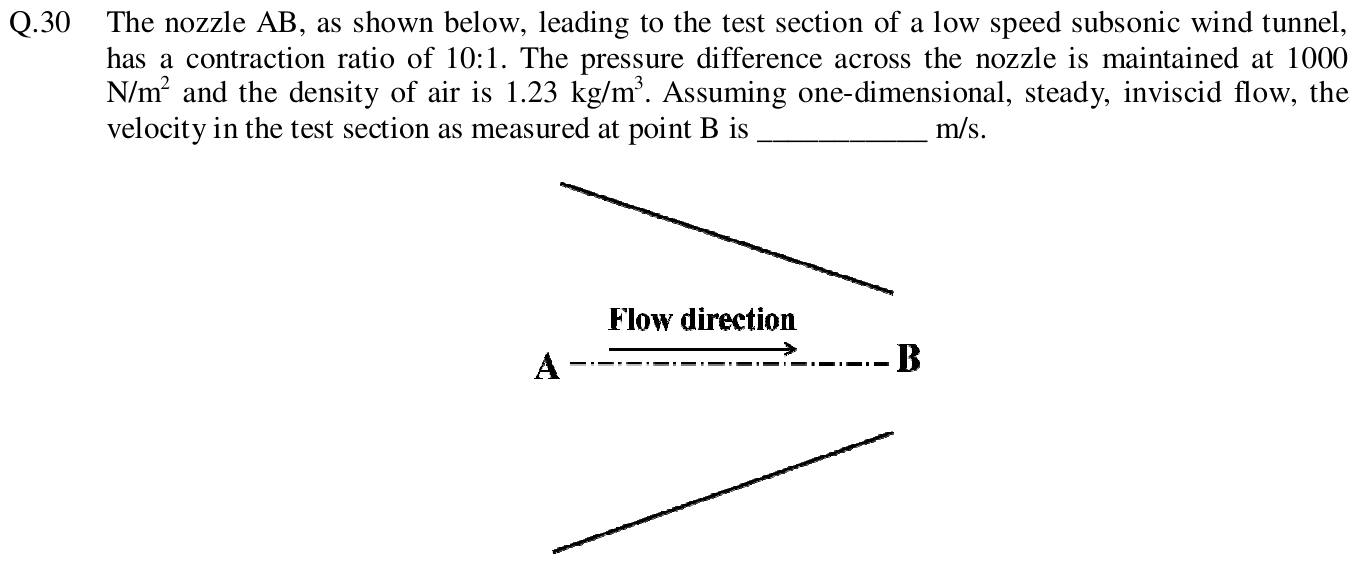
Official answer: 40.0 to 41.0
GATE AE 2016, Question 41 (2 marks, MCQ)
Aerodynamics - Airfoils & Wings
The rate of change of moment coefficient with respect to the angle of attack, $\dfrac{dC_m}{d\alpha}$, at half chord point of a thin airfoil, as per approximations from the thin airfoil theory is
- $\pi/4\ \text{radian}^{-1}$
- $\pi/2\ \text{radian}^{-1}$
- $\pi\ \text{radian}^{-1}$
- $2\pi\ \text{radian}^{-1}$
Official answer: B
GATE AE 2016, Question 42 (2 marks, MCQ)
Aerodynamics - Airfoils & Wings
An untwisted wing of elliptic planform and aspect ratio 6 consists of thin symmetric airfoil sections. The coefficient of lift ($C_L$) at $10^\circ$ angle of attack assuming inviscid incompressible flow is
- $\pi^2/16$
- $\pi^2/12$
- $\pi^2/8$
- $\pi/2$
Official answer: B
GATE AE 2016, Question 44 (2 marks, MCQ)
Aerodynamics - Compressible Flows
Consider 1-D, steady, inviscid, compressible flow through a convergent nozzle. The total temperature and total pressure are $T_o$, $P_o$ respectively. The flow through the nozzle is choked with a mass flow rate of $\dot{m}_o$. If the total temperature is increased to $4T_o$, with total pressure remaining unchanged, then the mass flow rate through the nozzle
- remains unchanged.
- becomes half of $\dot{m}_o$.
- becomes twice of $\dot{m}_o$.
- becomes four times of $\dot{m}_o$.
Official answer: B
GATE AE 2014, Question 16 (1 mark, MCQ)
Aerodynamics - Airfoils & Wings
For a NACA 5-digit airfoil of chord $c$, the designed lift coefficient and location of maximum camber along the chord from the leading edge are denoted by $C_L$ and $X_m$ respectively. For NACA 12018 airfoil, which combination of $C_L$ and $X_m$ given below are correct?
- $C_L = 0.15$ and $X_m = 0.1c$
- $C_L = 0.12$ and $X_m = 0.2c$
- $C_L = 0.12$ and $X_m = 0.18c$
- $C_L = 0.15$ and $X_m = 0.2c$
Official answer: A
GATE AE 2014, Question 17 (1 mark, MCQ)
Aerodynamics - Compressible Flows
For inviscid, supersonic flow over a diamond shaped airfoil, shown in the figure, which statement is correct among the following?
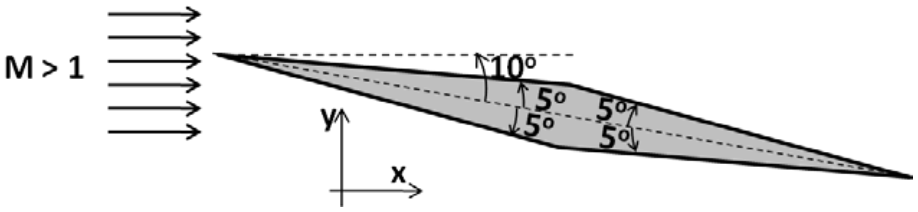
- The airfoil will experience zero lift and positive drag force
- The airfoil will experience positive lift and zero drag force
- The airfoil will experience negative lift and zero drag force
- The airfoil will experience positive lift and positive drag force
Official answer: D
GATE AE 2014, Question 18 (1 mark, MCQ)
Aerodynamics - Compressible Flows
Consider supersonic flow near a corner (at an angle $\theta$ from the horizontal) with an attached oblique shock (at an angle $\beta$ with horizontal) as shown in figure. If Mach number $M$ decreases gradually from a high supersonic value, which of the following statements is correct?
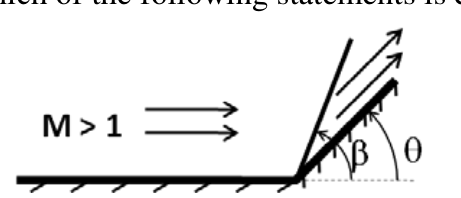
- $\beta$ will decrease if the shock is a weak shock
- $\beta$ will decrease if the shock is a strong shock
- $\beta$ will increase for both weak and strong shocks
- $\beta$ remains unchanged for both weak and strong shocks
Official answer: B
GATE AE 2014, Question 19 (1 mark, MCQ)
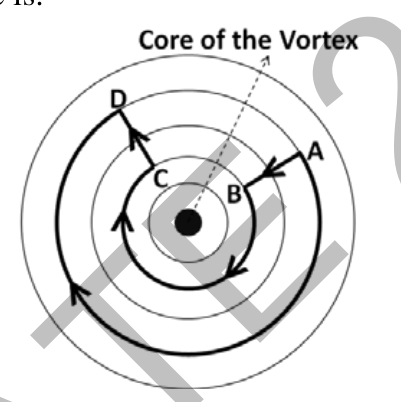
Aerodynamics - Potential Flow
The streamlines of a potential line vortex is concentric circles with respect to the vortex center as shown in figure. Velocity along these streamlines, outside the core of the vortex can be written as, $v_\theta = \dfrac{\Gamma}{2\pi r}$, where strength of the vortex is $\dfrac{\Gamma}{2\pi}$ and $r$ is radial direction. The value of circulation along the curve shown in the figure is:
- $\Gamma$
- $-2\Gamma$
- $2\Gamma$
- 0
Official answer: D
GATE AE 2014, Question 20 (1 mark, MCQ)
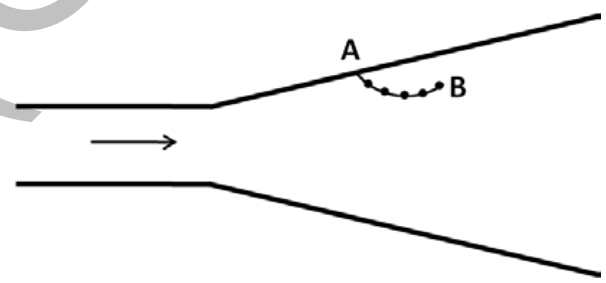
Aerodynamics - Basic Fluid Mechanics
To observe unsteady separated flow in a diverging channel, bubbles are injected at each 10 ms interval at point A as shown in figure. These bubbles act as tracer particles and follow the flow faithfully. The curved line AB shown at any instant represents:
- Streamline, streakline and pathline
- Streamline and pathline
- Only a pathline
- Only a streakline
Official answer: D
GATE AE 2014, Question 41 (2 marks, NAT)
Aerodynamics - Basic Fluid Mechanics
For a steady, incompressible two-dimensional flow, represented in Cartesian co-ordinates $(x, y)$, a student correctly writes the equation of pathline of any arbitrary particle as, $\dfrac{dx}{dt} = ax$ and $\dfrac{dy}{dt} = by$, where $a$ and $b$ are constants having unit of (second)$^{-1}$. If value of $a$ is 5, the value of $b$ is _____.
Official answer: -5.01 to -4.99
GATE AE 2014, Question 42 (2 marks, MCQ)
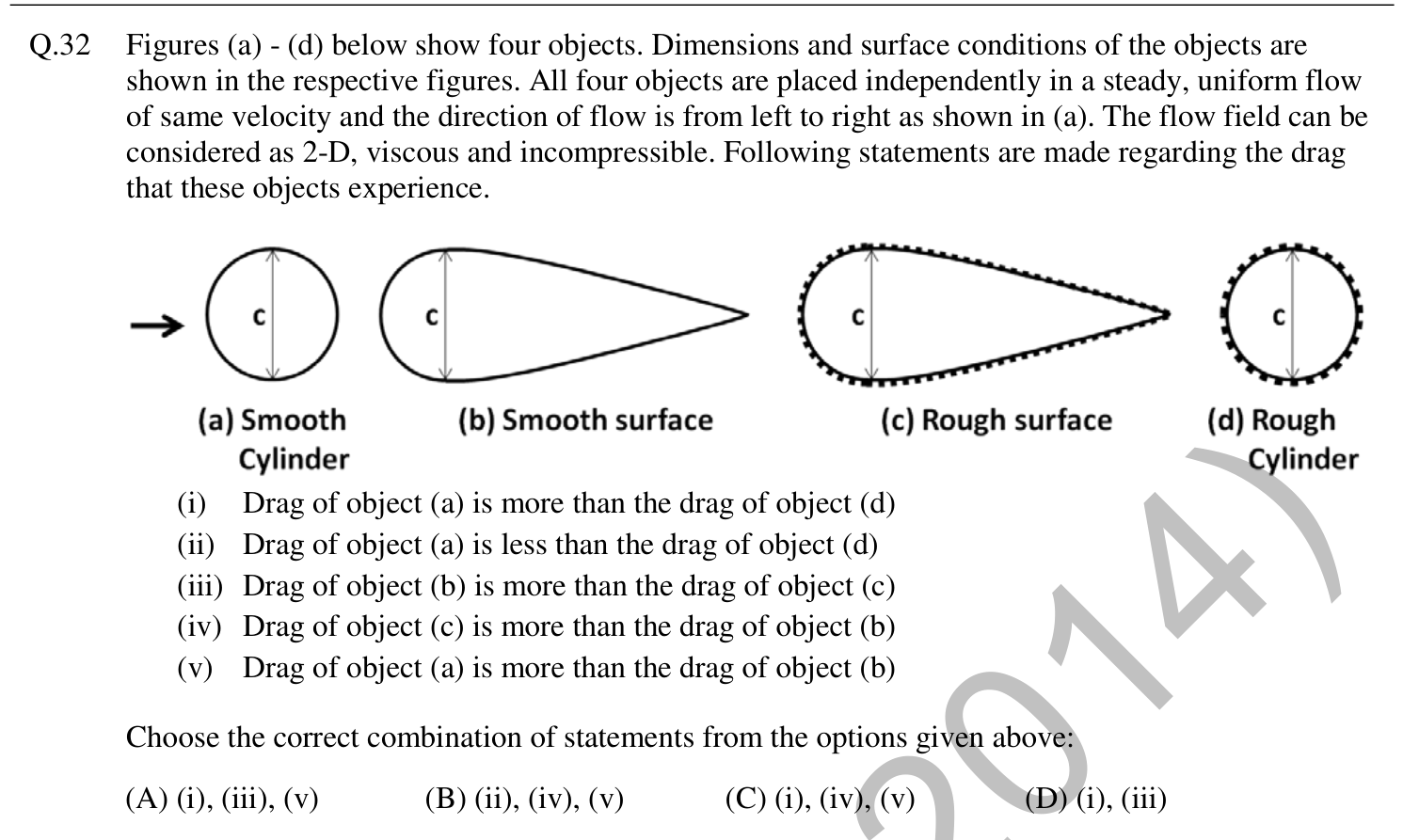
Aerodynamics - Basic Fluid Mechanics
Figures (a) - (d) below show four objects. Dimensions and surface conditions of the objects are shown in the respective figures. All four objects are placed independently in a steady, uniform flow of same velocity and the direction of flow is from left to right as shown in (a). The flow field can be considered as 2-D, viscous and incompressible. Following statements are made regarding the drag that these objects experience. (i) Drag of object (a) is more than the drag of object (d). (ii) Drag of object (a) is less than the drag of object (d). (iii) Drag of object (b) is more than the drag of object (c). (iv) Drag of object (c) is more than the drag of object (b). (v) Drag of object (a) is more than the drag of object (b). Choose the correct combination of statements from the options given above:
- (i), (iii), (v)
- (ii), (iv), (v)
- (i), (iv), (v)
- (i), (iii)
Official answer: C
GATE AE 2014, Question 43 (2 marks, NAT)
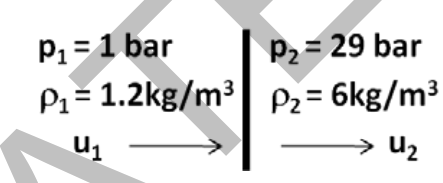
Aerodynamics - Compressible Flows
A student needs to find velocity across a stationary normal shock. He measures density and pressure across the shock as shown in the figure below. 1 bar = $10^5$ Pa. (No shock table is needed for the calculations). The value of $u_1$ in m/s is ____. ($p_1 = 1$ bar, $\rho_1 = 1.2$ kg/m$^3$; $p_2 = 29$ bar, $\rho_2 = 6$ kg/m$^3$)
Official answer: 1705 to 1720
GATE AE 2014, Question 44 (2 marks, MCQ)
Aerodynamics - Compressible Flows
For inviscid, compressible flow past a thin airfoil, shown in the figure, free-stream Mach number and pressure are denoted by $M_\infty$ and $p_\infty$ respectively. Ratio of pressure at point A and $p_\infty$ is 0.8 and specific heat ratio is 1.4. If the Mach number at point A is 1.0 and rest of the flow field is subsonic, the value of $M_\infty$ is
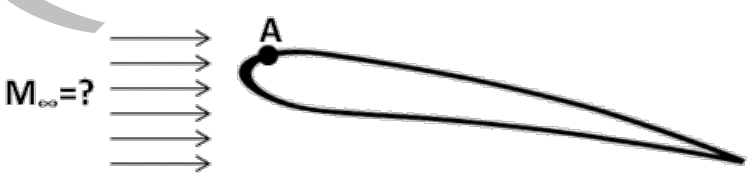
- 2.95
- 0.79
- 1.18
- 0.64
Official answer: B
GATE AE 2014, Question 45 (2 marks, MCQ)
Aerodynamics - Basic Fluid Mechanics
A student can measure free-stream velocity of a low-speed wind tunnel using a: i. Pitot tube alone aligned with the flow direction. ii. Pitot tube aligned with the flow direction with static pressure measurement at an appropriate position on the tunnel wall. iii. Pitot tube aligned with the flow direction along with barometer pressure reading of the outside ambient. iv. Pitot static tube alone aligned with the flow direction. Considering the above statements, which of the following options is correct?
- (i) only
- (i) & (ii)
- (ii) & (iv)
- (i), (iii) & (iv)
Official answer: C
GATE AE 2014, Question 46 (2 marks, MCQ)
Aerodynamics - Airfoils & Wings
Induced velocity $w$ at a point $z = z_1$ along the lifting line can be calculated using the formula $w(z_1) = -\dfrac{1}{4\pi}\int_{-s}^{s}\dfrac{d\Gamma}{dz}\dfrac{1}{z - z_1}\,dz$. Given $\dfrac{\Gamma^2}{\Gamma_o^2} + \dfrac{z^2}{s^2} = 1$, where $z$, $\Gamma_o$ and $s$ are given in figure below. For the above semi-elliptic distribution of circulation, $\Gamma$, the downwash velocity at any point $z_1$ for symmetric flight can be obtained as, $w(z_1) = \dfrac{\Gamma_o}{4\pi s}\left[\pi + z_1 I\right]$, where $I = z_1\int_{-s}^{s}\dfrac{dz}{\sqrt{s^2 - z^2}(z - z_1)}$. Which of the following options is correct if the induced drag is $D_i$ (given $\int_{-s}^{s}\sqrt{1 - \dfrac{z^2}{s^2}}\,dz = \dfrac{\pi s}{2}$)?
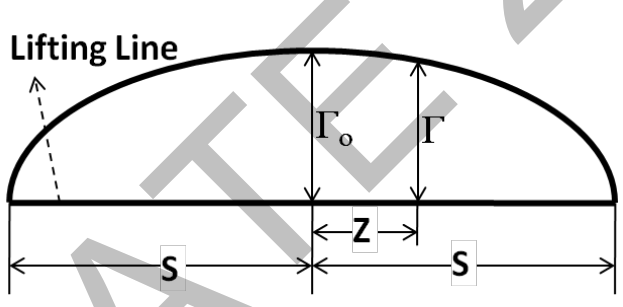
- $I = 0$ and $D_i = \dfrac{8\rho\Gamma_o^2}{\pi}$
- $I = 1$ and $D_i = \dfrac{8\rho\Gamma_o^2}{\pi}$
- $I = 0$ and $D_i = \dfrac{\pi\rho\Gamma_o^2}{8}$
- $I = 1$ and $D_i = \dfrac{\pi\rho\Gamma_o^2}{8}$
Official answer: C
GATE AE 2014, Question 47 (2 marks, NAT)
Aerodynamics - Basic Fluid Mechanics
Two overflowing water reservoirs are connected with a 100 m long pipe of circular cross-section (of radius, $R = 0.02$ m), such that height difference $h$ remains constant as shown in the figure below. The centerline velocity in the pipe is 10 m/s. The velocity profile inside the pipe over the entire length is $u = -\dfrac{R^2}{4\mu}\dfrac{dp}{dx}\left[1 - \dfrac{r^2}{R^2}\right]$, where, $\dfrac{dp}{dx}$ is a constant pressure gradient along the pipe length, $x$ is measured from the left end of the pipe along its central axis and $r$ is radial location inside the pipe with respect to its axis. (Given data: Density and kinematic viscosity of water are 1000 kg/m$^3$ and $1 \times 10^{-6}$ m$^2$/s respectively; acceleration due to gravity is 10 m/s$^2$). If all other losses except the frictional losses at the pipe wall are neglected, the value of $h$ in meter is ____.
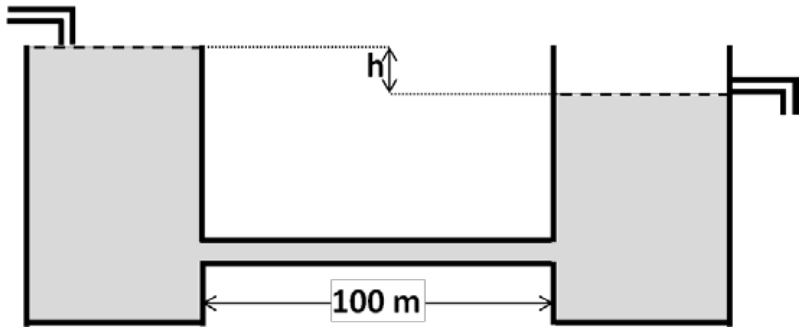
Official answer: 0.99 to 1.01
GATE AE 2014, Question 59 (2 marks, MCQ)
Aerodynamics - Compressible Flows
An aircraft is flying at Mach 3.0 at an altitude where the ambient pressure and temperature are 50 kPa and 200 K respectively. If the converging-diverging diffuser of the engine (considered isentropic with ratio of specific heats, $\gamma = 1.4$ and specific gas constant $R = 287$ J/kgK) has a throat area of 0.05 m$^2$, the mass flow rate through the engine in kg/s is
- 197
- 232
- 790
- 157
Official answer: D