GATE AE 2018 Question Paper
GATE Aerospace Engineering 2018 question paper: all 65 questions with figures and the official answer key. Practice free on CMB Space.
All GATE AE papers
Question 1 (1 mark, MCQ)
General Aptitude - Verbal Ability
“The dress _________ her so well that they all immediately _________ her on her appearance.” The words that best fill the blanks in the above sentence are
- complemented, complemented
- complimented, complemented
- complimented, complimented
- complemented, complimented
Official answer: D
Question 2 (1 mark, MCQ)
General Aptitude - Verbal Ability
“The judge’s standing in the legal community, though shaken by false allegations of wrongdoing, remained _________.” The word that best fills the blank in the above sentence is
- undiminished
- damaged
- illegal
- uncertain
Official answer: A
Question 3 (1 mark, MCQ)
General Aptitude - Numerical Ability
Find the missing group of letters in the following series: BC, FGH, LMNO, _____
- UVWXY
- TUVWX
- STUVW
- RSTUV
Official answer: B
Question 4 (1 mark, MCQ)
General Aptitude - Numerical Ability
The perimeters of a circle, a square and an equilateral triangle are equal. Which one of the following statements is true?
- The circle has the largest area.
- The square has the largest area.
- The equilateral triangle has the largest area.
- All the three shapes have the same area.
Official answer: A
Question 5 (1 mark, MCQ)
General Aptitude - Numerical Ability
The value of the expression $\dfrac{1}{1+\log_u vw} + \dfrac{1}{1+\log_v wu} + \dfrac{1}{1+\log_w uv}$ is ________.
- -1
- 0
- 1
- 3
Official answer: C
Question 6 (2 marks, MCQ)
General Aptitude - Numerical Ability
Forty students watched films A, B and C over a week. Each student watched either only one film or all three. Thirteen students watched film A, sixteen students watched film B and nineteen students watched film C. How many students watched all three films?
- 0
- 2
- 4
- 8
Official answer: C
Question 7 (2 marks, MCQ)
General Aptitude - Numerical Ability
A wire would enclose an area of 1936 m$^2$, if it is bent into a square. The wire is cut into two pieces. The longer piece is thrice as long as the shorter piece. The long and the short pieces are bent into a square and a circle, respectively. Which of the following choices is closest to the sum of the areas enclosed by the two pieces in square meters?
- 1096
- 1111
- 1243
- 2486
Official answer: C
Question 8 (2 marks, MCQ)
General Aptitude - Numerical Ability
A contract is to be completed in 52 days and 125 identical robots were employed, each operational for 7 hours a day. After 39 days, five-seventh of the work was completed. How many additional robots would be required to complete the work on time, if each robot is now operational for 8 hours a day?
- 50
- 89
- 146
- 175
Question 9 (2 marks, MCQ)
General Aptitude - Numerical Ability
A house has a number which needs to be identified. The following three statements are given that can help in identifying the house number. i. If the house number is a multiple of 3, then it is a number from 50 to 59. ii. If the house number is NOT a multiple of 4, then it is a number from 60 to 69. iii. If the house number is NOT a multiple of 6, then it is a number from 70 to 79. What is the house number?
- 54
- 65
- 66
- 76
Official answer: D
Question 10 (2 marks, MCQ)
General Aptitude - Analytical & Spatial Reasoning
An unbiased coin is tossed six times in a row and four different such trials are conducted. One trial implies six tosses of the coin. If H stands for head and T stands for tail, the following are the observations from the four trials: (1) HTHTHT (2) TTHHHT (3) HTTHHT (4) HHHT__ __. Which statement describing the last two coin tosses of the fourth trial has the highest probability of being correct?
- Two T will occur.
- One H and one T will occur.
- Two H will occur.
- One H will be followed by one T.
Official answer: B
Question 11 (1 mark, MCQ)
Engineering Mathematics - Linear Algebra
Let $\vec{a}, \vec{b}$ be two distinct vectors that are not parallel. The vector $\vec{c} = \vec{a} \times \vec{b}$ is
- zero.
- orthogonal to $\vec{a}$ alone.
- orthogonal to $\vec{a} + \vec{b}$.
- orthogonal to $\vec{b}$ alone.
Official answer: C
Question 12 (1 mark, MCQ)
Engineering Mathematics - Calculus
Consider the function $f(x,y) = \dfrac{x^2}{2} + \dfrac{y^2}{3} - 5$. All the roots of this function
- form a finite set of points.
- lie on an elliptical curve.
- lie on the surface of a sphere.
- lie on a hyperbolic curve.
Official answer: B
Question 13 (1 mark, MCQ)
Engineering Mathematics - Calculus
Consider a vector field given by $x\hat{i} + y\hat{j} + z\hat{k}$. This vector field is
- divergence-free and curl-free.
- curl-free but not divergence-free.
- divergence-free but not curl-free.
- neither divergence-free nor curl-free.
Official answer: B
Question 14 (1 mark, MCQ)
Flight Mechanics & Space Dynamics - Airplane Performance
A jet aircraft is initially flying steady and level at its maximum endurance condition. For the aircraft to fly steady and level, but faster at the same altitude, the pilot should
- increase thrust alone.
- increase thrust and increase angle of attack.
- increase thrust and reduce angle of attack.
- reduce angle of attack alone.
Official answer: C
Question 15 (1 mark, MCQ)
Flight Mechanics & Space Dynamics - Static Stability & Control
The pilot of a conventional airplane that is flying steady and level at some altitude, deflects the port side aileron up and the starboard aileron down. The aircraft will then
- pitch, nose up.
- roll with the starboard wing up.
- pitch, nose down.
- roll with the port wing up.
Official answer: B
Question 16 (1 mark, MCQ)
Aerodynamics - Airfoils & Wings
A NACA 0012 airfoil has a trailing edge flap. The airfoil is operating at an angle of attack of 5 degrees with un-deflected flap. If the flap is now deflected by 5 degrees downwards, the $C_L$ versus $\alpha$ curve
- shifts right and slope increases.
- shifts left and slope increases.
- shifts left and slope stays the same.
- shifts right and slope stays the same.
Official answer: C
Question 17 (1 mark, MCQ)
Flight Mechanics & Space Dynamics - Airplane Performance
An airplane requires a longer ground roll to lift-off on hot summer days because
- the thrust is directly proportional to free-stream density.
- the thrust is directly proportional to weight of the aircraft.
- the lift-off distance is directly proportional to free-stream density.
- the runway friction is high on hot summer days.
Official answer: A
Question 18 (1 mark, MCQ)
Aerodynamics - Viscous Flows & Boundary Layers
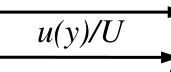
The velocity profile in an incompressible, laminar boundary layer is shown in the figure below. $U$ is the free-stream velocity, $u(y)$ is the stream-wise velocity component. The area of the black shaded region in the figure below represents the
- boundary layer thickness.
- momentum thickness.
- displacement thickness.
- shape factor.
Official answer: C
Question 19 (1 mark, MCQ)
Flight Mechanics & Space Dynamics - Space Dynamics
The tangential velocity component 'V' of a spacecraft, which is in a circular orbit of radius 'R' around a spherical Earth ($\mu = GM$, gravitational parameter of Earth) is given by the following expression.
- $V = \sqrt{\dfrac{\mu}{2R}}$
- $V = \sqrt{\dfrac{\mu}{R}}$
- $V = \dfrac{2\pi}{\sqrt{\mu}}R^{3/2}$
- $V = \dfrac{2\pi}{\sqrt{\mu}}R^{2/3}$
Official answer: B
Question 20 (1 mark, MCQ)
Flight Mechanics & Space Dynamics - Space Dynamics
Equation of the trajectory of a typical space object around any planet, in polar coordinates $(r, \tau)$ (i.e. a general conic section geometry), is given as follows. ($h$ is angular momentum, $\mu$ is gravitational parameter, $e$ is eccentricity, $r$ is radial distance from the planet center, $\tau$ is angle between vectors $\vec{e}$ and $\vec{r}$.
- $r = \dfrac{h^2/\mu}{1 - e\cos\tau}$
- $r = \dfrac{h^2/\mu}{e - \cos\tau}$
- $r = \dfrac{h^2/\mu}{1 + e\cos\tau}$
- $r = \dfrac{h^2/\mu}{e + \cos\tau}$
Official answer: C
Question 21 (1 mark, MCQ)
Flight Mechanics & Space Dynamics - Space Dynamics
In an elliptic orbit around any planet, the location at which a spacecraft has the maximum angular velocity is
- apoapsis.
- periapsis.
- a point at $+45^\circ$ from periapsis.
- a point at $90^\circ$ from apoapsis.
Official answer: B
Question 22 (1 mark, MCQ)
Aerodynamics - Airfoils & Wings
The pitching moment of a positively cambered NACA airfoil about its leading edge at zero- lift angle of attack is
- negative.
- positive.
- indeterminate.
- zero.
Official answer: A
Question 23 (1 mark, MCQ)
Aerodynamics - Potential Flow
In a low-speed wind tunnel, the angular location(s) from the front stagnation point on a circular cylinder where the static pressure equals the free-stream static pressure, is
- $\pm 38^\circ$
- $\pm 30^\circ$
- $\pm 60^\circ$
- $0^\circ$
Official answer: B
Question 24 (1 mark, MCQ)
Aerodynamics - Compressible Flows
A thermocouple, mounted flush in an insulated flat surface in a supersonic laminar flow of air measures the
- static temperature.
- temperature greater than static but less than total temperature.
- total temperature.
- temperature greater than total temperature.
Official answer: B
Question 25 (1 mark, MCQ)
Aerodynamics - Compressible Flows
A shock wave is moving into still air in a shock tube. Which one of the following happens to the air?
- static temperature increases, total temperature remains constant.
- static temperature increases, total temperature increases.
- static temperature increases, total temperature decreases.
- static pressure increases, total temperature remains constant.
Official answer: B
Question 26 (1 mark, MCQ)
Flight Mechanics & Space Dynamics - Airplane Performance
The highest limit load factor experienced by a civil transport aircraft is in the range
- 0.0 – 2.0
- 2.0 – 5.0
- 5.0 – 8.0
- 8.0 – 10.0
Official answer: B
Question 27 (1 mark, MCQ)
Structures - Flight Vehicle Structures
Determine the correctness or otherwise of the following statements, [a] and [r]: [a] A closed-section box beam configuration is used in aircraft wings. [r] Closed-section box beam configuration is capable of resisting torsional loads.
- Both [a] and [r] are true and [r] is the correct reason for [a].
- Both [a] and [r] are true but [r] is not the correct reason for [a].
- Both [a] and [r] are false.
- [a] is true but [r] is false.
Official answer: A
Question 28 (1 mark, MCQ)
Propulsion - Aerothermodynamics & Cycles
The first law of thermodynamics is also known as conservation of
- mass.
- momentum.
- energy.
- species.
Official answer: C
Question 29 (1 mark, MCQ)
Propulsion - Aerothermodynamics & Cycles
In an ideal gas turbine cycle, the expansion in a turbine is represented by
- an isenthalpic process.
- an isentropic process.
- an isobaric process.
- an isochoric process.
Official answer: B
Question 30 (1 mark, NAT)
Engineering Mathematics - Linear Algebra
The determinant of the matrix $\begin{bmatrix} 1 & 1 & -1 \\ 2 & 1 & 0 \\ 3 & 1 & 1 \end{bmatrix}$ is ______ (accurate to one decimal place).
Official answer: 0
Question 31 (1 mark, NAT)
Propulsion - Aerothermodynamics & Cycles
The theoretical maximum velocity (in m/s) of air expanding from a reservoir at 700 K is __________ (accurate to two decimal places). Specific heat of air at constant pressure is 1005 J/(kg-K).
Official answer: 1185.00 to 1186.50
Question 32 (1 mark, NAT)
Structures - Structural Dynamics
For a damped single degree of freedom system with damping ratio of 0.1, ratio of two successive peak amplitudes of free vibration is ___________ (accurate to two decimal places).
Official answer: 1.75 to 1.95
Question 33 (1 mark, NAT)
Structures - Structural Dynamics
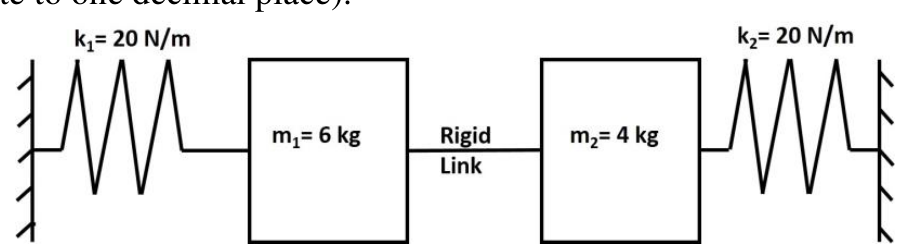
The natural frequency (in rad/s) of the spring-mass system shown in the figure below is _____ (accurate to one decimal place). (Springs $k_1 = k_2 = 20$ N/m; masses $m_1 = 6$ kg and $m_2 = 4$ kg joined by a rigid link.)
Official answer: 2
Question 34 (1 mark, NAT)
Propulsion - Engine Performance
The stagnation pressures at the inlet and exit of a subsonic intake are 100 kPa and 98 kPa, respectively. The pressure recovery of this intake will be ______ (accurate to two decimal places).
Official answer: 0.98
Question 35 (1 mark, NAT)
Propulsion - Combustors
A combustor is operating with a fuel-air ratio of 0.03. If the stoichiometric fuel-air ratio of the fuel used is 0.06, the equivalence ratio of the combustor will be _______ (accurate to two decimal places).
Official answer: 0.5
Question 36 (2 marks, MCQ)
Engineering Mathematics - Differential Equations
The solution of the differential equation $\dfrac{d^2y}{dx^2} + 3\dfrac{dy}{dx} = 0$, given that $y = 0$ and $\dfrac{dy}{dx} = 1$ at $x = 0$ is
- $x(1 - e^{-3x})$
- $\dfrac{1}{3}(1 - e^{-3x})$
- $\dfrac{1}{3}(1 + e^{-3x})$
- $\dfrac{1}{3}xe^{-3x/2}$
Official answer: B
Question 37 (2 marks, MCQ)
Aerodynamics - Compressible Flows
The relation between pressure ($p$) and velocity ($V$) for a steady, isentropic flow at two points along a streamline is, ($c$ is a constant)
- $c\left(p_2^{\gamma} - p_1^{\gamma}\right) = \dfrac{V_1^2}{2} - \dfrac{V_2^2}{2}$
- $c\left(p_2^{\frac{\gamma}{\gamma-1}} - p_1^{\frac{\gamma}{\gamma-1}}\right) = \dfrac{V_1^2}{2} - \dfrac{V_2^2}{2}$
- $c\left(p_2^{\frac{\gamma-1}{\gamma}} - p_1^{\frac{\gamma-1}{\gamma}}\right) = \dfrac{V_1^2}{2} - \dfrac{V_2^2}{2}$
- $c\left(p_2^{\gamma-1} - p_1^{\gamma-1}\right) = \dfrac{V_1^2}{2} - \dfrac{V_2^2}{2}$
Official answer: C
Question 38 (2 marks, MCQ)
Aerodynamics - Compressible Flows
A thin airfoil is mounted in a low-speed, subsonic wind tunnel, in which the Mach number is 0.1. At a point on the airfoil, the pressure coefficient is measured to be $-1.2$. If the flow velocity is increased such that the free-stream Mach number is 0.6, the pressure coefficient at the same point on the airfoil will approximately be:
- -3.5
- -2.9
- -1.5
- -0.75
Official answer: C
Question 39 (2 marks, MCQ)
Structures - Strength of Materials
A solid circular shaft of diameter $d$ is under pure torsion of magnitude $T$. The maximum tensile stress experienced at any point on the shaft is
- $\dfrac{32T}{\pi d^3}$
- $\dfrac{16T}{\pi d^4}$
- $\dfrac{32T}{\pi d^4}$
- $\dfrac{16T}{\pi d^3}$
Official answer: D
Question 40 (2 marks, MCQ)
Structures - Strength of Materials
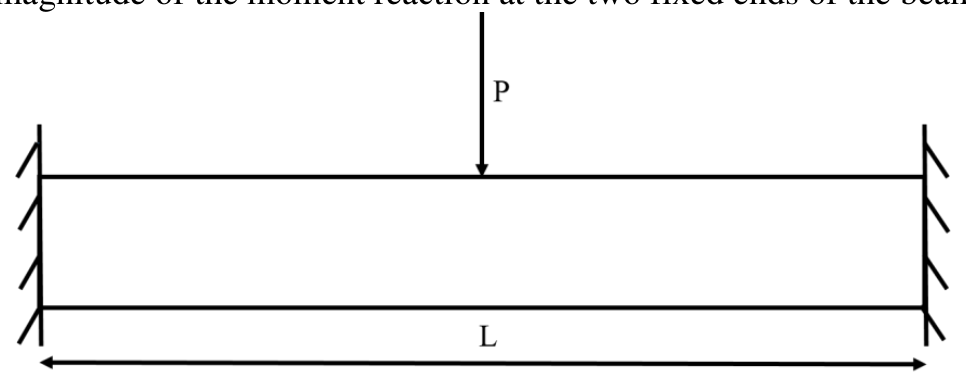
A clamped-clamped beam, subjected to a point load $P$ at the midspan, is shown in the figure below. The magnitude of the moment reaction at the two fixed ends of the beam is
- $PL/2$
- $PL/4$
- $PL/8$
- $PL/16$
Official answer: C
Question 41 (2 marks, MCQ)
Structures - Strength of Materials
Which of the following statement(s) is/are true about the state of a body in plane strain condition? P: All the points in the body undergo displacements in one plane only, for example the x-y plane, leading to $\varepsilon_{zz} = \gamma_{xz} = \gamma_{yz} = 0$. Q: All the components of stress perpendicular to the plane of deformation, for example the x-y plane, of the body are equal to zero, i.e. $\sigma_{zz} = \tau_{xz} = \tau_{yz} = 0$. R: Except the normal component, all the other components of stress perpendicular to the plane of deformation of the body, for example the x-y plane, are equal to zero, i.e. $\sigma_{zz} \neq 0$, $\tau_{xz} = \tau_{yz} = 0$.
- P only
- Q only
- P and Q
- P and R
Official answer: D
Question 42 (2 marks, MCQ)
Propulsion - Engine Performance
An aircraft with a turbojet engine flies at a velocity of 100 m/s. If the jet exhaust velocity is 300 m/s, the propulsive efficiency of the engine, assuming a negligible fuel-air ratio, is
- 0.33
- 0.50
- 0.67
- 0.80
Official answer: B
Question 43 (2 marks, MCQ)
Propulsion - Engine Performance
An aircraft with a turboprop engine produces a thrust of 500 N and flies at 100 m/s. If the propeller efficiency is 0.5, the shaft power produced by the engine is
- 50 kW
- 100 kW
- 125 kW
- 500 kW
Official answer: B
Question 44 (2 marks, MCQ)
Propulsion - Turbomachinery
An axial compressor that generates a stagnation pressure ratio of 4.0, operates with inlet and exit stagnation temperatures of 300 K and 480 K, respectively. If the ratio of specific heats ($\gamma$) is 1.4, the isentropic efficiency of the compressor is
- 0.94
- 0.81
- 0.72
- 0.63
Official answer: B
Question 45 (2 marks, MCQ)
Propulsion - Rockets
A rocket has an initial mass of 150 kg. After operating for a duration of 10 s, its final mass is 50 kg. If the acceleration due to gravity is 9.81 m/s$^2$ and the thrust produced by the rocket is 19.62 kN, the specific impulse of the rocket is
- 400 s
- 300 s
- 200 s
- 100 s
Official answer: C
Question 46 (2 marks, NAT)
Engineering Mathematics - Calculus
Consider the vector field $\vec{v} = -\dfrac{y}{r^2}\hat{i} + \dfrac{x}{r^2}\hat{j}$; where $r = \sqrt{x^2 + y^2}$. The contour integral $\oint \vec{v}\cdot\vec{ds}$, where $\vec{ds}$ is tangent to the contour that encloses the origin, is __________ (accurate to two decimal places).
Official answer: 6.25 to 6.35
Question 47 (2 marks, NAT)
Engineering Mathematics - Calculus
The magnitude of the $x$-component of a unit vector at the point (1, 1) that is normal to equi-potential lines of the potential function $\phi(r) = \dfrac{1}{r^2+4}$, where $r = \sqrt{x^2+y^2}$, is _______ (accurate to two decimal places).
Official answer: 0.68 to 0.73
Question 48 (2 marks, NAT)
Flight Mechanics & Space Dynamics - Atmosphere & Flight Instruments
Assuming ISA standard sea level conditions (288.16 K, density 1.225 kg/m$^3$, $g = 9.81$ m/s$^2$, $R = 287$ J/(kg-K)), the density (in kg/m$^3$) of air at Leh, which is at an altitude of 3500 m above mean sea level is ________ (accurate to two decimal places).
Official answer: 0.85 to 0.88
Question 49 (2 marks, NAT)
Aerodynamics - Basic Fluid Mechanics
Consider a cubical tank of side 2 m with its top open. It is filled with water up to a height of 1 m. Assuming the density of water to be 1000 kg/m$^3$, $g$ as 9.81 m/s$^2$ and the atmospheric pressure to be 100 kPa, the net hydrostatic force (in kN) on the side face of the tank due to the air and water is ______ (accurate to two decimal places).
Official answer: 9.80 to 9.81
Question 50 (2 marks, NAT)
Flight Mechanics & Space Dynamics - Airplane Performance
An aircraft with mass of 400,000 kg cruises at 240 m/s at an altitude of 10 km. Its lift to drag ratio at cruise is 15. Assuming $g$ as 9.81 m/s$^2$, the power (in MW) needed for it to cruise is _______ (accurate to two decimal places).
Official answer: 62.00 to 63.50
Question 51 (2 marks, NAT)
Flight Mechanics & Space Dynamics - Static Stability & Control
A statically-stable aircraft has a $C_{L_\alpha} = 5$ (where the angle of attack, $\alpha$, is measured in radians). The coefficient of moment of the aircraft about the center of gravity is given as $C_{M,c.g} = 0.05 - 4\alpha$. The mean aerodynamic chord of the aircraft wing is 1 m. The location (positive towards the nose) of the neutral point of the aircraft from the center of gravity is ______ (in m, accurate to two decimal places).
Official answer: -0.81 to -0.79
Question 52 (2 marks, NAT)
Flight Mechanics & Space Dynamics - Atmosphere & Flight Instruments
An aircraft with a gross weight of 2000 kg, has a speed of 130 m/s at sea level, where the conditions are: 1 atmosphere (pressure), 288 K (temperature), and 1.23 kg/m$^3$ (density). The speed (in m/s) required by the aircraft at an altitude of 9000 m, where the conditions are: 0.31 atmosphere, 230 K, and 0.47 kg/m$^3$, to maintain a steady, level flight is ________ (accurate to two decimal places).
Official answer: 209.00 to 211.00
Question 53 (2 marks, NAT)
Flight Mechanics & Space Dynamics - Atmosphere & Flight Instruments
A pitot probe on an aircraft in a steady, level flight records a pressure of 55,000 N/m$^2$. The static pressure and density are 45,280 N/m$^2$ and 0.6 kg/m$^3$, respectively. The wing area and the lift coefficient are 16 m$^2$ and 2, respectively. The wing loading (in N/m$^2$) on this aircraft is _________ (accurate to one decimal place).
Official answer: 18000 to 19440
Question 54 (2 marks, NAT)
Flight Mechanics & Space Dynamics - Space Dynamics
A spacecraft forms a circular orbit at an altitude of 150 km above the surface of a spherical Earth. Assuming the gravitational parameter, $\mu = 3.986 \times 10^{14}$ m$^3$/s$^2$ and radius of earth, $R_E = 6{,}400$ km, the velocity required for the injection of the spacecraft, parallel to the local horizon, is _______________ (accurate to two decimal places).
Question 55 (2 marks, NAT)
Aerodynamics - Compressible Flows
Air at 50 kPa pressure and 400 K temperature flows in a duct at Mach 3.0. A part of the flow leaks through an opening on the duct wall into the ambient, where the pressure is 30 kPa. The maximum Mach number achieved in the discharge is _______ (accurate to two decimal places). (Ratio of specific heats of air is $\gamma = 1.4$).
Official answer: 3.30 to 3.40
Question 56 (2 marks, NAT)
Aerodynamics - Compressible Flows
Consider a $20^\circ$ half-angle wedge in a supersonic flow at Mach 3.0 at standard sea-level conditions. If the shock-wave angle on the wedge is $36^\circ$, the Mach number of the tangential component of the flow post-shock is _______ (accurate to two decimal places).
Official answer: 1.90 to 2.20
Question 57 (2 marks, NAT)
Aerodynamics - Viscous Flows & Boundary Layers
The boundary layer thickness at the location of a sensor on a flat plate in an incompressible, laminar flow of air is required to be restricted to 1 mm for an effective measurement. If the flow velocity is 20 m/s with 1 bar pressure, 300 K temperature, and $1.789 \times 10^{-5}$ kg/(m-s) viscosity, the maximum distance (in mm) of the sensor location from the leading edge is ________ (accurate to one decimal place).
Official answer: 47.0 to 55.0
Question 58 (2 marks, NAT)
Flight Mechanics & Space Dynamics - Airplane Performance
Gross weight of an airplane is 7000 N, wing area is 16 m$^2$, and the maximum lift coefficient is 2.0. Assuming density at the altitude as 1.23 kg/m$^3$, the stall speed (in m/s) of the aircraft is _________ (accurate to two decimal places).
Official answer: 18.80 to 18.90
Question 59 (2 marks, NAT)
Structures - Strength of Materials
A thin-walled tube with external radius of 100 mm and wall thickness of 2 mm, is fixed at one end. It is subjected to a compressive force of 1 N acting at a point on the circumference parallel to its length. The maximum normal stress (in kPa) experienced by the structure is _____________ (accurate to two decimal places).
Official answer: -2.50 to -2.20
Question 60 (2 marks, NAT)
Structures - Structural Dynamics
A 1 m long massless cantilever beam oscillates at 2 Hz, while a 60 kg mass is attached at the tip of it. The flexural rigidity of the beam (in kN-m$^2$) is _________________ (accurate to two decimal places).
Official answer: 3.10 to 3.20
Question 61 (2 marks, NAT)
Structures - Strength of Materials
A cantilever beam having a rectangular cross-section of width 60 mm and depth 100 mm, is made of aluminum alloy. The material mechanical properties are: Young's modulus, $E = 73$ GPa and ultimate stress, $\sigma_u = 480$ MPa. Assuming a factor of safety of 4, the maximum bending moment (in kN-m) that can be applied on the beam is _____ (accurate to one decimal place).
Official answer: 12
Question 62 (2 marks, NAT)
Structures - Strength of Materials
The components of stress in a body under plane stress condition, in the absence of body forces, is given by: $\sigma_{xx} = Ax^2;\ \sigma_{yy} = 12x^2 - 6y^2$ and $\sigma_{xy} = 12xy$. The coefficient, $A$, such that the body is under equilibrium is _____ (accurate to one decimal place).
Official answer: -6
Question 63 (2 marks, NAT)
Propulsion - Turbomachinery
An axial compressor rotor with 50 % degree of reaction, operates with an axial velocity of 200 m/s. The absolute flow angle at the inlet of the rotor is $22^\circ$ with reference to the axial direction. If the axial velocity is assumed to remain constant through the rotor, the magnitude of the relative velocity (in m/s) at the rotor exit is ___________ (accurate to one decimal place).
Official answer: 215.0 to 216.5
Question 64 (2 marks, NAT)
Propulsion - Turbomachinery
The relative velocity of air leaving a straight radial impeller of a centrifugal compressor is 100 m/s. If the impeller tip speed is 200 m/s, for a slip free operation, the absolute velocity (in m/s) at the impeller exit is _________ (accurate to one decimal place).
Official answer: 222.0 to 225.0
Question 65 (2 marks, NAT)
Flight Mechanics & Space Dynamics - Flight Dynamics
An aircraft wind tunnel model, having a pitch axis mass moment of inertia ($I_{yy}$) of 0.014 kg-m$^2$, is mounted in such a manner that it has pure pitching motion about its centre of gravity, where it is supported through a frictionless hinge. If the pitching moment ($M$) derivative with respect to angle of attack ($\alpha$), denoted by $M_\alpha$, is $-0.504$ N-m/rad and the pitching moment ($M$) derivative with respect to pitch rate ($q$), denoted by $M_q$, is $-0.0336$ N-m/(rad/s), the damping ratio of the resulting motion due to an initial disturbance in pitch angle is approximately _________ (accurate to three decimal places).
Official answer: 0.195 to 0.205