GATE AE 2014 Question Paper
GATE Aerospace Engineering 2014 question paper: all 65 questions with figures and the official answer key. Practice free on CMB Space.
All GATE AE papers
Question 1 (1 mark, MCQ)
General Aptitude - Verbal Ability
A student is required to demonstrate a high level of comprehension of the subject, especially in the social sciences. The word closest in meaning to comprehension is
- understanding
- meaning
- concentration
- stability
Official answer: A
Question 2 (1 mark, MCQ)
General Aptitude - Verbal Ability
Choose the most appropriate word from the options given below to complete the following sentence. One of his biggest ______ was his ability to forgive.
- vice
- virtues
- choices
- strength
Official answer: B
Question 3 (1 mark, MCQ)
General Aptitude - Verbal Ability
Rajan was not happy that Sajan decided to do the project on his own. On observing his unhappiness, Sajan explained to Rajan that he preferred to work independently. Which one of the statements below is logically valid and can be inferred from the above sentences?
- Rajan has decided to work only in a group.
- Rajan and Sajan were formed into a group against their wishes.
- Sajan had decided to give in to Rajan's request to work with him.
- Rajan had believed that Sajan and he would be working together.
Official answer: D
Question 4 (1 mark, MCQ)
General Aptitude - Numerical Ability
If $y = 5x^2 + 3$, then the tangent at $x = 0$, $y = 3$
- passes through $x = 0$, $y = 0$
- has a slope of $+1$
- is parallel to the $x$-axis
- has a slope of $-1$
Official answer: C
Question 5 (1 mark, NAT)
General Aptitude - Numerical Ability
A foundry has a fixed daily cost of Rs 50,000 whenever it operates and a variable cost of Rs $800Q$, where $Q$ is the daily production in tonnes. What is the cost of production in Rs per tonne for a daily production of 100 tonnes?
Official answer: 1300
Question 6 (2 marks, MCQ)
General Aptitude - Numerical Ability
Find the odd one in the following group: ALRVX, EPVZB, ITZDF, OYEIK
- ALRVX
- EPVZB
- ITZDF
- OYEIK
Official answer: D
Question 7 (2 marks, MCQ)
General Aptitude - Analytical & Spatial Reasoning
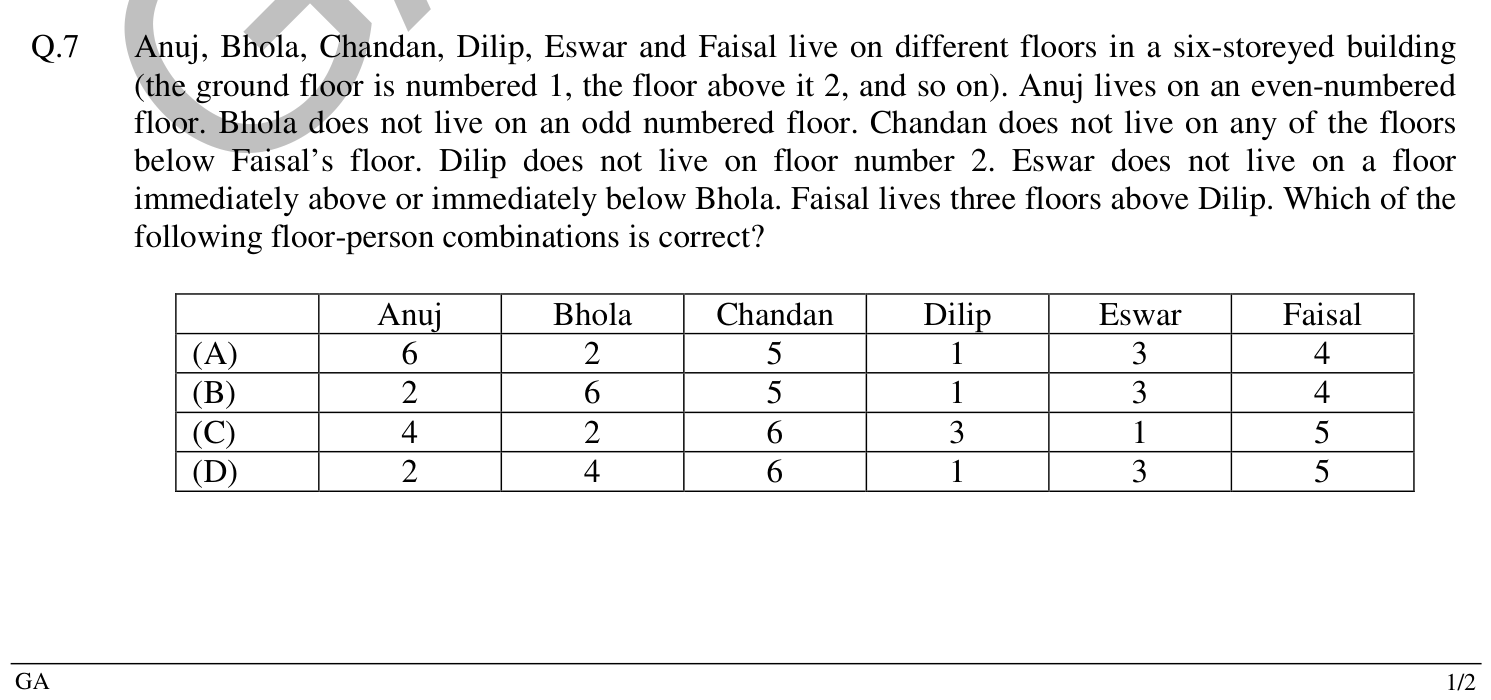
Anuj, Bhola, Chandan, Dilip, Eswar and Faisal live on different floors in a six-storeyed building (the ground floor is numbered 1, the floor above it 2, and so on). Anuj lives on an even-numbered floor. Bhola does not live on an odd numbered floor. Chandan does not live on any of the floors below Faisal's floor. Dilip does not live on floor number 2. Eswar does not live on a floor immediately above or immediately below Bhola. Faisal lives three floors above Dilip. Which of the following floor-person combinations is correct?
Official answer: B
Question 8 (2 marks, NAT)
General Aptitude - Numerical Ability
The smallest angle of a triangle is equal to two thirds of the smallest angle of a quadrilateral. The ratio between the angles of the quadrilateral is 3:4:5:6. The largest angle of the triangle is twice its smallest angle. What is the sum, in degrees, of the second largest angle of the triangle and the largest angle of the quadrilateral?
Official answer: 180
Question 9 (2 marks, MCQ)
General Aptitude - Numerical Ability
One percent of the people of country X are taller than 6 ft. Two percent of the people of country Y are taller than 6 ft. There are thrice as many people in country X as in country Y. Taking both countries together, what is the percentage of people taller than 6 ft?
- 3.0
- 2.5
- 1.5
- 1.25
Official answer: D
Question 10 (2 marks, MCQ)
General Aptitude - Analytical & Spatial Reasoning
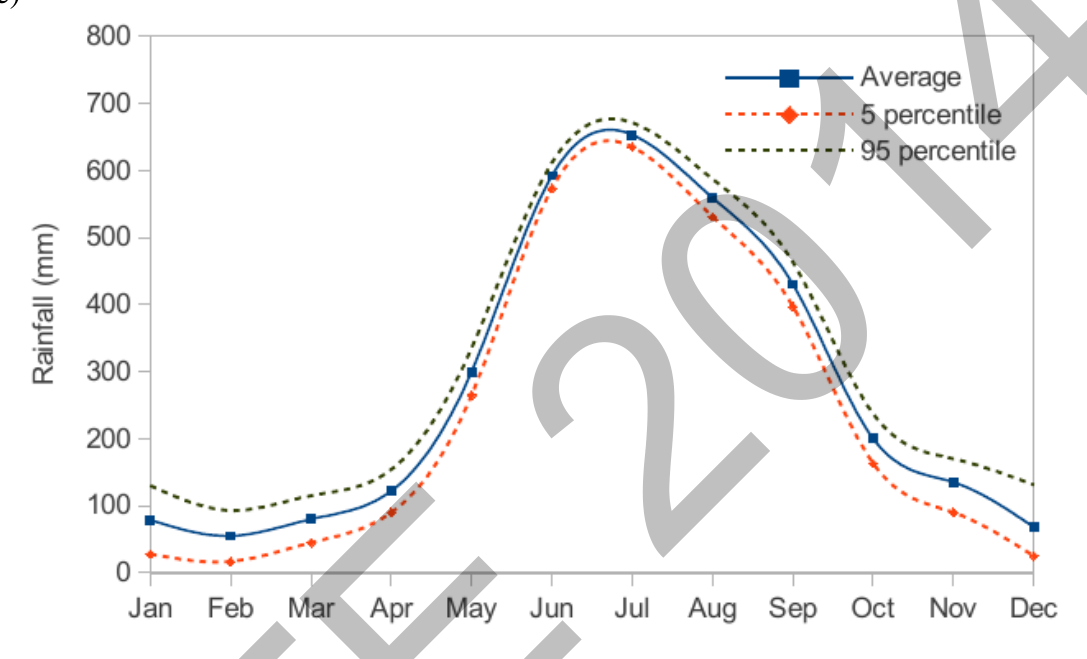
The monthly rainfall chart based on 50 years of rainfall in Agra is shown in the following figure. Which of the following are true? ($k$ percentile is the value such that $k$ percent of the data fall below that value) (i) On average, it rains more in July than in December. (ii) Every year, the amount of rainfall in August is more than that in January. (iii) July rainfall can be estimated with better confidence than February rainfall. (iv) In August, there is at least 500 mm of rainfall.
- (i) and (ii)
- (i) and (iii)
- (ii) and (iii)
- (iii) and (iv)
Official answer: B
Question 11 (1 mark, MCQ)
Engineering Mathematics - Linear Algebra
For a real symmetric matrix $[A]$, which of the following statements is true:
- The matrix is always diagonalizable and invertible.
- The matrix is always invertible but not necessarily diagonalizable.
- The matrix is always diagonalizable but not necessarily invertible.
- The matrix is always neither diagonalizable nor invertible.
Official answer: C
Question 12 (1 mark, MCQ)
Engineering Mathematics - Complex Analysis & Fourier Series
The series $s = \sum_{m=1}^{\infty} \dfrac{m^2}{3^m}(x-2)^m$ converges for all $x$ with $|x-2| \le R$ given by
- $R = 0$
- $R = 3$
- $R = \infty$
- $R = 1/3$
Official answer: B
Question 13 (1 mark, MCQ)
Engineering Mathematics - Calculus
The function given by $f(x) = \begin{cases} \sin(1/x), & x \neq 0 \\ 0, & x = 0 \end{cases}$ is
- Unbounded everywhere
- Bounded and continuous everywhere
- Bounded but not continuous at $x = 0$
- Continuous and differentiable everywhere
Official answer: C
Question 14 (1 mark, MCQ)
Engineering Mathematics - Differential Equations
Given the boundary-value problem $\dfrac{d}{dx}\left(x\dfrac{dy}{dx}\right) + ky = 0,\ 0 < x < 1$, with $y(0) = y(1) = 0$. Then the solutions of the boundary-value problem for $k = 1$ (given by $y_1$) and $k = 5$ (given by $y_5$) satisfy:
- $\int_0^1 y_1 y_5\,dx = 0$
- $\int_0^1 \dfrac{dy_1}{dx}\dfrac{dy_5}{dx}\,dx = 0$
- $\int_0^1 y_1 y_5\,dx \neq 0$
- $\int_0^1 \left(y_1 y_5 + \dfrac{dy_1}{dx}\dfrac{dy_5}{dx}\right)dx = 0$
Official answer: A
Question 15 (1 mark, MCQ)
Engineering Mathematics - Calculus
The value of $I = \int_0^1 1000x^4\,dx$, obtained by using Simpson's rule with 2 equally spaced intervals, is,
- 200
- 400
- 180
- 208
Official answer: D
Question 16 (1 mark, MCQ)
Aerodynamics - Airfoils & Wings
For a NACA 5-digit airfoil of chord $c$, the designed lift coefficient and location of maximum camber along the chord from the leading edge are denoted by $C_L$ and $X_m$ respectively. For NACA 12018 airfoil, which combination of $C_L$ and $X_m$ given below are correct?
- $C_L = 0.15$ and $X_m = 0.1c$
- $C_L = 0.12$ and $X_m = 0.2c$
- $C_L = 0.12$ and $X_m = 0.18c$
- $C_L = 0.15$ and $X_m = 0.2c$
Official answer: A
Question 17 (1 mark, MCQ)
Aerodynamics - Compressible Flows
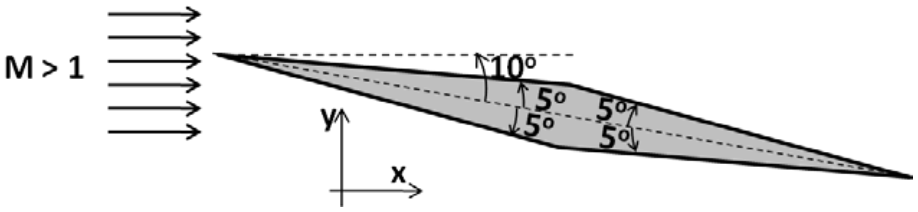
For inviscid, supersonic flow over a diamond shaped airfoil, shown in the figure, which statement is correct among the following?
- The airfoil will experience zero lift and positive drag force
- The airfoil will experience positive lift and zero drag force
- The airfoil will experience negative lift and zero drag force
- The airfoil will experience positive lift and positive drag force
Official answer: D
Question 18 (1 mark, MCQ)
Aerodynamics - Compressible Flows
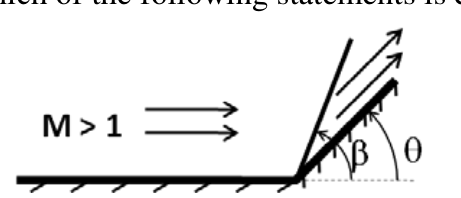
Consider supersonic flow near a corner (at an angle $\theta$ from the horizontal) with an attached oblique shock (at an angle $\beta$ with horizontal) as shown in figure. If Mach number $M$ decreases gradually from a high supersonic value, which of the following statements is correct?
- $\beta$ will decrease if the shock is a weak shock
- $\beta$ will decrease if the shock is a strong shock
- $\beta$ will increase for both weak and strong shocks
- $\beta$ remains unchanged for both weak and strong shocks
Official answer: B
Question 19 (1 mark, MCQ)
Aerodynamics - Potential Flow
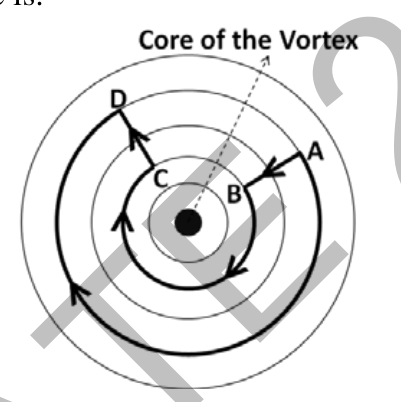
The streamlines of a potential line vortex is concentric circles with respect to the vortex center as shown in figure. Velocity along these streamlines, outside the core of the vortex can be written as, $v_\theta = \dfrac{\Gamma}{2\pi r}$, where strength of the vortex is $\dfrac{\Gamma}{2\pi}$ and $r$ is radial direction. The value of circulation along the curve shown in the figure is:
- $\Gamma$
- $-2\Gamma$
- $2\Gamma$
- 0
Official answer: D
Question 20 (1 mark, MCQ)
Aerodynamics - Basic Fluid Mechanics
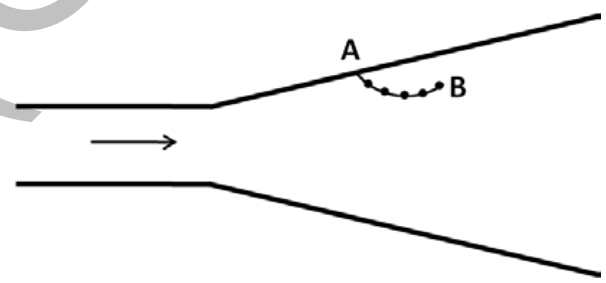
To observe unsteady separated flow in a diverging channel, bubbles are injected at each 10 ms interval at point A as shown in figure. These bubbles act as tracer particles and follow the flow faithfully. The curved line AB shown at any instant represents:
- Streamline, streakline and pathline
- Streamline and pathline
- Only a pathline
- Only a streakline
Official answer: D
Question 21 (1 mark, MCQ)
Structures - Strength of Materials
It is desired to measure the Young's modulus and the Poisson's ratio of a given homogeneous, isotropic material. A bar of length 20 cm and square cross-section (10 mm $\times$ 10 mm) of this material is subjected to a tensile load of 40 kN. Under this load, length increases to 20.1 cm while the cross-section reduces to 9.98 mm $\times$ 9.98 mm. Young's modulus and Poisson's ratio of the material are:
- 80 GPa & 0.4 respectively
- 40 GPa & -0.4 respectively
- 80 GPa & -0.2 respectively
- 40 GPa & 0.2 respectively
Official answer: A
Question 22 (1 mark, MCQ)
Structures - Strength of Materials
In general, for any given solid subjected to arbitrary loading, which of the following statements is always true:
- Volume does not vary with loading
- Mass does not vary with loading
- Density does not vary with loading
- Volume, mass and density vary with loading
Official answer: B
Question 23 (1 mark, MCQ)
Structures - Strength of Materials
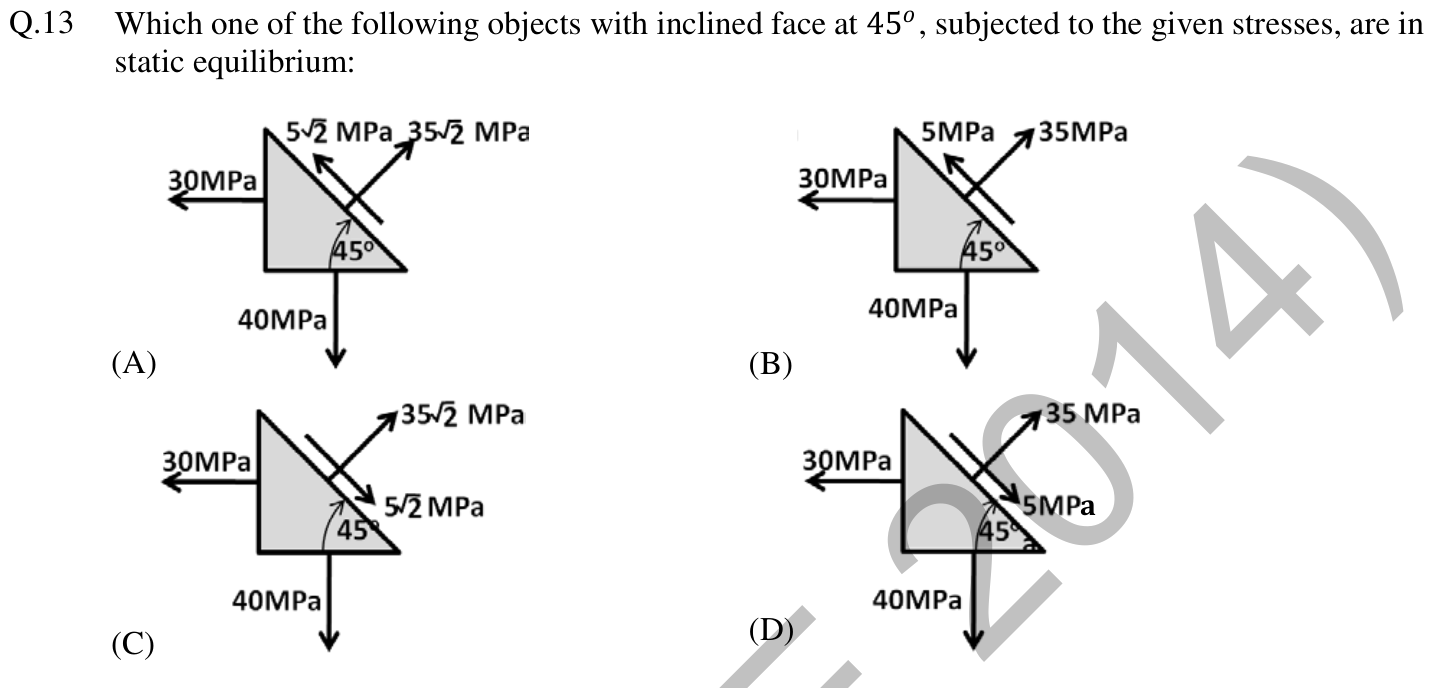
Which one of the following objects with inclined face at $45^\circ$, subjected to the given stresses, are in static equilibrium:
Official answer: B
Question 24 (1 mark, NAT)
Structures - Structural Dynamics
A damped single degree of freedom system whose undamped natural frequency, $\omega_n = 10$ Hz, is subjected to sinusoidal external force. Power is half of the maximum for the two frequencies of 60.9469 rad/s and 64.7168 rad/s. The damping factor associated with the vibrating system (in %) is _______.
Official answer: 2.95 to 3.05
Question 25 (1 mark, MCQ)
Structures - Structural Dynamics
The boundary conditions for a rod with circular cross-section, under torsional vibration, are changed from fixed-free to fixed-fixed. The fundamental natural frequency of the fixed-fixed rod is $k$ times that of fixed-free rod. The value of $k$ is
- 1.5
- $\pi$
- 2.0
- 0.5
Official answer: C
Question 26 (1 mark, MCQ)
Propulsion - Engine Performance
Match the appropriate engine (in right column) with the corresponding aircraft (in left column) for most efficient performance of the engine. a. Low speed transport aircraft; b. High subsonic civilian aircraft; c. Supersonic fighter aircraft; d. Hypersonic aircraft. i. Ramjet; ii. Turboprop; iii. Turbojet; iv. Turbofan.
- a - iv, b - iii, c - i, d - ii
- a - ii, b - i, c - iii, d - iv
- a - i, b - ii, c - iv, d - iii
- a - ii, b - iv, c - iii, d - i
Official answer: D
Question 27 (1 mark, MCQ)
Propulsion - Engine Performance
For a given fuel flow rate and thermal efficiency, the take-off thrust for a gas turbine engine burning aviation turbine fuel (considering fuel-air ratio $f \ll 1$) is
- Directly proportional to exhaust velocity
- Inversely proportional to exhaust velocity
- Independent of exhaust velocity
- Directly proportional to the square of the exhaust velocity
Official answer: B
Question 28 (1 mark, MCQ)
Propulsion - Turbomachinery
For a fifty percent reaction axial compressor stage, following statements are given: I. Velocity triangles at the entry and exit of the rotor are symmetrical. II. The whirl or swirl component of absolute velocity at the entry of rotor and entry of stator are same. Which of the following options are correct?
- Both I and II are correct statements
- I is correct but II is incorrect
- I is incorrect but II is correct
- Both I and II are incorrect
Official answer: B
Question 29 (1 mark, MCQ)
Propulsion - Rockets
A small rocket having a specific impulse of 200 s produces a total thrust of 98 kN, out of which 10 kN is the pressure thrust. Considering the acceleration due to gravity to be 9.8 m/s$^2$, the propellant mass flow rate in kg/s is
- 55.1
- 44.9
- 50
- 60.2
Official answer: C
Question 30 (1 mark, MCQ)
Propulsion - Engine Performance
The thrust produced by a turbojet engine
- Increases with increasing compressor pressure ratio
- Decreases with increasing compressor pressure ratio
- Remains constant with increasing compressor pressure ratio
- First increases and then decreases with increasing compressor pressure ratio
Official answer: D
Question 31 (1 mark, NAT)
Flight Mechanics & Space Dynamics - Static Stability & Control
The moment coefficient measured about the centre of gravity and about aerodynamic centre of a given wing-body combination are 0.0065 and -0.0235 respectively. The aerodynamic centre lies 0.06 chord lengths ahead of the centre of gravity. The lift coefficient for this wing-body is _____.
Official answer: 0.45 to 0.55
Question 32 (1 mark, MCQ)
Flight Mechanics & Space Dynamics - Atmosphere & Flight Instruments
The vertical ground load factor on a stationary aircraft parked in its hangar is:
- 0
- -1
- Not defined
- 1
Official answer: D
Question 33 (1 mark, MCQ)
Flight Mechanics & Space Dynamics - Airplane Performance
Under what condition should a glider be operated to ensure minimum sink rate?
- Maximum $C_L/C_D$
- Minimum $C_L/C_D$
- Maximum $C_D/C_L^{3/2}$
- Minimum $C_D/C_L^{3/2}$
Official answer: D
Question 34 (1 mark, MCQ)
Flight Mechanics & Space Dynamics - Flight Dynamics
In most airplanes, the Dutch roll mode can be excited by applying
- a step input to the elevators
- a step input to the rudder
- a sinusoidal input to the aileron
- an impulse input to the elevators
Official answer: B
Question 35 (1 mark, NAT)
Flight Mechanics & Space Dynamics - Space Dynamics
Considering $R$ as the radius of the moon, the ratio of the velocities of two spacecraft orbiting moon in circular orbit at altitudes $R$ and $2R$ above the surface of the moon is ________.
Official answer: 1.2 to 1.25
Question 36 (2 marks, MCQ)
Engineering Mathematics - Linear Algebra
If $[A] = \begin{bmatrix} 3 & -3 \\ -3 & 4 \end{bmatrix}$. Then $\det\left(-[A]^2 + 7[A] - 3[I]\right)$ is
- 0
- -324
- 324
- 6
Official answer: A
Question 37 (2 marks, MCQ)
Engineering Mathematics - Complex Analysis & Fourier Series
For the periodic function given by $f(x) = \begin{cases} -2, & -\pi < x < 0 \\ 2, & 0 < x < \pi \end{cases}$ with $f(x + 2\pi) = f(x)$, using Fourier series, the sum $s = 1 - \dfrac{1}{3} + \dfrac{1}{5} - \dfrac{1}{7} + \cdots$ converges to
- 1
- $\dfrac{\pi}{3}$
- $\dfrac{\pi}{4}$
- $\dfrac{\pi}{5}$
Official answer: C
Question 38 (2 marks, MCQ)
Engineering Mathematics - Calculus
Let $\Gamma$ be the boundary of the closed circular region $A$ given by $x^2 + y^2 \le 1$. Then $I = \oint_\Gamma (3x^3 - 9xy^2)\,ds$ (where $ds$ means integration along the bounding curve) is
- $\pi$
- $-\pi$
- 1
- 0
Official answer: D
Question 39 (2 marks, MCQ)
Engineering Mathematics - Differential Equations
Solution to the boundary-value problem $-9\dfrac{d^2u}{dx^2} + u = 5x,\ 0 < x < 3$ with $u(0) = 0,\ \dfrac{du}{dx}\Big|_{x=3} = 0$ is
- $u(x) = \dfrac{15e}{1+e^2}\left(e^{-x/3} - e^{x/3}\right) + 5x$
- $u(x) = \dfrac{15e}{1+e^2}\left(e^{-x/3} + e^{x/3}\right) + 5x$
- $u(x) = -\dfrac{15\sin(x/3)}{\cos(1)} + 5x$
- $u(x) = -\dfrac{15\sin(x/3)}{\cos(1)} - \dfrac{5}{54}x^3$
Official answer: A
Question 40 (2 marks, MCQ)
Engineering Mathematics - Differential Equations
The Laplace transform $\mathcal{L}(u(t)) = U(s)$, for the solution $u(t)$ of the problem $\dfrac{d^2u}{dt^2} + 2\dfrac{du}{dt} + u = 1,\ t > 0$ with initial conditions $u(0) = 0,\ \dfrac{du(0)}{dt} = 5$ is given by:
- $\dfrac{6}{(s+1)^2}$
- $\dfrac{5s+1}{s(s+1)^2}$
- $\dfrac{1-5s}{s(s+1)^2}$
- $\dfrac{5s^2+1}{s(s+1)^2}$
Official answer: B
Question 41 (2 marks, NAT)
Aerodynamics - Basic Fluid Mechanics
For a steady, incompressible two-dimensional flow, represented in Cartesian co-ordinates $(x, y)$, a student correctly writes the equation of pathline of any arbitrary particle as, $\dfrac{dx}{dt} = ax$ and $\dfrac{dy}{dt} = by$, where $a$ and $b$ are constants having unit of (second)$^{-1}$. If value of $a$ is 5, the value of $b$ is _____.
Official answer: -5.01 to -4.99
Question 42 (2 marks, MCQ)
Aerodynamics - Basic Fluid Mechanics
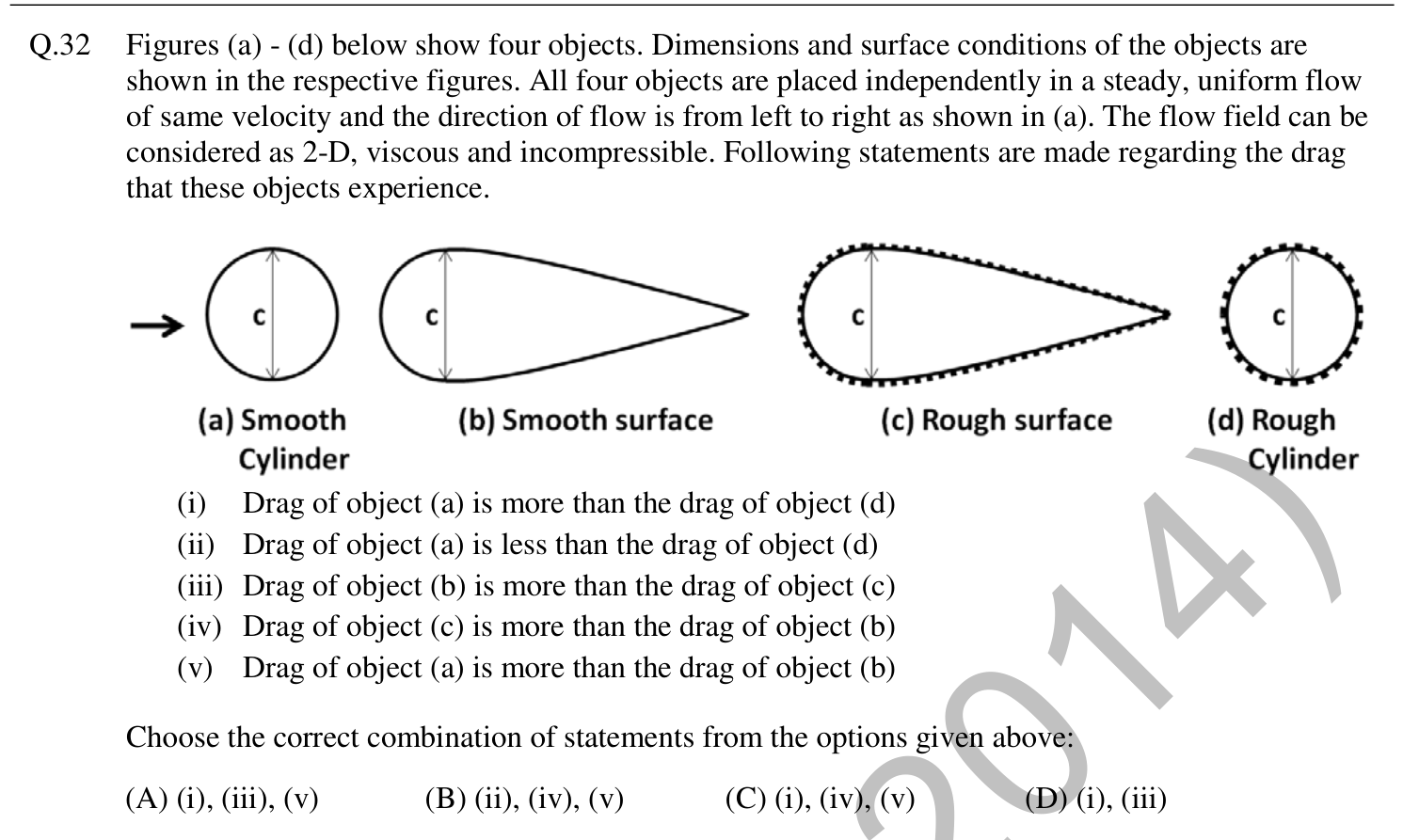
Figures (a) - (d) below show four objects. Dimensions and surface conditions of the objects are shown in the respective figures. All four objects are placed independently in a steady, uniform flow of same velocity and the direction of flow is from left to right as shown in (a). The flow field can be considered as 2-D, viscous and incompressible. Following statements are made regarding the drag that these objects experience. (i) Drag of object (a) is more than the drag of object (d). (ii) Drag of object (a) is less than the drag of object (d). (iii) Drag of object (b) is more than the drag of object (c). (iv) Drag of object (c) is more than the drag of object (b). (v) Drag of object (a) is more than the drag of object (b). Choose the correct combination of statements from the options given above:
- (i), (iii), (v)
- (ii), (iv), (v)
- (i), (iv), (v)
- (i), (iii)
Official answer: C
Question 43 (2 marks, NAT)
Aerodynamics - Compressible Flows
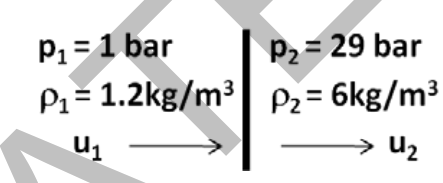
A student needs to find velocity across a stationary normal shock. He measures density and pressure across the shock as shown in the figure below. 1 bar = $10^5$ Pa. (No shock table is needed for the calculations). The value of $u_1$ in m/s is ____. ($p_1 = 1$ bar, $\rho_1 = 1.2$ kg/m$^3$; $p_2 = 29$ bar, $\rho_2 = 6$ kg/m$^3$)
Official answer: 1705 to 1720
Question 44 (2 marks, MCQ)
Aerodynamics - Compressible Flows
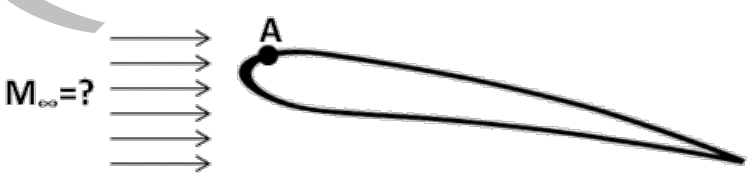
For inviscid, compressible flow past a thin airfoil, shown in the figure, free-stream Mach number and pressure are denoted by $M_\infty$ and $p_\infty$ respectively. Ratio of pressure at point A and $p_\infty$ is 0.8 and specific heat ratio is 1.4. If the Mach number at point A is 1.0 and rest of the flow field is subsonic, the value of $M_\infty$ is
- 2.95
- 0.79
- 1.18
- 0.64
Official answer: B
Question 45 (2 marks, MCQ)
Aerodynamics - Basic Fluid Mechanics
A student can measure free-stream velocity of a low-speed wind tunnel using a: i. Pitot tube alone aligned with the flow direction. ii. Pitot tube aligned with the flow direction with static pressure measurement at an appropriate position on the tunnel wall. iii. Pitot tube aligned with the flow direction along with barometer pressure reading of the outside ambient. iv. Pitot static tube alone aligned with the flow direction. Considering the above statements, which of the following options is correct?
- (i) only
- (i) & (ii)
- (ii) & (iv)
- (i), (iii) & (iv)
Official answer: C
Question 46 (2 marks, MCQ)
Aerodynamics - Airfoils & Wings
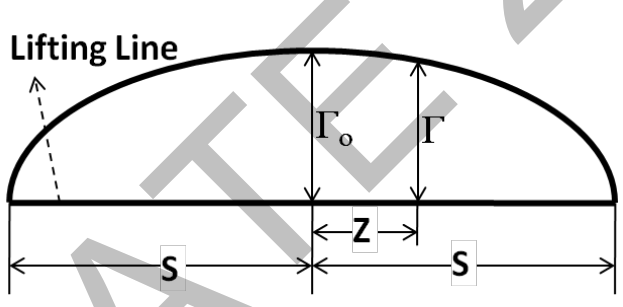
Induced velocity $w$ at a point $z = z_1$ along the lifting line can be calculated using the formula $w(z_1) = -\dfrac{1}{4\pi}\int_{-s}^{s}\dfrac{d\Gamma}{dz}\dfrac{1}{z - z_1}\,dz$. Given $\dfrac{\Gamma^2}{\Gamma_o^2} + \dfrac{z^2}{s^2} = 1$, where $z$, $\Gamma_o$ and $s$ are given in figure below. For the above semi-elliptic distribution of circulation, $\Gamma$, the downwash velocity at any point $z_1$ for symmetric flight can be obtained as, $w(z_1) = \dfrac{\Gamma_o}{4\pi s}\left[\pi + z_1 I\right]$, where $I = z_1\int_{-s}^{s}\dfrac{dz}{\sqrt{s^2 - z^2}(z - z_1)}$. Which of the following options is correct if the induced drag is $D_i$ (given $\int_{-s}^{s}\sqrt{1 - \dfrac{z^2}{s^2}}\,dz = \dfrac{\pi s}{2}$)?
- $I = 0$ and $D_i = \dfrac{8\rho\Gamma_o^2}{\pi}$
- $I = 1$ and $D_i = \dfrac{8\rho\Gamma_o^2}{\pi}$
- $I = 0$ and $D_i = \dfrac{\pi\rho\Gamma_o^2}{8}$
- $I = 1$ and $D_i = \dfrac{\pi\rho\Gamma_o^2}{8}$
Official answer: C
Question 47 (2 marks, NAT)
Aerodynamics - Basic Fluid Mechanics
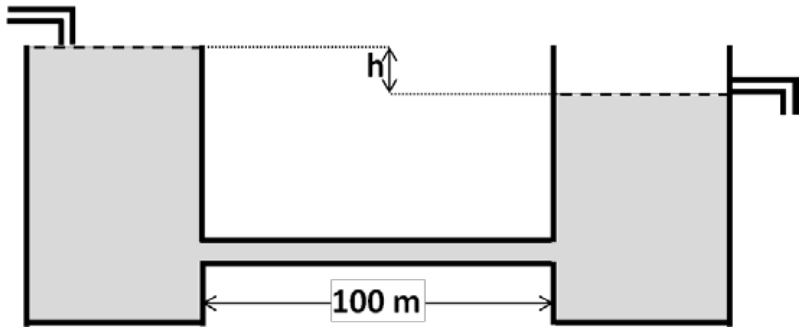
Two overflowing water reservoirs are connected with a 100 m long pipe of circular cross-section (of radius, $R = 0.02$ m), such that height difference $h$ remains constant as shown in the figure below. The centerline velocity in the pipe is 10 m/s. The velocity profile inside the pipe over the entire length is $u = -\dfrac{R^2}{4\mu}\dfrac{dp}{dx}\left[1 - \dfrac{r^2}{R^2}\right]$, where, $\dfrac{dp}{dx}$ is a constant pressure gradient along the pipe length, $x$ is measured from the left end of the pipe along its central axis and $r$ is radial location inside the pipe with respect to its axis. (Given data: Density and kinematic viscosity of water are 1000 kg/m$^3$ and $1 \times 10^{-6}$ m$^2$/s respectively; acceleration due to gravity is 10 m/s$^2$). If all other losses except the frictional losses at the pipe wall are neglected, the value of $h$ in meter is ____.
Official answer: 0.99 to 1.01
Question 48 (2 marks, NAT)
Structures - Strength of Materials
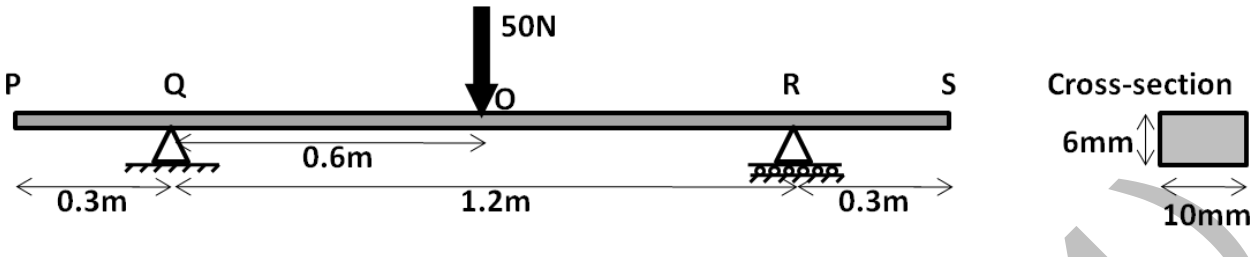
A 1.8 m long steel beam of rectangular cross section (10 mm $\times$ 6 mm) is simply supported with a length of 1.2 m between the supports and an overhang of 0.3 m on either side. Young's modulus for the material of the beam is 200 GPa. For a 50 N load applied at the center of the beam, magnitude of the slope of the beam at tip $S$ is _______.
Official answer: 0.12 to 0.13
Question 49 (2 marks, MCQ)
Structures - Strength of Materials
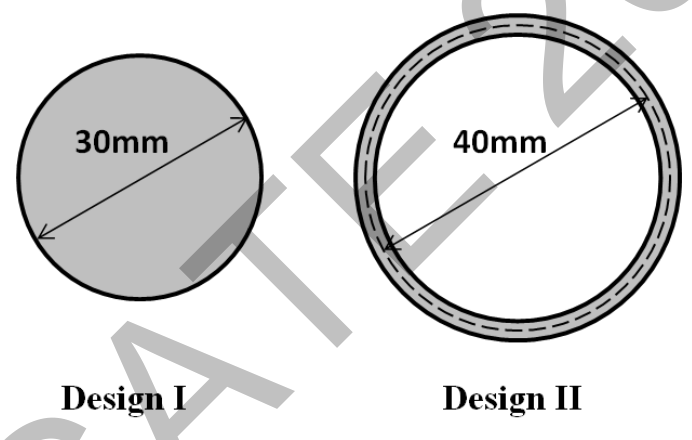
There are 2 designs proposed for a shaft of length $l$, with a torque carrying capacity of $T$. Design I is a solid circular cross-section shaft of diameter 30 mm. Design II is a thin-walled circular shaft of average diameter 40 mm. Thickness of the wall in Design II has to be determined such that maximum shear stress is the same in both the designs for the given torque $T$ (so that same material can be used for manufacturing both the shafts). Ratio of mass of shaft using Design I to the mass of shaft using Design II is
- 2.68
- 5.36
- 1.79
- 3.58
Official answer: A
Question 50 (2 marks, MCQ)
Structures - Strength of Materials
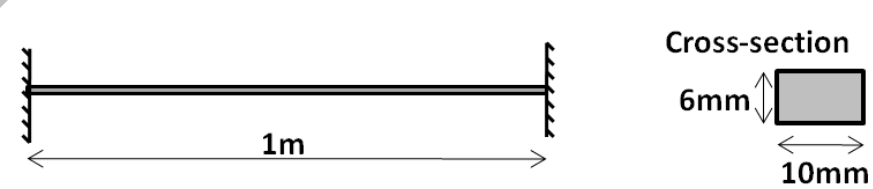
A structural member of rectangular cross-section 10 mm $\times$ 6 mm and length 1 m is made of steel (Young's modulus is 200 GPa and coefficient of thermal expansion is $12 \times 10^{-6}/{}^\circ$C). It is rigidly fixed at both the ends and then subjected to a gradual increase in temperature. Ignoring the three dimensional effects, the structural member will buckle if the temperature is increased by $\Delta T\ ^\circ$C which is
- 19.74
- 9.87
- 78.96
- 39.48
Official answer: B
Question 51 (2 marks, MCQ)
Structures - Strength of Materials
A gas cylinder (closed thin-walled cylindrical pressure vessel) of diameter 30 cm and wall thickness 1 mm is subjected to a design maximum internal pressure of 5 bar (0.5 MPa). The material used for manufacturing this cylinder has a failure stress of 260 MPa. Assuming von Mises failure criterion, the factor of safety (with respect to maximum allowable stress) for this cylinder is
- 2.8
- 2.0
- 6.9
- 4.0
Official answer: D
Question 52 (2 marks, MCQ)
Structures - Strength of Materials
A cantilevered beam is subjected to a parabolic distribution of shear traction at the right edge while the top and bottom surfaces are traction free. To solve this problem, following Airy's stress function is proposed: $\phi = C_1xy + C_2xy^3 + C_3x^2y^2 + C_4x^3y$. This is an admissible Airy's function that would satisfy the bi-harmonic equation as well as the boundary conditions if and only if

- $C_1 = 0, C_2 = \lambda, C_3 = 0, C_4 = \dfrac{\lambda}{3d^2}$
- $C_1 = \lambda, C_2 = \dfrac{\lambda}{3d^2}, C_3 = 0, C_4 = 0$
- $C_1 = 0, C_2 = 0, C_3 = \lambda, C_4 = -\dfrac{\lambda}{3d^2}$
- $C_1 = \lambda, C_2 = -\dfrac{\lambda}{3d^2}, C_3 = 0, C_4 = 0$
Official answer: D
Question 53 (2 marks, MCQ)
Structures - Structural Dynamics
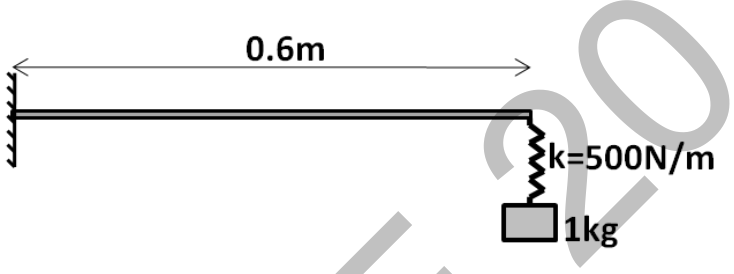
A 1 kg mass is hanging from a spring of stiffness 500 N/m attached to a massless, symmetric beam of length 0.6 m, moment of inertia about the bending axis $I = 8.33 \times 10^{-10}$ m$^4$ and Young's modulus $E = 210$ GPa as shown in the figure. The fundamental natural frequency (in rad/s) of the system is
- 3.24
- 20.36
- 22.36
- 3.56
Official answer: B
Question 54 (2 marks, MCQ)
Structures - Structural Dynamics
A single degree of freedom system is vibrating with initial (first cycle) amplitude of 5 cm. The viscous damping factor associated with the vibrating system is 2%. Vibration amplitude of the fifth cycle (in cm) is
- 1.65
- 4.41
- 2.67
- 3.02
Official answer: D
Question 55 (2 marks, NAT)
Propulsion - Engine Performance
A cruise missile with an ideal ramjet engine is flying at Mach 4.0 at an altitude where the ambient temperature is 100 K. Consider ratio of specific heats $\gamma = 1.4$ and specific gas constant $R = 287$ J/kgK. If the stagnation temperature in the combustion chamber is equal to 2310 K, the speed of the exhaust gases (in m/s) is ______________.
Official answer: 1880 to 1881
Question 56 (2 marks, NAT)
Propulsion - Turbomachinery
A gas turbine engine is operating under the following conditions: stagnation temperature at turbine inlet 1350 K; stagnation pressure at turbine inlet 10 bar; static temperature at turbine exit 800 K; velocity at turbine exit 200 m/s; total-to-total efficiency of turbine 0.96; $\gamma$ (ratio of specific heats) 1.33; $C_p$ (specific heat at constant pressure) 1.147 kJ/kgK. The stagnation pressure (in bar) in the nozzle (considering isentropic nozzle) is equal to _______.
Official answer: 1.10 to 1.25
Question 57 (2 marks, NAT)
Propulsion - Turbomachinery
Air at a stagnation temperature of 300 K (ratio of specific heats, $\gamma = 1.4$ and specific gas constant $R = 287$ J/kgK) enters the impeller of a centrifugal compressor in axial direction. The stagnation pressure ratio between the diffuser outlet and impeller inlet is 4.0. The impeller blade radius is 0.3 m and it is rotating at 15000 rev/min. If the slip factor $\sigma_s$ (Ratio of tangential component of air velocity at the blade tip to the blade tip speed) is 0.88, the overall efficiency (total-to-total) of the compressor (in %) is ___________.
Official answer: 74 to 76
Question 58 (2 marks, NAT)
Propulsion - Rockets
A stationary two stage rocket with initial mass of 16000 kg, carrying a payload of 1000 kg, is fired in a vertical trajectory from the surface of the earth. Both the stages of the rocket have same specific impulse, $I_{sp}$, of 300 s and same structural coefficient of 0.14. The acceleration due to gravity is 9.8 m/s$^2$. Neglecting drag and gravity effects and considering both the stages with same payload ratio, the terminal velocity attained by the payload in m/s is __________________.
Official answer: 6050 to 6250
Question 59 (2 marks, MCQ)
Aerodynamics - Compressible Flows
An aircraft is flying at Mach 3.0 at an altitude where the ambient pressure and temperature are 50 kPa and 200 K respectively. If the converging-diverging diffuser of the engine (considered isentropic with ratio of specific heats, $\gamma = 1.4$ and specific gas constant $R = 287$ J/kgK) has a throat area of 0.05 m$^2$, the mass flow rate through the engine in kg/s is
- 197
- 232
- 790
- 157
Official answer: D
Question 60 (2 marks, MCQ)
Propulsion - Rockets
A cryogenic rocket has a specific impulse of 455 s and characteristic velocity of 2386 m/s. The value of thrust coefficient for this rocket is
- 1.78
- 1.73
- 1.87
- 1.95
Official answer: C
Question 61 (2 marks, MCQ)
Flight Mechanics & Space Dynamics - Airplane Performance
For a given airplane with a given wing loading executing a turn in the vertical plane, under what conditions will the turn radius be minimum and the turn rate be maximum?
- Highest possible $C_L$ and lowest possible load factor
- Lowest possible $C_L$ and lowest possible load factor
- Lowest possible $C_L$ and highest possible load factor
- Highest possible $C_L$ and highest possible load factor
Official answer: D
Question 62 (2 marks, NAT)
Flight Mechanics & Space Dynamics - Airplane Performance
Lift-off distance for a given aircraft of weight $W$ is $S_{LO}$. If the take-off weight is reduced by 10%, then the magnitude of percentage change in the lift-off distance (assume all other parameters to remain constant) is _______.
Official answer: 18 to 20
Question 63 (2 marks, MCQ)
Flight Mechanics & Space Dynamics - Airplane Performance
Which of the following design parameters influence the maximum rate-of-climb for a jet-propelled airplane? P. Wing loading; Q. Maximum thrust-to-weight ratio; R. Zero-lift drag coefficient; S. Aspect ratio.
- P and Q alone
- P, Q, R and S
- P, Q and S alone
- Q, R, and S alone
Official answer: B
Question 64 (2 marks, MCQ)
Flight Mechanics & Space Dynamics - Static Stability & Control
Consider the following four statements regarding aircraft longitudinal stability: P. $C_{M,cg}$ at zero lift must be positive. Q. $\partial C_{M,cg}/\partial\alpha_a$ must be negative ($\alpha_a$ is absolute angle of attack). R. $C_{M,cg}$ at zero lift must be negative. S. Slope of $C_L$ versus $\alpha_a$ must be negative. Which of the following combination is the necessary criterion for stick fixed longitudinal balance and static stability?
- Q and R only
- Q, R, and S only
- P and Q only
- Q and S only
Official answer: C
Question 65 (2 marks, MCQ)
Flight Mechanics & Space Dynamics - Airplane Performance
Data for a light, single-engine, propeller driven aircraft in steady level flight at sea-level is as follows: velocity $V_\infty = 40$ m/s, weight $W = 13000$ N, lift coefficient $C_L = 0.65$, drag coefficient $C_D = 0.025 + 0.04C_L^2$ and power available $P_{av} = 100{,}000$ J/s. The rate of climb possible for this aircraft under the given conditions (in m/s) is
- 7.20
- 5.11
- 6.32
- 4.23
Official answer: B