Question 1 (1 mark, MCQ)
General Aptitude - Verbal Ability
Choose the word from the options given below that is most nearly opposite in meaning to the given word: Deference
- aversion
- resignation
- suspicion
- contempt
GATE Aerospace Engineering 2011 question paper: all 65 questions with figures. Practice free on CMB Space.
General Aptitude - Verbal Ability
Choose the word from the options given below that is most nearly opposite in meaning to the given word: Deference
General Aptitude - Verbal Ability
Choose the most appropriate word(s) from the options given below to complete the following sentence. We lost confidence in him because he never __________ the grandiose promises he had made.
General Aptitude - Verbal Ability
Choose the word or phrase that best completes the sentence below. ______________ in the frozen wastes of Arctic takes special equipment.
General Aptitude - Numerical Ability
In how many ways 3 scholarships can be awarded to 4 applicants, when each applicant can receive any number of scholarships?
General Aptitude - Verbal Ability
Choose the most appropriate word from the options given below to complete the following sentence. The __________ of evidence was on the side of the plaintiff since all but one witness testified that his story was correct.
General Aptitude - Numerical Ability
If $(2y+1)/(y+2) < 1$, then which of the following alternatives gives the CORRECT range of $y$?
General Aptitude - Numerical Ability
A student attempted to solve a quadratic equation in $x$ twice. However, in the first attempt, he incorrectly wrote the constant term and ended up with the roots as (4, 3). In the second attempt, he incorrectly wrote down the coefficient of $x$ and got the roots as (3, 2). Based on the above information, the roots of the correct quadratic equation are
General Aptitude - Analytical & Spatial Reasoning
L, M and N are waiting in a queue meant for children to enter the zoo. There are 5 children between L and M, and 8 children between M and N. If there are 3 children ahead of N and 21 children behind L, then what is the minimum number of children in the queue?
General Aptitude - Analytical & Spatial Reasoning
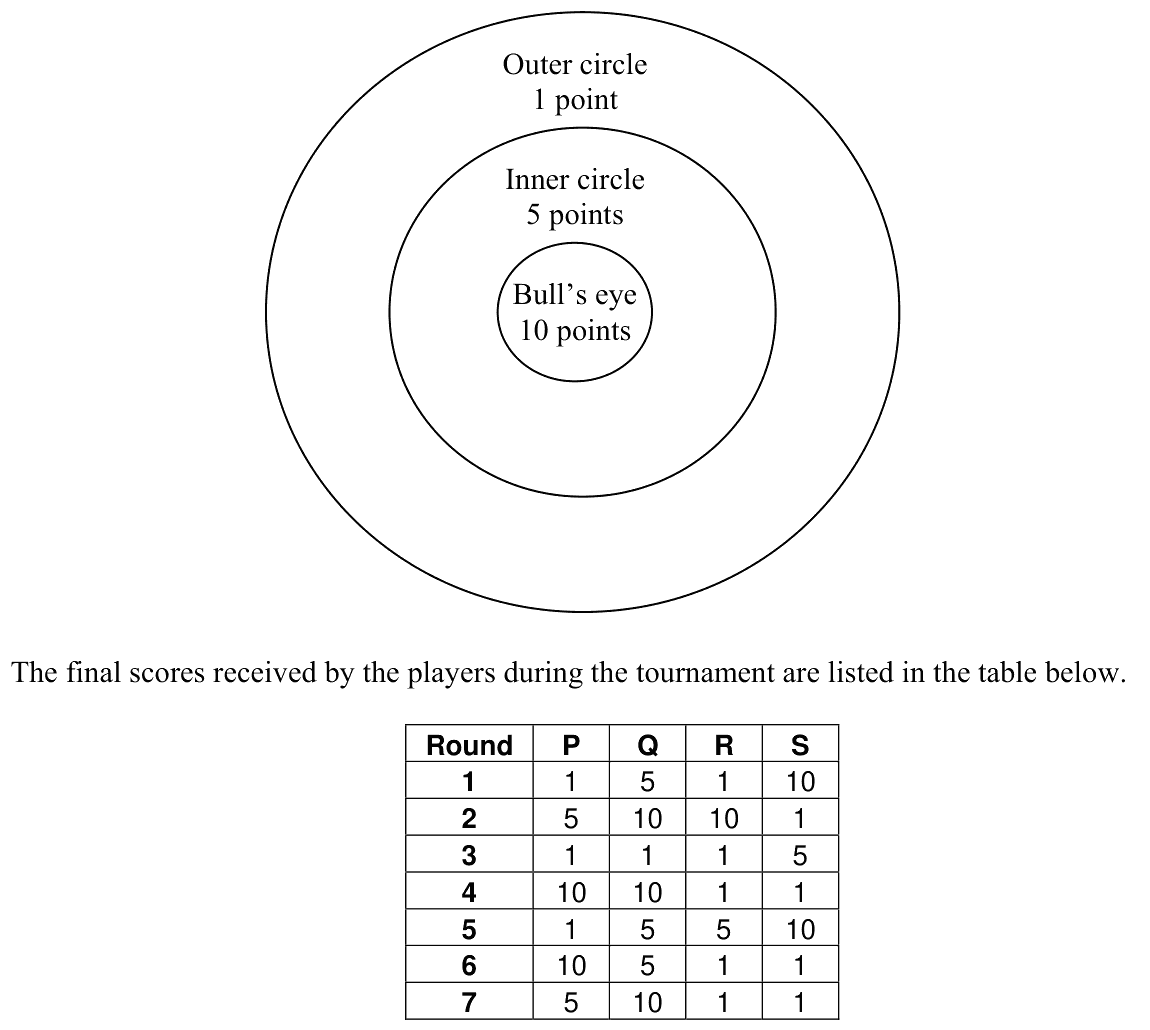
Four archers P, Q, R and S try to hit a bull's eye during a tournament consisting of seven rounds. As illustrated in the figure below, a player receives 10 points for hitting the bulls' eye, 5 points for hitting within the inner circle and 1 point for hitting within the outer circle. The final scores received by the players during the tournament are listed in the table below (see figure). The most accurate and the most consistent players during the tournament are respectively
General Aptitude - Verbal Ability
Nimbus clouds are dark and ragged, stratus clouds appear dull in colour and cover the entire sky. Cirrus clouds are thin and delicate, whereas cumulus clouds look like cotton balls. It can be inferred from the passage that
Engineering Mathematics - Calculus
Consider $x, y, z$ to be right-handed Cartesian coordinates. A vector function is defined in this coordinate system as $\mathbf{v} = 3x\mathbf{i} + 3xy\mathbf{j} - yz^2\mathbf{k}$, where $\mathbf{i}$, $\mathbf{j}$ and $\mathbf{k}$ are the unit vectors along $x$, $y$ and $z$ axes, respectively. The curl of $\mathbf{v}$ is given by
Engineering Mathematics - Calculus
Which of the following functions is periodic?
Engineering Mathematics - Calculus
The function $f(x_1, x_2, x_3) = x_1^2 + x_2^2 + x_3^2 - 2x_1 - 4x_2 - 6x_3 + 14$ has its minimum value at
Engineering Mathematics - Calculus
Consider the function $f(x_1, x_2) = x_1^2 + 2x_2^2 + e^{-x_1 - x_2}$. The vector pointing in the direction of maximum increase of the function at the point $(1, -1)$ is
Engineering Mathematics - Linear Algebra
Two simultaneous equations given by $y = \pi + x$ and $y = x - \pi$ have
Structures - Strength of Materials
In three-dimensional linear elastic solids, the number of non-trivial stress-strain relations, strain-displacement equations and equations of equilibrium are, respectively,
Structures - Strength of Materials
An Euler-Bernoulli beam in bending is assumed to satisfy
Structures - Strength of Materials
A statically indeterminate frame structure has
Structures - Structural Dynamics
Consider a single degree of freedom spring-mass-damper system with mass, damping and stiffness of $m$, $c$ and $k$, respectively. The logarithmic decrement of this system can be calculated using
Structures - Structural Dynamics
Consider a single degree of freedom spring-mass system of spring stiffness $k_1$ and mass $m$ which has a natural frequency of 10 rad/s. Consider another single degree of freedom spring-mass system of spring stiffness $k_2$ and mass $m$ which has a natural frequency of 20 rad/s. The spring stiffness $k_2$ is equal to
Structures - Strength of Materials
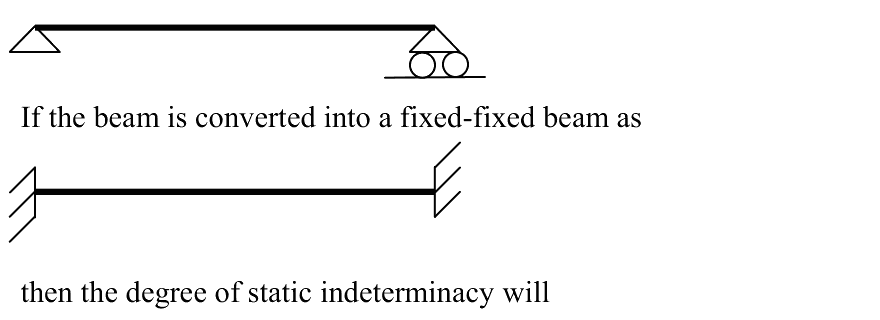
Consider a simply supported two-dimensional beam (first figure). If the beam is converted into a fixed-fixed beam as (second figure), then the degree of static indeterminacy will
Propulsion - Rockets
An impulsive launch of a rocket minimizes the loss of burn-out velocity due to
Propulsion - Rockets
Multi-staging in rockets improves the burn-out performance by increasing mainly stage-wise
Flight Mechanics & Space Dynamics - Airplane Performance
In an un-powered glide of an aircraft having weight $W$, lift $L$ and drag $D$, the equilibrium glide angle is defined as
Flight Mechanics & Space Dynamics - Airplane Performance
Lift on an aircraft climbing vertically up is
Flight Mechanics & Space Dynamics - Flight Dynamics
If an aircraft is performing a positive yawing manoeuvre, the side slip angle
Flight Mechanics & Space Dynamics - Static Stability & Control
For an airplane to be statically stable, its centre of gravity must always be
Aerodynamics - Airfoils & Wings
It is seen that the drag polar of a certain aerofoil is symmetric about the $C_d$ axis. This drag polar could refer to
Aerodynamics - Compressible Flows
The aerodynamic centre of a supersonic aerofoil, with chord c, is located at
Aerodynamics - Airfoils & Wings
Winglets are used on wings to minimize
Aerodynamics - Potential Flow
Consider a potential flow with free stream velocity $V_\infty$, over a spinning circular cylinder of radius $R$ and circulation $\Gamma$. The stream function, $\psi$, where $\psi = 0$ on the cylinder surface, in cylindrical coordinates $(r, \theta)$ is given by
Propulsion - Aerothermodynamics & Cycles
A main objective of by-pass in a turbo-fan engine is to increase
Propulsion - Turbomachinery
The pressure ratio in any one stage of a jet engine compressor is limited by
Propulsion - Aerothermodynamics & Cycles
Thermodynamic cycle on which the jet engine operates can be
Propulsion - Engine Performance
Propulsion efficiency of a jet engine is
Structures - Strength of Materials
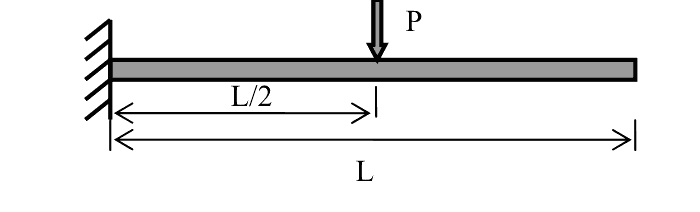
Consider a cantilever beam having length $L$ = 1 m, square cross-section (width = depth = 0.01 m) and Young's modulus 50 GPa. The beam is subjected to a transverse load P = 1 N at the mid-span ($L/2$) at the center of the cross-section (see figure). Under the small deformation theory, the transverse deflection of the beam (in mm) at its free-end is ____
Structures - Strength of Materials
Consider a beam in bending with a solid circular cross-section of 1 mm$^2$, which is subjected to a transverse shear force of 1 N. The shear stress at the center of the cross-section (in N/mm$^2$) is ____
Structures - Strength of Materials
A simply supported slender column of square cross section (width=depth=$d$) has to be designed such that it buckles at the same instant as it yields. Length of the column is given to be 1.57 m and it is made of a material whose Young's modulus is 200 GPa and yield stress is 240 MPa. The width, $d$, of the column (in cm) should be ____
Propulsion - Engine Performance
A turbojet powered aircraft is flying at Mach number 0.8 at an altitude of 10 km. The inlet and exit areas of the engine are 0.7 m$^2$ and 0.4 m$^2$ respectively. The exhaust gases have velocity of 500 m/s and pressure of 60 kPa. The free stream pressure, density and speed of sound are 26.5 kPa, 0.413 kg/m$^3$ and 299.5 m/s respectively. The thrust of the engine (in kN) is ____
Aerodynamics - Basic Fluid Mechanics
A low speed wind tunnel has a contraction ratio of 14:1 and the cross-sectional area of the test section is 1 m$^2$. The static pressure difference between the settling chamber and the test section is 40 cm of water column. Assume $g = 9.81$ m/s$^2$, $\rho_{air} = 1.2$ kg/m$^3$ and $\rho_{water} = 1000$ kg/m$^3$. The speed of air in the test section (in m/s) is ____
Engineering Mathematics - Numerical Methods
Consider the function $f(x) = x - \sin(x)$. The Newton-Raphson iteration formula to find the root of the function starting from an initial guess $x^{(0)}$ at iteration $k$ is
Engineering Mathematics - Linear Algebra
Consider the matrix $\begin{bmatrix} 2 & a \\ b & 2 \end{bmatrix}$ where $a$ and $b$ are real numbers. The two eigenvalues of this matrix $\lambda_1$ and $\lambda_2$ are real and distinct $(\lambda_1 \ne \lambda_2)$ when
Engineering Mathematics - Differential Equations
The solution of $\dfrac{dy}{dt} = y^3 e^t t^2$ with initial condition $y(0) = 1$ is given by
Propulsion - Aerothermodynamics & Cycles
A jet engine is operating at a Mach number of 0.8 at an altitude of 10 km. The efficiency of the air intake is 0.8 and that of the compressor is 0.87. The total temperatures (in K) at the exits of the air intake and the compressor respectively are (Ambient pressure = 26.5 kPa; Ambient temperature = 223.3 K; Gas constant, $\gamma = 1.4$; $p_{rc} = 8$)
Propulsion - Rockets
A rocket engine is tested on a test bed under the ideal condition of fully expanded jet. The exhaust velocity is 2 km/s through a nozzle of area 2.5 m$^2$. The mass flow rate is 200 kg/s. The specific impulse of the propellant and the thrust developed respectively are (assume $g$ = 9.81 m/s$^2$)
Structures - Strength of Materials
A body undergoes deformation under plane strain conditions when subjected to the following stresses (in MPa): $\sigma_{xx} = 450, \sigma_{yy} = 450, \tau_{xy} = 75, \tau_{xz} = 0, \tau_{yz} = 0$. What are the remaining components of stresses (in MPa) and strains? Assume the material to be isotropic and linear-elastic with Young's modulus $E$ = 200 GPa and Poisson's ratio $\nu$ = 1/3.
Structures - Strength of Materials
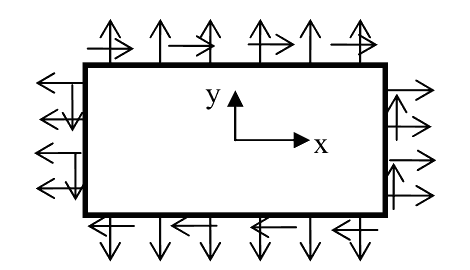
Which of the following Airy's stress functions could satisfy the given boundary conditions, assuming constant values of $\sigma_{xx} = P$, $\sigma_{yy} = Q$ and $\tau_{xy} = R$, along the boundary (see figure)?
Flight Mechanics & Space Dynamics - Airplane Performance
An aircraft is performing a coordinated turn manoeuvre at a bank angle of $30^\circ$ and forward speed of 100 m/s. Assume g = 9.81 ms$^{-2}$. The load factor and turn radius respectively are
Flight Mechanics & Space Dynamics - Flight Dynamics
An aircraft in a steady level flight at forward speed of 50 m/s suddenly rolls by $180^\circ$ and becomes inverted. If no other changes are made to the configuration or controls of the aircraft, the nature of the subsequent flight path taken by the aircraft and its characteristic parameter(s) (assume g = 9.81 ms$^{-2}$) are
Flight Mechanics & Space Dynamics - Airplane Performance
An aircraft with a mass of 5000 kg takes off from sea level with a forward speed of 50 m/s and starts to climb with a climb angle of $15^\circ$. The rate of climb and excess thrust available at the start of the climb respectively are (assume g = 9.81 ms$^{-2}$)
Flight Mechanics & Space Dynamics - Airplane Performance
A glider having a mass of 500 kg is taken to an altitude of 1000 m with a jeep moving on ground at 54 kmph. Upon reaching the required altitude in 50 s, the glider is released and starts its descent. Under the assumption of equilibrium glide, the range and endurance of the glider for a constant lift-to-drag ratio of 15 are
Flight Mechanics & Space Dynamics - Space Dynamics
An elliptic orbit has its perigee at 400 km above the Earth's surface and apogee at 3400 km above the Earth's surface. For this orbit, the eccentricity and semi-major axis respectively are (assume radius of Earth = 6400 km)
Flight Mechanics & Space Dynamics - Flight Dynamics
An aircraft in level flight encounters a vertical gust, which excites the phugoid mode. The phugoid motion completes 10 cycles in 50 s and its amplitude reduces to half of its maximum value in 25 s. The eigenvalues of the phugoid mode are
Aerodynamics - Compressible Flows
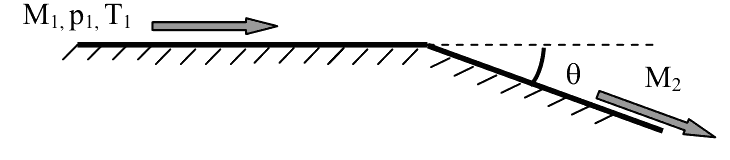
Consider the inviscid, adiabatic flow of air at free stream conditions, $M_1$ = 2, $p_1$ = 1 atm and $T_1$ = 288 K around a sharp expansion corner ($\theta$ = 20°) as shown (see figure). The Prandtl-Meyer function, $\nu$, is given as a function of Mach number, $M$, as $\nu(M) = \sqrt{\dfrac{\gamma+1}{\gamma-1}}\tan^{-1}\sqrt{\dfrac{\gamma-1}{\gamma+1}(M^2 - 1)} - \tan^{-1}\sqrt{M^2 - 1}$. Assume air to be calorically perfect with $\gamma$ = 1.4. The Mach number, $M_2$, downstream of the expansion corner is approximately
Aerodynamics - Viscous Flows & Boundary Layers
Consider a steady two dimensional zero-pressure gradient laminar flow of air over a flat plate as shown (see figure). The free stream conditions are $U_\infty$ = 100 ms$^{-1}$, $\rho_\infty$ = 1.2 kg m$^{-3}$, $p_\infty$ = 1 atm and $\mu_\infty = 1.8 \times 10^{-5}$ kg m$^{-1}$s$^{-1}$. The ratio of displacement thickness to momentum thickness of the boundary layer at a distance of 2 m from the leading edge is

Aerodynamics - Airfoils & Wings
In the context of Prandtl's lifting line theory for a finite wing, which of the following combinations of statements is TRUE? P: The bound vortex is responsible for the lift force. Q: The trailing vortices are responsible for the induced drag. R: The bound vortex is responsible for the induced drag. S: The trailing vortices are responsible for the lift force.
Aerodynamics - Compressible Flows
Consider flow over a thin aerofoil at Mach number, $M_\infty = 0.5$ at an angle of attack, $\alpha$. Using the Prandtl-Glauert rule for compressibility correction, the formula for lift coefficient, $c_l$, can be written as
Structures - Structural Dynamics
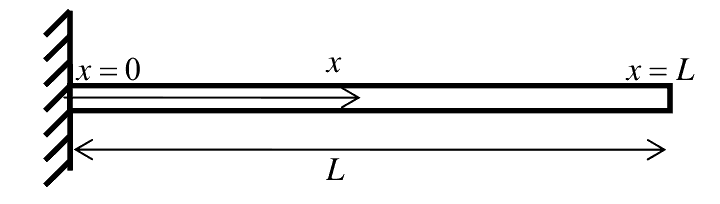
Common Data for Questions 48 and 49: The partial differential equation (PDE) governing free vibrations of a uniform Euler-Bernoulli beam is given by $EI\dfrac{\partial^4 w}{\partial x^4} + m\dfrac{\partial^2 w}{\partial t^2} = 0$, where $EI$ is the flexural stiffness, $m$ is the mass per unit length, $w(x,t)$ is the bending displacement, $x$ is the coordinate along the beam length, $t$ is time and $L$ is the beam length (cantilever fixed at $x = 0$, see figure). To solve the PDE, the number of boundary conditions (BC) and initial conditions (IC) needed are
Structures - Structural Dynamics
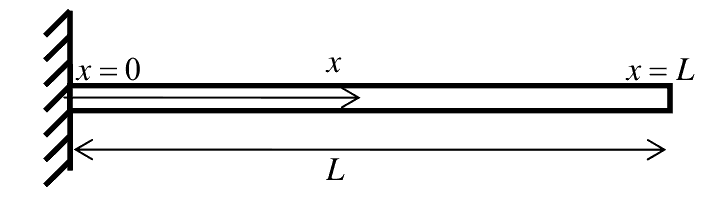
Common Data for Questions 48 and 49: The partial differential equation (PDE) governing free vibrations of a uniform Euler-Bernoulli beam is given by $EI\dfrac{\partial^4 w}{\partial x^4} + m\dfrac{\partial^2 w}{\partial t^2} = 0$ (cantilever fixed at $x = 0$, see figure). For the cantilever beam shown in the figure, which of the following CANNOT be a possible boundary condition?
Aerodynamics - Compressible Flows
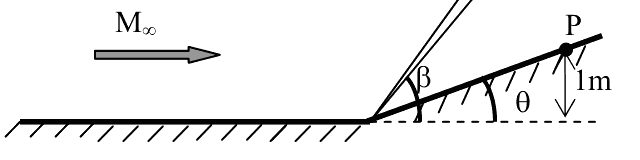
Common Data for Questions 50 and 51: Consider an inviscid, adiabatic flow of air at free stream Mach Number, $M_\infty$ = 2, across a compression corner ($\theta$ = 20°) as shown (see figure). The free stream total enthalpy is $h_{0\infty}$ = 810 kJ kg$^{-1}$. Assume that air is calorically perfect with $\gamma$ = 1.4, $R$ = 287 J kg$^{-1}$ K$^{-1}$. The shock angle $\beta$ is
Aerodynamics - Compressible Flows
Common Data for Questions 50 and 51: Consider an inviscid, adiabatic flow of air at free stream Mach Number, $M_\infty$ = 2, across a compression corner ($\theta$ = 20°) as shown (see figure). The free stream total enthalpy is $h_{0\infty}$ = 810 kJ kg$^{-1}$. Assume that air is calorically perfect with $\gamma$ = 1.4, $R$ = 287 J kg$^{-1}$ K$^{-1}$. The total temperature at point P is
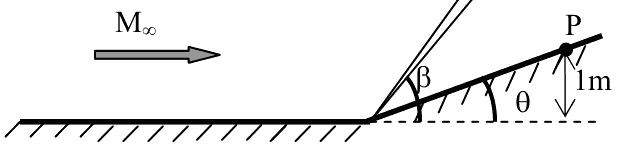
Structures - Strength of Materials
Statement for Linked Answer Questions 52 and 53: A thin-walled (thickness << radius), hollow shaft of length 1m and mean radius, $R$ = 5 cm has to be designed such that it can transmit a torque, $T$ = 7 kN-m. A survey of different commercially available materials was made and following data was obtained from the suppliers ($E$: Young's modulus, $\tau_y$: yield stress in shear, $\rho$: density): Material X: E = 200 GPa, $\tau_y$ = 550 MPa, $\rho$ = 7700 kg/m$^3$; Material Y: E = 70 GPa, $\tau_y$ = 225 MPa, $\rho$ = 2700 kg/m$^3$; Material Z: E = 110 GPa, $\tau_y$ = 375 MPa, $\rho$ = 4875 kg/m$^3$. Which of the above materials would you choose such that weight of the shaft is minimum?
Structures - Strength of Materials
Statement for Linked Answer Questions 52 and 53: A thin-walled (thickness << radius), hollow shaft of length 1m and mean radius, $R$ = 5 cm has to be designed such that it can transmit a torque, $T$ = 7 kN-m. Materials: X: E = 200 GPa, $\tau_y$ = 550 MPa, $\rho$ = 7700 kg/m$^3$; Y: E = 70 GPa, $\tau_y$ = 225 MPa, $\rho$ = 2700 kg/m$^3$; Z: E = 110 GPa, $\tau_y$ = 375 MPa, $\rho$ = 4875 kg/m$^3$. If you assume a factor of safety of 2, what should be the approximate thickness of such a shaft?
Aerodynamics - Airfoils & Wings
Statement for Linked Answer Questions 54 and 55: Prandtl's lifting line equation for a general wing is given by $\alpha(y_0) = \dfrac{\Gamma(y_0)}{\pi U_\infty c(y_0)} + \alpha_{L=0}(y_0) + \dfrac{1}{4\pi U_\infty}\displaystyle\int_{-b/2}^{b/2}\dfrac{(\partial\Gamma/\partial y)}{y_0 - y}dy$, where $U_\infty$ is the free-stream velocity, $\alpha$ is the angle of attack, $y_0$ is the spanwise location, $\alpha_{L=0}(y_0)$ gives the spanwise variation of zero-lift angle, $c$ is the chord, $b$ is the span, and $\Gamma(y_0)$ gives the spanwise variation of circulation. The rate of change of circulation with angle of attack $\Gamma_\alpha = \dfrac{\partial\Gamma}{\partial\alpha}$ is
Aerodynamics - Airfoils & Wings
Statement for Linked Answer Questions 54 and 55: Prandtl's lifting line equation for a general wing is given by $\alpha(y_0) = \dfrac{\Gamma(y_0)}{\pi U_\infty c(y_0)} + \alpha_{L=0}(y_0) + \dfrac{1}{4\pi U_\infty}\displaystyle\int_{-b/2}^{b/2}\dfrac{(\partial\Gamma/\partial y)}{y_0 - y}dy$. Given that $C_L \propto \displaystyle\int_{-b/2}^{b/2}\Gamma(y)\,dy$, the corresponding lift curve-slope $\dfrac{\partial C_L}{\partial\alpha}$ is