AAI JE ATC 2023 Shift 1, Question 15
General Intelligence & Reasoning - Syllogism & Statement-Conclusion
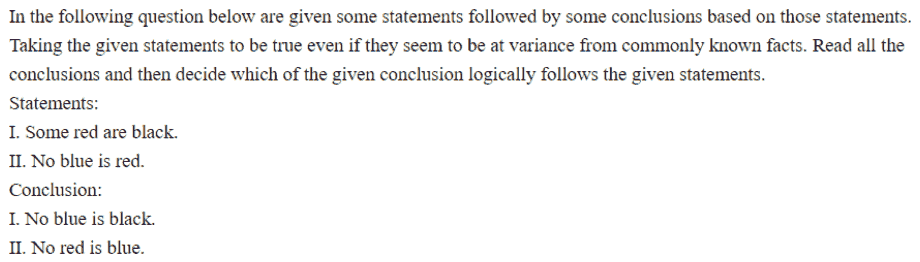
Answer: C (as marked correct in the candidate response sheet)
AAI Junior Executive (Air Traffic Control) Syllogism & Statement-Conclusion previous year questions (General Intelligence & Reasoning) from 2015 to 2025, with answers.
General Intelligence & Reasoning | All AAI JE ATC papers
General Intelligence & Reasoning - Syllogism & Statement-Conclusion




Answer: C (as marked correct in the candidate response sheet)
General Intelligence & Reasoning - Syllogism & Statement-Conclusion
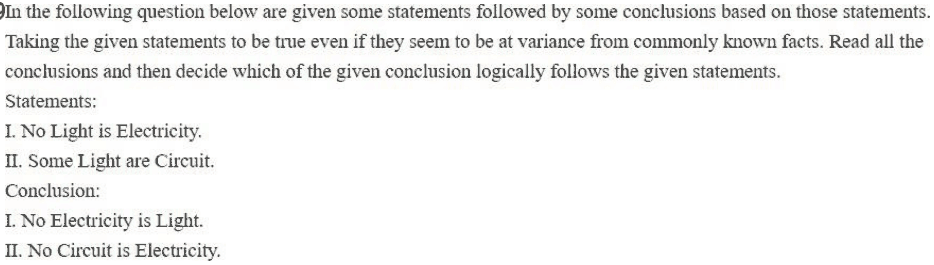




Answer: A (as marked correct in the candidate response sheet)
General Intelligence & Reasoning - Syllogism & Statement-Conclusion
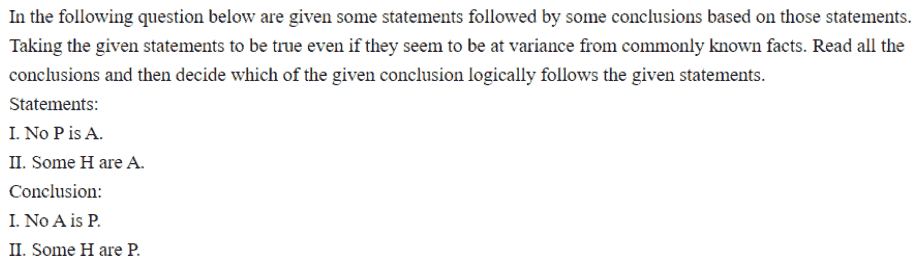




Answer: D (as marked correct in the candidate response sheet)
General Intelligence & Reasoning - Syllogism & Statement-Conclusion
In this question, two statements are followed by two conclusions, numbered I and II. Find out which conclusion (s) is/are true based on the given statements. Statements: R > S ≥ T ≥ W, W ≥ U < M Conclusions: I. U < S II. S = U
Answer: A (as per the solved paper)
General Intelligence & Reasoning - Syllogism & Statement-Conclusion
This question has two statements followed by two conclusions numbered I and II. You have to take the given statements to be true even if they seem to be at variance from commonly known facts. You have to decide which conclusion/s logically follow/s from the given statements. Statements: Some pinks are rats. All ears are rats. Conclusions (I): Some rats are ears. Conclusions (II): Some rats are pinks.
Answer: A (as per the solved paper)
General Intelligence & Reasoning - Syllogism & Statement-Conclusion
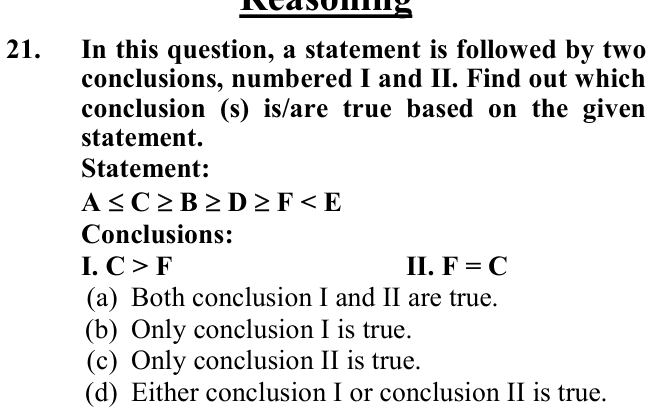
(The four options are printed in the question.)
Answer: D (as per the solved paper)
General Intelligence & Reasoning - Syllogism & Statement-Conclusion
This question has two statements followed by two conclusions numbered I and II. You have to take the given statements to be true even if they seem to be at variance from commonly known facts. You have to decide which conclusions logically follows from the given statements. Statements: All hats are inks. All inks are fans. Conclusions (I): All fans are inks. Conclusions (II): All hats are fans.
Answer: A (as per the solved paper)
General Intelligence & Reasoning - Syllogism & Statement-Conclusion
A statement is given followed by two conclusions. Find which conclusion(s) is/are true based on the given statement. Statement: P > Q > R < S > X ≤ T; L ≥ N < O Conclusions: I. T < O II. O ≥ T
Answer: B (as per the solved paper)
General Intelligence & Reasoning - Syllogism & Statement-Conclusion
This question has two statements followed by two conclusions numbered I and II. You have to take the given statements to be true even if they seem to be at variance from commonly known facts. You have to decide which conclusion/s logically follow/s from the given statements. Statements: All ants are goats. All goats are balls. Conclusions (I): All ants are balls. Conclusions (II): Some goats are ants.
Answer: B (as per the solved paper)
General Intelligence & Reasoning - Syllogism & Statement-Conclusion
Read in the given statements and conclusions carefully. Assuming that the information given in the statements is true, even if it appears to be at variance with commonly known facts, decide which of the given conclusions logically follow (s) from the statements. Statements: 1. All pads are keyboards. 2. All keyboards are monitors. Conclusions: I. Some keyboards are pads. II. Some monitors are pads.
Answer: C (as per the solved paper)
General Intelligence & Reasoning - Syllogism & Statement-Conclusion
Read the given statements and conclusions carefully. Assuming that the information given in the statements Is true, even If It appears to be at variance with commonly known facts, decide which of the given conclusions logically follow (s) from the statements. statements: 1. Some parrots are sparrows. 2. Some crows are parrots. Conclusions: I. Some sparrows are parrots. II. Some crows are sparrows.
Answer: D (as per the solved paper)
General Intelligence & Reasoning - Syllogism & Statement-Conclusion
A question is given, followed by two arguments. Decide which of the arguments is/are valid with respect to the question. Question: Should school-going children have internet access at home? Arguments: (I): Yes, because through the internet students can have access to educational videos on YouTube, articles addressing current events that impact their lives, and online tests or quizzes required in their coursework. (II): No, it’s a waste of time.
Answer: A (as per the solved paper)
General Intelligence & Reasoning - Syllogism & Statement-Conclusion
Read the given statements and conclusions carefully. Assuming that the information given in the statements is true, even if it appears to be at variance with commonly known facts, decide which of the given conclusions logically follow(s) from the statements. Statements: 1. All pins are bins. 2. All bins are not papers. Conclusions: I. Some papers are pins. II. All pins are not papers.
Answer: C (as per the solved paper)
General Intelligence & Reasoning - Syllogism & Statement-Conclusion
Given below are two statements and two conclusions. Consider these statements to be true even if they seem factually absurd. Read the conclusion and then decide which of the given conclusions logically follow(s) from the given statements. Statements: A. All tables are chairs. B. All chairs are racks. Conclusion: 1. All racks are tables. 2. All chairs are tables.
Answer: C (as per the solved paper)
Answers are not an official AAI key: papers up to 2022 follow a published solved-papers book, and the 2023 and 2025 papers follow the options marked correct in candidate response sheets.